
Close Menu
    Facebook X (Twitter) Instagram
    SciTechDaily
    • Biology
    • Chemistry
    • Earth
    • Health
    • Physics
    • Science
    • Space
    • Technology
    Facebook X (Twitter) Pinterest YouTube RSS
    SciTechDaily
    Home»Physics»Probing Ultracold Quantum Gases With Sound Waves to Reveal the Unique Properties of Superfluids
    Physics

    Probing Ultracold Quantum Gases With Sound Waves to Reveal the Unique Properties of Superfluids

    By FLEET / ARC Centre of ExcellenceMay 3, 2020No Comments3 Mins Read
    Facebook Twitter Pinterest Telegram LinkedIn WhatsApp Email Reddit
    Share
    Facebook Twitter LinkedIn Pinterest Telegram Email Reddit
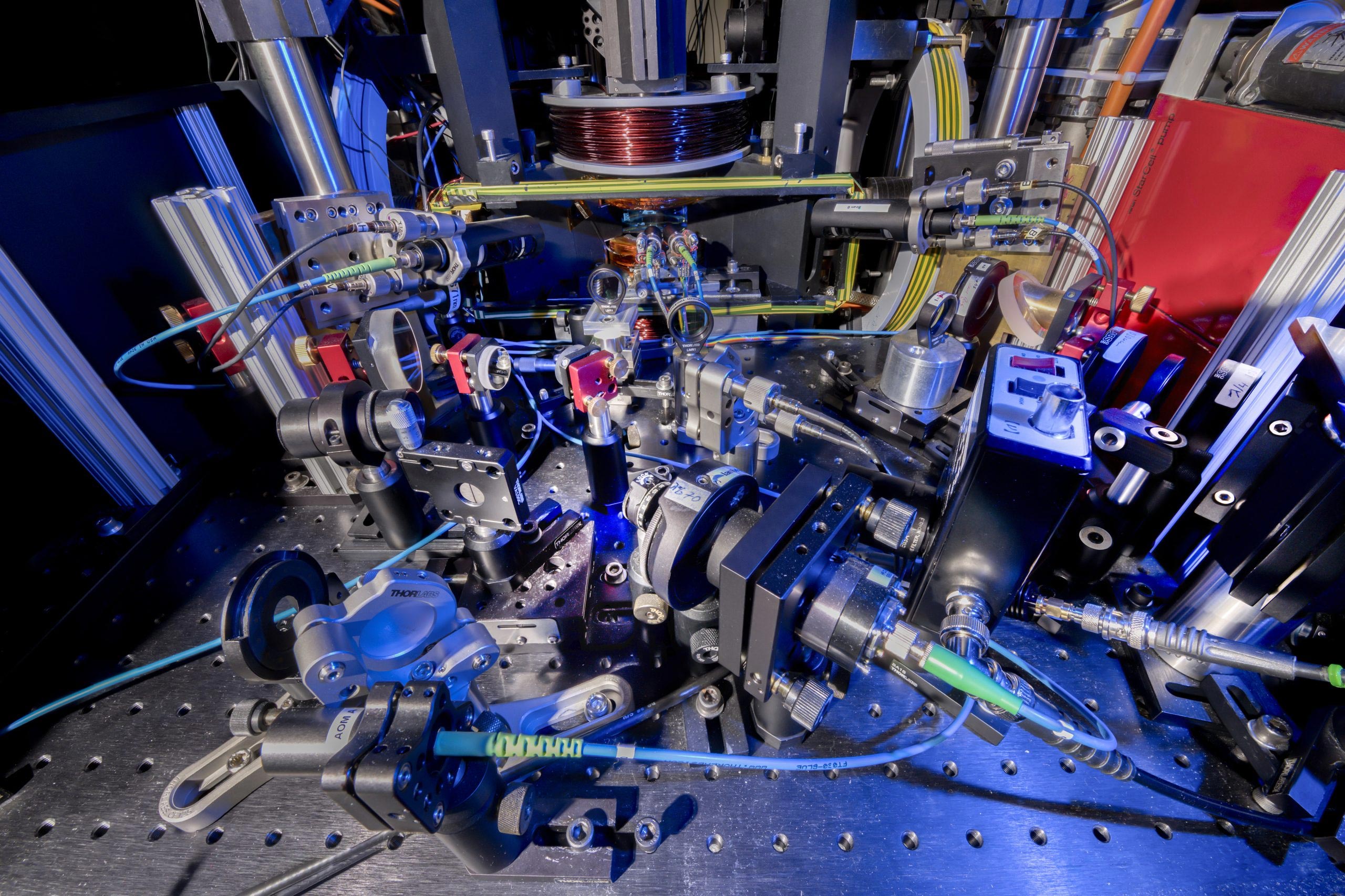
    Ultracold Atomic Lab
    Ultracold atomic lab at Swinburne University of Technology. Credit: FLEET

    Sound waves reveal the unique properties of an ultracold quantum gas, a model system for describing certain superconductors and forms of nuclear matter. A new Australian study examines the propagation of energy as sound waves in a quantum gas, revealing for the first time strong variations in the nature of the sound wave as a function of temperature.

    At low energies, this energy travels via the collective movement of many particles moving in sync — essentially, as sound waves — quantified using quasiparticles known as phonons.

    Below the superfluid transition temperature Tc these sound waves in a unitary Fermi gas can propagate without collisions and are driven by ripples in the phase of the superfluid order parameter (wave-function) — this mode is known as the Bogoliubov-Anderson (BA) phonon.

    Above Tc, the sound waves become more strongly-damped, and collisions play a dominant role.

    Strong similarities were identified in the temperature dependence of sound in the unitary Fermi gas and the behavior of phonons in liquid helium, which was one of the first superfluids identified historically.

    This study provides quantitative benchmarks for dynamical theories of strongly-correlated fermions.

    Excitation Spectra Unitary Fermi Gas
    Excitation spectra for unitary Fermi gas showing (top) experimental data and (b) theory. Credit: FLEET

    More About The Study

    The ultracold atomic gases formed and studied in Prof Chris Vale’s lab at Swinburne allow very precise tuning of interactions between atoms.

    “We cooled and confined a highly dilute gas of Li6 atoms, realizing a unitary Fermi gas, which exhibits the strongest interactions allowed by quantum mechanics with a contact potential,” explains Prof Vale.

    In a unitary gas, elastic collisions become resonant and the thermodynamic properties of the gas become universal functions of the temperature and density. Unitary Fermi gases allow precise testing of theories of interacting fermions.

    Chris Vale
    Prof Chris Vale leads FLEET’s ultra-cold atomic gas studies at Swinburne University of Technology. Credit: FLEET

    The team then studied excitations in the gas above and below the superfluid phase transition Tc using two-photon Bragg spectroscopy.

    “We measured excitation spectra at a momentum of approximately half the Fermi momentum, both above and below the superfluid critical temperature Tc,” explains study author Dr. Carlos Kuhn.

    Two, focused laser pulses (approx 1.2 milliseconds in duration) intersecting within the gas create a periodic perturbation for the lithium atoms.

    Immediately after the twin laser pulse, the confining optical trap is switched off and the momentum of atoms is measured after 4 milliseconds of expansion, and can be mapped as a function of laser frequency.

    The finite duration and size of the Bragg beams lead to a Fourier-limited spectral resolution of approximately 1:25 kHz FWHM which is well below the typical Fermi energies, EF 11 kHz, used in the experiments.

    Reference: “High-Frequency Sound in a Unitary Fermi Gas” by C. C. N. Kuhn, S. Hoinka, I. Herrera, P. Dyke, J. J. Kinnunen, G. M. Bruun and C. J. Vale, 13 April 2020, Physical Review Letters.
    DOI: 10.1103/physrevlett.124.150401

    Never miss a breakthrough: Join the SciTechDaily newsletter.
    Follow us on Google and Google News.

    Optics Particle Physics Quantum Physics Swinburne University of Technology
    Share. Facebook Twitter Pinterest LinkedIn Email Reddit

    Related Articles

    Dissecting the Quantum Illusion: Debunking the Cheshire Cat Effect

    Swirls of Light to Enable Researchers to Observe Previously Invisible Quantum States

    Ultra-Precise Measurements Powered by Quantum Negativity – “Highly Counterintuitive and Truly Amazing!”

    Quantum Entanglement of 15 Trillion Atoms at 450 Kelvin With “Surprising Results”

    First Universal Quantum Network Prototype Operational

    Physicists Use Cheap Colliders to Probe for Heavy Photons

    Quantum Interference Shown Experimentally in Larger Molecules

    Evidence of Elusive Majorana Fermions Raises Possibilities for Quantum Computing

    Higgs Boson Signals Gain Strength at Large Hadron Collider

    Leave A Reply Cancel Reply

    • Facebook
    • Twitter
    • Pinterest
    • YouTube

    Don't Miss a Discovery

    Subscribe for the Latest in Science & Tech!

    Trending News

    Sitting Up Straight Could Actually Help You Make Better Decisions

    Never-Before-Seen Vortices Are Swirling Across the Sun

    This Common Amino Acid May Help the Body Fight Cancer and Viruses

    Low-Protein “Longevity Diet” Linked to Fat Loss, Muscle Preservation, and Healthy Aging

    How Prehistoric Poop Changed Earth’s Ecosystems Forever

    This Fossil Upends a Decades-Old Debate About Snake Evolution

    A Blood Test Years Before Cancer May Reveal a Hidden Warning Sign

    Starlink Satellites Reveal a Hidden Atmosphere 300 Miles Above Earth

    Follow SciTechDaily
    • Facebook
    • Twitter
    • YouTube
    • Pinterest
    • Newsletter
    • RSS
    SciTech News
    • Biology News
    • Chemistry News
    • Earth News
    • Health News
    • Physics News
    • Science News
    • Space News
    • Technology News
    Recent Posts
    • A “Double Punch” Nanoparticle Could Reveal and Destroy Brain Cancer Cells
    • Popular GLP-1 Weight-Loss Drugs Linked to 30% Lower Breast Cancer Risk
    • A Deadly Fungus Has Found the Perfect Hiding Place: Human Hair Follicles
    • Tiny Fossil Overlooked for Decades Reveals a New Ice Age Species
    • Melting Sea Ice Could Be Changing the Clouds Above the Arctic
    Copyright © 1998 - 2026 SciTechDaily. All Rights Reserved.
    • Science News
    • About
    • Contact
    • Editorial Board
    • Privacy Policy
    • Terms of Use

    Type above and press Enter to search. Press Esc to cancel.