
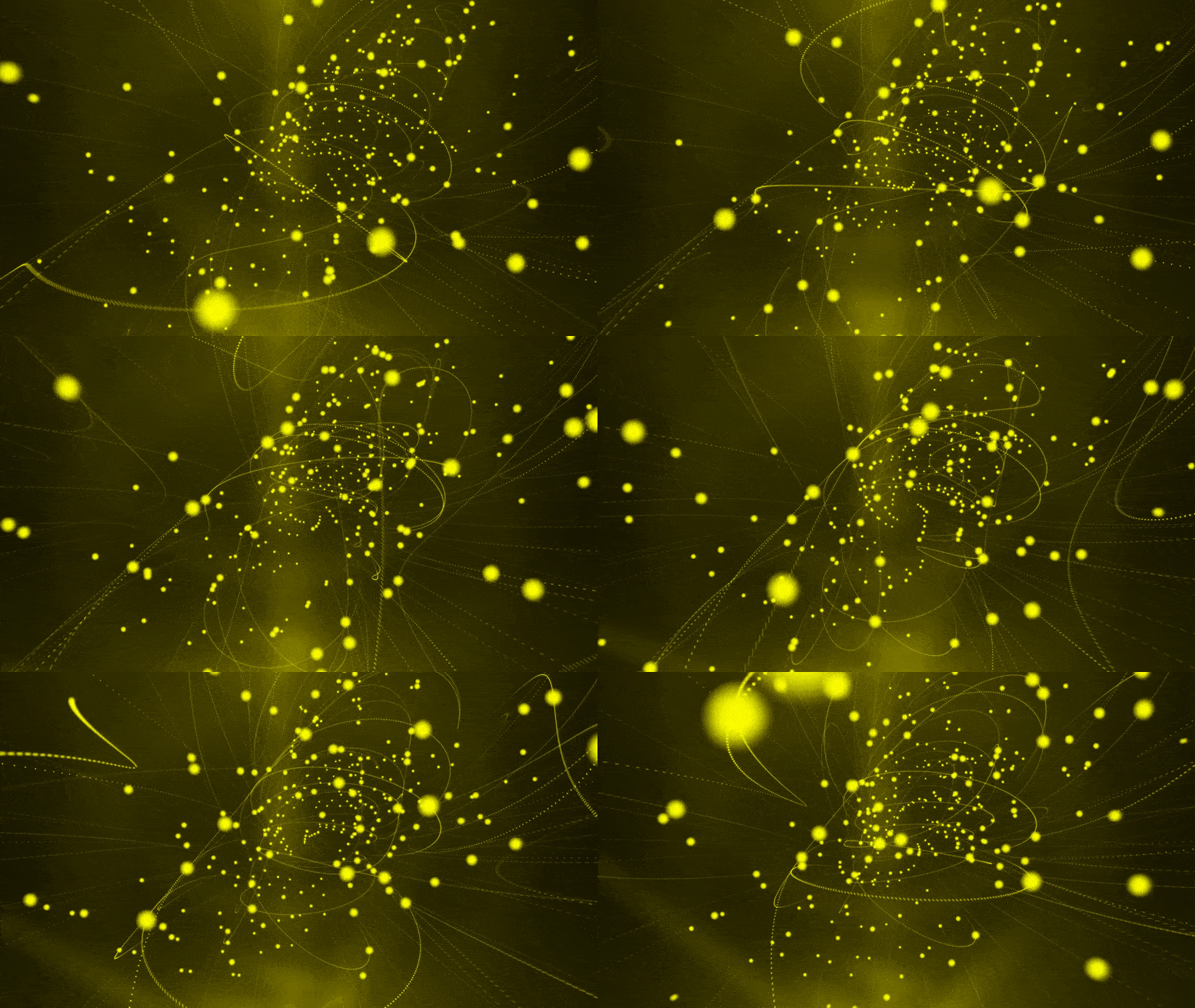
Light Swirls Provide Insights Into the Quantum World
A new method uses swirls of light to enable researchers to observe previously invisible quantum states of electrons. The method was developed by physicists from Martin Luther University Halle-Wittenberg (MLU) and an international team of researchers. It promises to deliver new insights into electron motion, which is crucial in understanding material properties such as electrical conductivity, magnetism and molecular structures. The free electron laser FERMI in Italy was used to provide experimental proof and the results were published in the journal Nature Photonics.
Optical microscopes gave the world its first glimpse of the microcosm of bacteria and cells. However, the wavelength of light limits the resolution of these microscopes. “The quantum world remains invisible,” says Dr. Jonas Wätzel from the Institute of Physics at MLU, who is a member of the research group led by Professor Jamal Berakdar. “In atoms, the spatial expansion of quantum particles, like electrons, is many times smaller than the wavelength of light, making imaging using traditional optical microscopy impossible.”
However, light can carry a considerable amount of energy. “When the energy of a photon is strong enough to knock an electron out of the material, it is called the photoelectric effect,” Wätzel explains. This effect was predicted by Einstein. Spectrometers can detect the properties of the emitted photoelectron. Photoelectron spectroscopy is currently the primary tool used to analyze a material’s electronic structure. “Many quantum states aren’t excited by photons and thus remain invisible,” Wätzel explains.
Together with an international team of researchers, he has developed a new method to furnish the photoelectron with more information. To do this, the physicists combine conventional laser beams with swirls of light, so-called optical vortices. “This forces the light waves onto a helical pathway with an angular momentum. When they interact with matter, electrons are ejected and this helical movement is transmitted,” Wätzel explains. When this is combined with spectroscopy, previously invisible properties of the material can be detected. How and whether the photoelectron interacts with the twisted wave of light and begins rotating itself, depends largely on the material properties.
The highly complex experiment was performed using the free electron laser FERMI, located in Trieste, Italy. “There was excellent agreement between the theoretical predictions and the measurement results,” says Wätzel. “This spectroscopy method paves the way for new insights into the structure of matter and its interaction with light. What a molecule looks like, whether it rotates clockwise or counter-clockwise, whether a material can conduct electricity or is magnetic, all depends on the electronic structure,” he explains. In effect, the method can be applied universally and can be used in a broad range of applications — from medicine to electronics and materials science.
Reference: “Photoelectric effect with a twist” by Giovanni De Ninno, Jonas Wätzel, Primož Rebernik Ribič, Enrico Allaria, Marcello Coreno, Miltcho B. Danailov, Christian David, Alexander Demidovich, Michele Di Fraia, Luca Giannessi, Klavs Hansen, Špela Krušič, Michele Manfredda, Michael Meyer, Andrej Mihelič, Najmeh Mirian, Oksana Plekan, Barbara Ressel, Benedikt Rösner, Alberto Simoncig, Simone Spampinati, Matija Stupar, Matjaž Žitnik, Marco Zangrando, Carlo Callegari and Jamal Berakdar, 10 August 2020, Nature Photonics.
DOI: 10.1038/s41566-020-0669-y
Never miss a breakthrough: Join the SciTechDaily newsletter.
Follow us on Google and Google News.