
Close Menu
    Facebook X (Twitter) Instagram
    SciTechDaily
    • Biology
    • Chemistry
    • Earth
    • Health
    • Physics
    • Science
    • Space
    • Technology
    Facebook X (Twitter) Pinterest YouTube RSS
    SciTechDaily
    Home»Space»Unprecedented Ground-Based Discovery of Unusual Planetary System, WASP-148
    Space

    Unprecedented Ground-Based Discovery of Unusual Planetary System, WASP-148

    By CNRSJuly 5, 2020No Comments3 Mins Read
    Facebook Twitter Pinterest Telegram LinkedIn WhatsApp Email Reddit
    Share
    Facebook Twitter LinkedIn Pinterest Telegram Email Reddit
    WASP Exoplanets
    Artistic view of the strongly interacting exoplanetary system WASP-148. The planet WASP-148c is shown in front. On the back, one can see the planet WASP-148b transiting the host star around which the two planets are in orbit. Credit: Institut d’astrophysique de Paris, Mark A. Garlick

    Several interacting exoplanets have already been spotted by satellites. But a new breakthrough has been achieved with, for the first time, the detection directly from the ground of an extrasolar system of this type. An international collaboration including CNRS researchers[1] has discovered an unusual planetary system, dubbed WASP-148, using the French instrument SOPHIE at the Observatoire de Haute-Provence (CNRS/Aix-Marseille Université;).

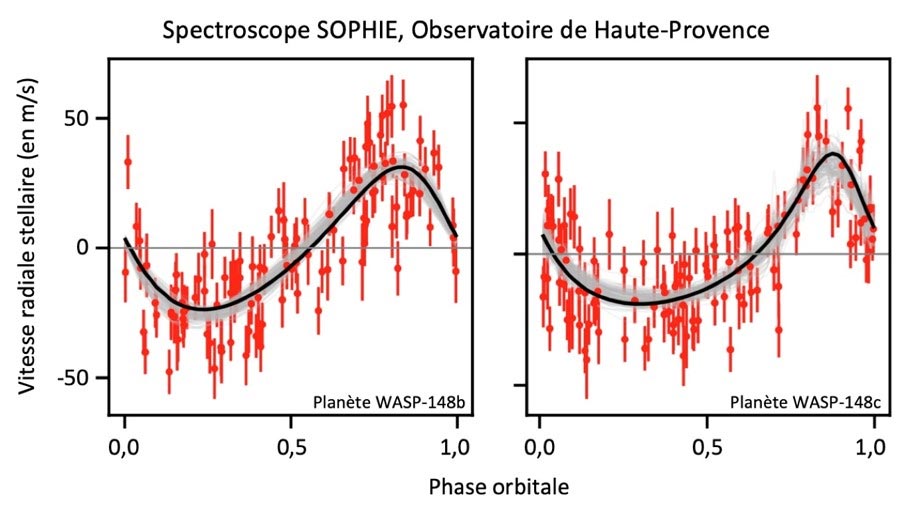
    The scientists analyzed the star’s motion and concluded that it hosted two planets, WASP-148b and WASP-148c. The observations showed that the two planets were strongly interacting, which was confirmed from other data[2].

    SOPHIE Spectroscope
    Observatoire de Haute-Provence. The SOPHIE spectroscope (mounted on the 193 cm telescope in the background) contributed to the detection and characterization of the WASP-148 exoplanetary system. Credit: OSU Pytheas / CNRS / AMU

    Whereas the first planet, WASP-148b, orbits its star in nearly nine days, the second one, WASP-148c, takes four times longer. This ratio between the orbital periods implies that the WASP-148 system is close to resonance, meaning that there is enhanced gravitational interaction between the two planets.

    And it turns out that the astronomers did indeed detect variations in the orbital periods of the planets. While a single planet, uninfluenced by a second one, would move with a constant period, WASP-148b and WASP-148c undergo acceleration and deceleration that provides evidence of their interaction. Their study will shortly be published in the journal Astronomy & Astrophysics.
    WASP 148 Measurements
    Measurements (in red) of the radial velocity of the WASP-148 planetary system with the SOPHIE spectroscope at the Observatoire de Haute-Provence. The data show variations in the star’s radial velocity caused by the planets WASP-148b (left) and WASP-148c (right). The black curves show the theoretical model that best fits the measurement points. Credit: G. Hébrard et al.

    Reference: “Discovery and characterization of the exoplanets WASP-148b and c. A transiting system with two interacting giant planets” by G. Hebrard, R.F. Diaz, A.C.M. Correia, A. Collier Cameron, J. Laskar, D. Pollacco et al., Forthcoming article, Astronomy & Astrophysics.
    DOI: 10.1051/0004-6361/202038296

    Notes

    1. French scientists work in the following laboratories : Institut d’astrophysique de Paris (CNRS/Sorbonne Université;) ; Observatoire de Haute-Provence (CNRS/Aix-Marseille Université;) ; Institut de mécanique céleste et de calcul des éphémérides (CNRS/Observatoire de Paris-PSL/Sorbonne Université;) ; Institut de planétologie et d’astrophysique de Grenoble (CNRS/Université; Grenoble Alpes) ; Laboratoire d’astrophysique de Marseille (CNRS/Aix-Marseille Université) ; Laboratoire d’études spatiales et d’instrumentation en astrophysique (CNRS/Observatoire de Paris-PSL/Sorbonne Université/Université; de Paris). They also colaborated with amateur astronomers from Hubert-Reeves Observatory.
    2. Mesures made with Hubert-Reeves telescope, France, and using SuperWASP, RISE, Carlos Sanchez and Liverpool, Canary Islands, Spain.

    Never miss a breakthrough: Join the SciTechDaily newsletter.
    Follow us on Google and Google News.

    Astronomy Astrophysics CNRS Exoplanet Popular
    Share. Facebook Twitter Pinterest LinkedIn Email Reddit

    Related Articles

    Mini-Neptunes Could Be Irradiated Ocean Planets

    Researchers Observed the Atmosphere of a Jupiter-Like Planet Beyond Our Solar System

    The Search for Exoplanets Intensifies

    Earth-like Planets May Have Older and More Evolved Life

    WASP-12 b, A Planet Being Consumed By Its Own Sun

    New Study Revives Doubted Exoplanet Fomalhaut b

    Scientists Detected Exoplanetary System With Regularly Aligned Orbits Similar to Our Solar System

    NASA Data Reveals Significant Changes in Exoplanet’s Atmosphere

    Astronomers Obtain Precise Measurements of the Two Kepler-16 Stars

    Leave A Reply Cancel Reply

    • Facebook
    • Twitter
    • Pinterest
    • YouTube

    Don't Miss a Discovery

    Subscribe for the Latest in Science & Tech!

    Trending News

    Quantum Gravity May Be Far Less Quantum Than Physicists Expected

    New Tool Supercharges Immunotherapy Against Prostate Cancer

    The Hidden Cancer Risk of Ketogenic Diets

    One Asteroid Collision May Have Rocked Earth, Mars, and the Moon

    New Study Reveals Herpesvirus Infection May Accelerate Alzheimer’s Disease

    Microplastics Found in 84% of Serious Heart Attack Patients

    Why Are Bees Struggling To Survive This Summer?

    New Metal Alloy Is up to 10 Times Stronger Than Structural Steel

    Follow SciTechDaily
    • Facebook
    • Twitter
    • YouTube
    • Pinterest
    • Newsletter
    • RSS
    SciTech News
    • Biology News
    • Chemistry News
    • Earth News
    • Health News
    • Physics News
    • Science News
    • Space News
    • Technology News
    Recent Posts
    • Rare “Super-Jupiter” Discovered on an Extraordinary 180-Day Orbit
    • First Sugar Ever Found in Interstellar Space Could Help Explain Life’s Origins
    • James Webb Telescope Discovers Hidden Giant Planet in Famous Star System
    • Scientists Watch Chemistry Unfold Atom by Atom
    • 20 Years in the Making: Physicists Confirm Long-Standing Quantum Prediction
    Copyright © 1998 - 2026 SciTechDaily. All Rights Reserved.
    • Science News
    • About
    • Contact
    • Editorial Board
    • Privacy Policy
    • Terms of Use

    Type above and press Enter to search. Press Esc to cancel.