
Close Menu
    Facebook X (Twitter) Instagram
    SciTechDaily
    • Biology
    • Chemistry
    • Earth
    • Health
    • Physics
    • Science
    • Space
    • Technology
    Facebook X (Twitter) Pinterest YouTube RSS
    SciTechDaily
    Home»Space»Hubble Spies Sculpted Galaxy Zooming Away From Us at 3.5 Million Miles per Hour
    Space

    Hubble Spies Sculpted Galaxy Zooming Away From Us at 3.5 Million Miles per Hour

    By ESA/HubbleJuly 6, 20205 Comments1 Min Read
    Facebook Twitter Pinterest Telegram LinkedIn WhatsApp Email Reddit
    Share
    Facebook Twitter LinkedIn Pinterest Telegram Email Reddit
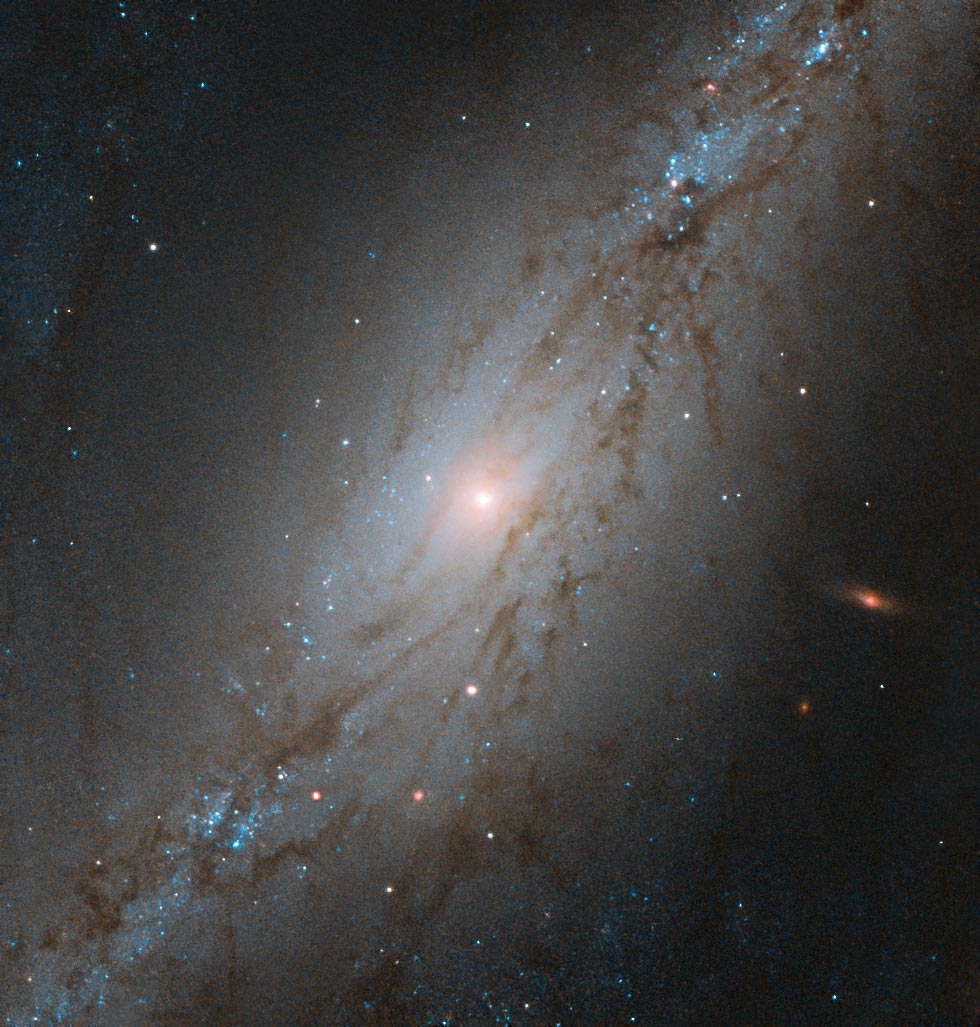
    Galaxy NGC 7513
    Hubble Space Telescope of galaxy NGC 7513, a barred spiral galaxy located approximately 60 million light-years away. Credit: ESA/Hubble & NASA, M. Stiavelli

    Captured by the NASA/ESA Hubble Space Telescope, this image shows NGC 7513, a barred spiral galaxy. Located approximately 60 million light-years away, NGC 7513 lies within the Sculptor constellation in the southern hemisphere. 

    This galaxy is moving at the astounding speed of 1564 kilometers per second (972 miles per second) or 5.6 million kph (3.5 million mph), and it is heading away from us. For context, the Earth orbits the Sun at about 30 kilometers per second. Though NGC 7513’s apparent movement away from the Milky Way might seem strange, it is not that unusual. 

    While some galaxies, like the Milky Way and the Andromeda galaxy, are caught in each other’s gravitational pull and will eventually merge together, the vast majority of galaxies in our Universe appear to be moving away from each other. This phenomenon is due to the expansion of the Universe, and it is the space between galaxies that is stretching, rather than the galaxies themselves moving.

    Never miss a breakthrough: Join the SciTechDaily newsletter.
    Follow us on Google and Google News.

    Astronomy European Space Agency Hubble Space Telescope NASA Popular
    Share. Facebook Twitter Pinterest LinkedIn Email Reddit

    Related Articles

    NASA’s Hubble Accidentally Witnesses a Comet Shattering in Space

    Hubble’s Newest Discovery Isn’t a Star, It’s a Window Into the Dark Universe

    Hubble Celebrates 34th Anniversary With a Spectacular View of the Little Dumbbell Nebula

    Hubble Captures Face-On Image of Messier 61

    Hubble Views an Ongoing Cosmic Collision

    Hubble Views Newborn Stars in Galaxy IC 5052

    New XDF Image, The Deepest-Ever View of the Universe

    Hubble Zooms in on the Center of M4

    Hubble Image of Peculiar Galaxy Pair Arp 116

    5 Comments

    1. Stefan Mochnacki on July 6, 2020 8:26 am

      After seeing red due to the headline, I was pleasantly relieved to see the radial velocity in the text first given in kilometers per second, the usual unit for radial velocities in astronomy. 1564 km/s is actually not fast at all, this is a very nearby galaxy, one in which the brightest stars can be distinguished by Hubble and giant ground-based telescopes (with the help of adaptive optics).

      Reply
    2. Jenni Li on July 6, 2020 9:08 am

      Who said this is especially fast and why single it out when other galaxies are moving away from earth just as rapidly? Who wrote this article?

      Reply
    3. Dennis Triplettd on July 6, 2020 10:39 am

      Why are some so surprised at this article? Today’s journalism is based on sensationalism, or as others say, Fake News. It got your attention, didn’t it? Can you really trust what is written these days in the news or articles?

      Reply
    4. Clark M. Thomas on July 6, 2020 2:26 pm

      For a fresh perspective on larger-scale universal expansion, which expresses as universal anisotropy, see this essay: astronomy-links.net/Universal.Anisotropy.Explained.pdf

      Reply
    5. Etherair on July 7, 2020 3:23 am

      The photo looks like a galaxy that has just come together again after a merger. This would fling it off on a high speed trajectory through its local group. The group itself may be traveling at several times this speed, but the relative velocities within the group are much less, causing this galaxy to stand out.

      Reply
    Leave A Reply Cancel Reply

    • Facebook
    • Twitter
    • Pinterest
    • YouTube

    Don't Miss a Discovery

    Subscribe for the Latest in Science & Tech!

    Trending News

    Study Finds a Surprising Link Between Gut Microbes and Aging

    Frequent Cannabis Users Wake Up With More “Stress Hormone”

    Scientists Reveal Hidden DNA Traces in the Shroud of Turin

    Giant Alien World Found Hiding in Plain Sight for 11 Years

    Scientists Link Heavy TV Watching to Brain Changes Decades Later

    Did T. rex Leave These Mysterious Marks on Dinosaur Bones?

    Quantum Computers Could Freeze Like Ordinary PCs

    Scientists Reversed Autism-Like Symptoms in Adult Mice Within Two Hours

    Follow SciTechDaily
    • Facebook
    • Twitter
    • YouTube
    • Pinterest
    • Newsletter
    • RSS
    SciTech News
    • Biology News
    • Chemistry News
    • Earth News
    • Health News
    • Physics News
    • Science News
    • Space News
    • Technology News
    Recent Posts
    • Two-Year Lifestyle Program Boosts Cognition 55% More in Older Adults
    • Speaking More Languages May Slow Brain Aging
    • Experimental Eye Drops Restore Sight in Blind Mice
    • Coffee’s Most Destructive Pest Is Accidentally Helping the Ants That Hunt It
    • Cells Join Forces To Survive Prolonged Mechanical Strain
    Copyright © 1998 - 2026 SciTechDaily. All Rights Reserved.
    • Science News
    • About
    • Contact
    • Editorial Board
    • Privacy Policy
    • Terms of Use

    Type above and press Enter to search. Press Esc to cancel.