
Close Menu
    Facebook X (Twitter) Instagram
    SciTechDaily
    • Biology
    • Chemistry
    • Earth
    • Health
    • Physics
    • Science
    • Space
    • Technology
    Facebook X (Twitter) Pinterest YouTube RSS
    SciTechDaily
    Home»Space»Hubble Views an Ongoing Cosmic Collision
    Space

    Hubble Views an Ongoing Cosmic Collision

    By European Space Agency/NASA HubbleJune 3, 20132 Comments1 Min Read
    Facebook Twitter Pinterest Telegram LinkedIn WhatsApp Email Reddit
    Share
    Facebook Twitter LinkedIn Pinterest Telegram Email Reddit
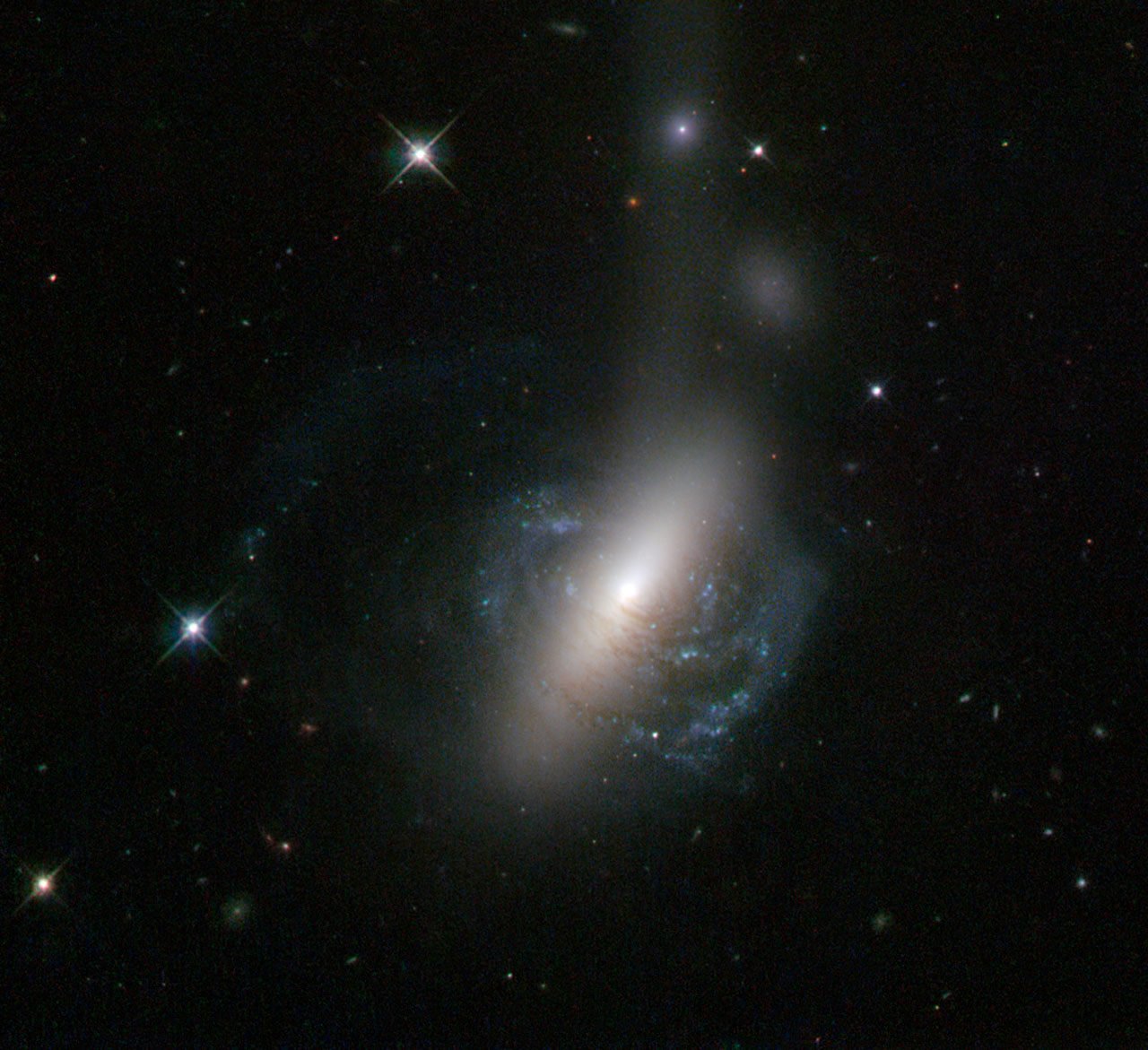
    Hubble Views an Ongoing Cosmic Collision between Two Galaxies
    Hubble Space Telescope image of an ongoing cosmic collision between two galaxies. Credit: ESA/Hubble & NASA, Acknowledgment: Luca Limatola

    In this new image, NASA’s Hubble Space Telescope views an ongoing cosmic collision between two galaxies.

    This new image from the NASA/ESA Hubble Space Telescope captures an ongoing cosmic collision between two galaxies — a spiral galaxy is in the process of colliding with a lenticular galaxy. The collision looks almost as if it is popping out of the screen in 3-D, with parts of the spiral arms clearly embracing the lenticular galaxy’s bulge.

    The image also reveals further evidence of the collision. There is a bright stream of stars coming out from the merging galaxies, extending out toward the top of the image. The bright spot in the middle of the plume, known as ESO 576-69, is what makes this image unique. This spot is believed to be the nucleus of the former spiral galaxy, which was ejected from the system during the collision and is now being shredded by tidal forces to produce the visible stellar stream.

    Never miss a breakthrough: Join the SciTechDaily newsletter.
    Follow us on Google and Google News.

    Astronomy European Space Agency Hubble Space Telescope NASA Popular
    Share. Facebook Twitter Pinterest LinkedIn Email Reddit

    Related Articles

    Hubble’s Newest Discovery Isn’t a Star, It’s a Window Into the Dark Universe

    Hubble Celebrates 34th Anniversary With a Spectacular View of the Little Dumbbell Nebula

    Hubble Telescope Views Vivid Auroras in Jupiter’s Atmosphere

    Hubble Views Spiral Galaxy NGC 5793

    Hubble Captures Face-On Image of Messier 61

    Hubble Views Newborn Stars in Galaxy IC 5052

    New XDF Image, The Deepest-Ever View of the Universe

    Hubble Zooms in on the Center of M4

    Hubble Image of Peculiar Galaxy Pair Arp 116

    2 Comments

    1. Conrad Winkelman on June 3, 2013 8:42 am

      How can one be sure that these Galaxies are not simply passing each other in the line of sight of the telescope without actually passing through each other at all and thus not actually causing any stellar collisions. . .which in any case would be a very rare event considering the great distances between these stars. . .If such galaxies would actually pass through each other then stellar collision might still not occur at all.

      Reply
    2. Peter Jackson FRAS on June 4, 2013 2:07 am

      These supposed interpretations just get more an more bizarre. Using the falsified foundation of the concordance model doesn’t help. The morphology comes within the constraints of a single galaxy with remains of the accretion disc around the lenticular core. The outflows top and bottom will then become ‘quasar’ jets. This is a ‘recycling’ process more consistent with the WMAP and Planck anisotropies. We seem to have something wrong with our scientific method, falsifying assumptions but then finding all still using them to confuse even further!

      Reply
    Leave A Reply Cancel Reply

    • Facebook
    • Twitter
    • Pinterest
    • YouTube

    Don't Miss a Discovery

    Subscribe for the Latest in Science & Tech!

    Trending News

    New Study Reveals Why Ozempic Works Better for Some People Than Others

    Climate Change Is Altering a Key Greenhouse Gas in a Way Scientists Didn’t Expect

    New Study Suggests Gravitational Waves May Have Created Dark Matter

    Scientists Discover Why the Brain Gets Stuck in Schizophrenia

    Scientists Engineer “Tumor-Eating” Bacteria That Devour Cancer From Within

    Even “Failed” Diets May Deliver Long-Term Health Gains, Study Finds

    NIH Scientists Discover Powerful New Opioid That Relieves Pain Without Dangerous Side Effects

    Collapsing Plasma May Hold the Key to Cosmic Magnetism

    Follow SciTechDaily
    • Facebook
    • Twitter
    • YouTube
    • Pinterest
    • Newsletter
    • RSS
    SciTech News
    • Biology News
    • Chemistry News
    • Earth News
    • Health News
    • Physics News
    • Science News
    • Space News
    • Technology News
    Recent Posts
    • 100 Times Worse? Thawing Permafrost May Be More Dangerous Than Previously Thought
    • “Pretty Close to Home”: The Hidden Earthquake Threat Beneath Seattle
    • The Surprising Reason You Might Want To Sleep Without a Pillow
    • Household Cats Could Hold the Secret to Fighting Breast Cancer
    • Scientists Say This Natural Hormone Reverses Obesity by Targeting the Brain
    Copyright © 1998 - 2026 SciTechDaily. All Rights Reserved.
    • Science News
    • About
    • Contact
    • Editorial Board
    • Privacy Policy
    • Terms of Use

    Type above and press Enter to search. Press Esc to cancel.