
Close Menu
    Facebook X (Twitter) Instagram
    SciTechDaily
    • Biology
    • Chemistry
    • Earth
    • Health
    • Physics
    • Science
    • Space
    • Technology
    Facebook X (Twitter) Pinterest YouTube RSS
    SciTechDaily
    Home»Biology»COVID-19 Impacts Some Organs, But Not Others – Here’s Why
    Biology

    COVID-19 Impacts Some Organs, But Not Others – Here’s Why

    By American Institute of PhysicsAugust 25, 2020No Comments3 Mins Read
    Facebook Twitter Pinterest Telegram LinkedIn WhatsApp Email Reddit
    Share
    Facebook Twitter LinkedIn Pinterest Telegram Email Reddit
    Main Disease Activators for SARS-CoV-2
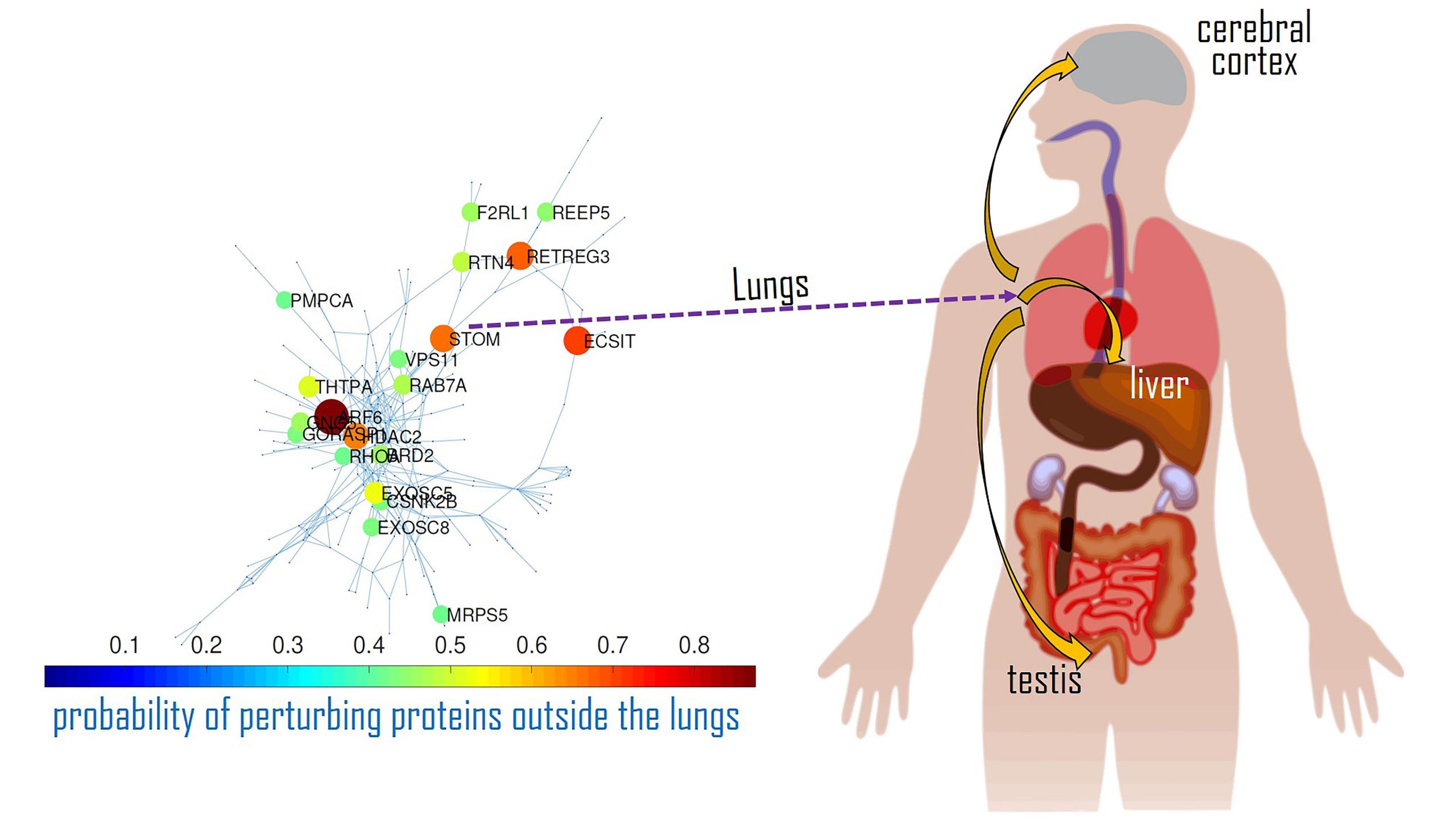
    An interaction map of the main disease activators for SARS-CoV-2 in the lungs and how they impact proteins in other organs. Credit: Ernesto Estrada

    COVID-19 proliferates through a receptor present in most of the human body; but if the receptor is so pervasive, why does the virus seem to target only specific organs?

    In severe cases of COVID-19, damage can spread beyond the lungs and into other organs, such as the heart, liver, kidney and parts of the neurological system. Beyond these specific sets of organs, however, the virus seems to lack impact.

    Ernesto Estrada, from the University of Zaragoza and Agencia Aragonesa para la Investigación Foundation in Spain, aimed to uncover an explanation as to how it is possible for these damages to propagate selectively rather than affecting the entire body. He discusses his findings in the journal Chaos, from AIP Publishing.

    In order to enter human cells, the coronavirus relies on interactions with an abundant protein called angiotensin-converting enzyme 2.

    “This receptor is ubiquitous in most human organs, such that if the virus is circulating in the body, it can also enter into other organs and affect them,” Estrada said. “However, the virus affects some organs selectively and not all, as expected from these potential mechanisms.”

    Once inside a human cell, the virus’s proteins interact with those in the body, allowing for its effects to cultivate. COVID-19 damages only a subset of organs, signaling to Estrada that there must be a different pathway for its transmission. To uncover a plausible route, he considered the displacements of proteins prevalent in the lungs and how they interact with proteins in other organs.

    “For two proteins to find each other and form an interaction complex, they need to move inside the cell in a subdiffusive way,” Estrada said.

    He described this subdiffusive motion as resembling a drunkard walking on a crowded street. The crowd presents obstacles to the drunkard, stunting displacement and making it difficult to reach the destination.

    Similarly, proteins in a cell face several crowded obstacles they must overcome in order to interact. Adding to the complexity of the process, some proteins exist within the same cell or organ, but others do not.

    Taking these into account, Estrada developed a mathematical model that allowed him to find a group of 59 proteins within the lungs that act as the primary activators affecting other human organs. A chain of interactions, beginning with this set, triggers changes in proteins down the line, ultimately impacting their health.

    “Targeting some of these proteins in the lungs with existing drugs will prevent the perturbation of the proteins expressed in organs other than the lungs, avoiding multiorgan failure, which, in many cases, conduces the death of the patient,” Estrada said.

    How the affected proteins travel between organs remains an open question that Estrada is dedicating for future studies.

    Reference: “Fractional diffusion on the human proteome as an alternative to the multi-organ damage of SARS CoV-2” by Ernesto Estrada, 11 August 2020, Chaos.
    DOI: 10.1063/5.0015626

    Never miss a breakthrough: Join the SciTechDaily newsletter.
    Follow us on Google and Google News.

    Algorithm American Institute of Physics COVID-19 Infectious Diseases Popular Virology
    Share. Facebook Twitter Pinterest LinkedIn Email Reddit

    Related Articles

    SARS vs. COVID-19: Why Some Coronavirus Strains Are More Infectious Than Others

    A Genetic Variant You May Have Inherited From Neanderthals Reduces the Risk of Severe COVID-19

    Humanity’s Best Friend: How Dogs Could Be Our Next Allies in the Fight Against COVID-19

    Temperature, Humidity & Wind Predict Second Wave of COVID-19 Pandemic

    Disposable Helmet Designed to Retain Cough Droplets, Minimize COVID-19 Transmission

    New Strategy Identifies Existing Drug That Inhibits COVID-19 Virus – Outperforms Remdesivir

    New Testing Shows Masks Not Enough to Stop COVID-19’s Spread Without Social Distancing

    COVID Face Shields No Match for Sneeze Vortex Rings

    Genetic Comparison of 24 Coronaviruses – Including SARS-CoV-2 Viruses From the U.S. and China – Yields Clues to COVID-19 Treatments

    Leave A Reply Cancel Reply

    • Facebook
    • Twitter
    • Pinterest
    • YouTube

    Don't Miss a Discovery

    Subscribe for the Latest in Science & Tech!

    Trending News

    Scientists Say Love Follows Mathematical Patterns

    “Zombie Cells” Reveal a Hidden Weakness That Could Help Fight Aging

    Alien Signals May Be Hiding in a Radio Band SETI Has Barely Explored

    Earth’s Hidden Thermostat Has Regulated Climate for 60 Million Years

    This 518-Million-Year-Old Creature Reveals How Spiders Got Their Bite

    Scientists Built a Programmable Chip That Can Slow Light on Command

    The Backyard “Silly Sprinkler” That Cracked One of Physics’ Biggest Puzzles

    This Common Sleep Habit Could Be Making You Gain Weight

    Follow SciTechDaily
    • Facebook
    • Twitter
    • YouTube
    • Pinterest
    • Newsletter
    • RSS
    SciTech News
    • Biology News
    • Chemistry News
    • Earth News
    • Health News
    • Physics News
    • Science News
    • Space News
    • Technology News
    Recent Posts
    • This Star Is Racing Around the Milky Way’s Black Hole at 8% the Speed of Light
    • Where on Earth Was This Fossil 200 Million Years Ago?
    • A 25,000-Year-Old Ritual Tradition Was Hidden Beneath This Cave Floor
    • A Hidden Source of Metal-Mining Emissions Could Be 10x Larger Than Estimated
    • Plant Compounds in Berries, Tea, and Cocoa May Support Healthy Brain Aging
    Copyright © 1998 - 2026 SciTechDaily. All Rights Reserved.
    • Science News
    • About
    • Contact
    • Editorial Board
    • Privacy Policy
    • Terms of Use

    Type above and press Enter to search. Press Esc to cancel.