
Close Menu
    Facebook X (Twitter) Instagram
    SciTechDaily
    • Biology
    • Chemistry
    • Earth
    • Health
    • Physics
    • Science
    • Space
    • Technology
    Facebook X (Twitter) Pinterest YouTube RSS
    SciTechDaily
    Home»Biology»SARS vs. COVID-19: Why Some Coronavirus Strains Are More Infectious Than Others
    Biology

    SARS vs. COVID-19: Why Some Coronavirus Strains Are More Infectious Than Others

    By Biophysical SocietyFebruary 25, 20211 Comment3 Mins Read
    Facebook Twitter Pinterest Telegram LinkedIn WhatsApp Email Reddit
    Share
    Facebook Twitter LinkedIn Pinterest Telegram Email Reddit
    SARS CoV2 Spike Glycoproteins
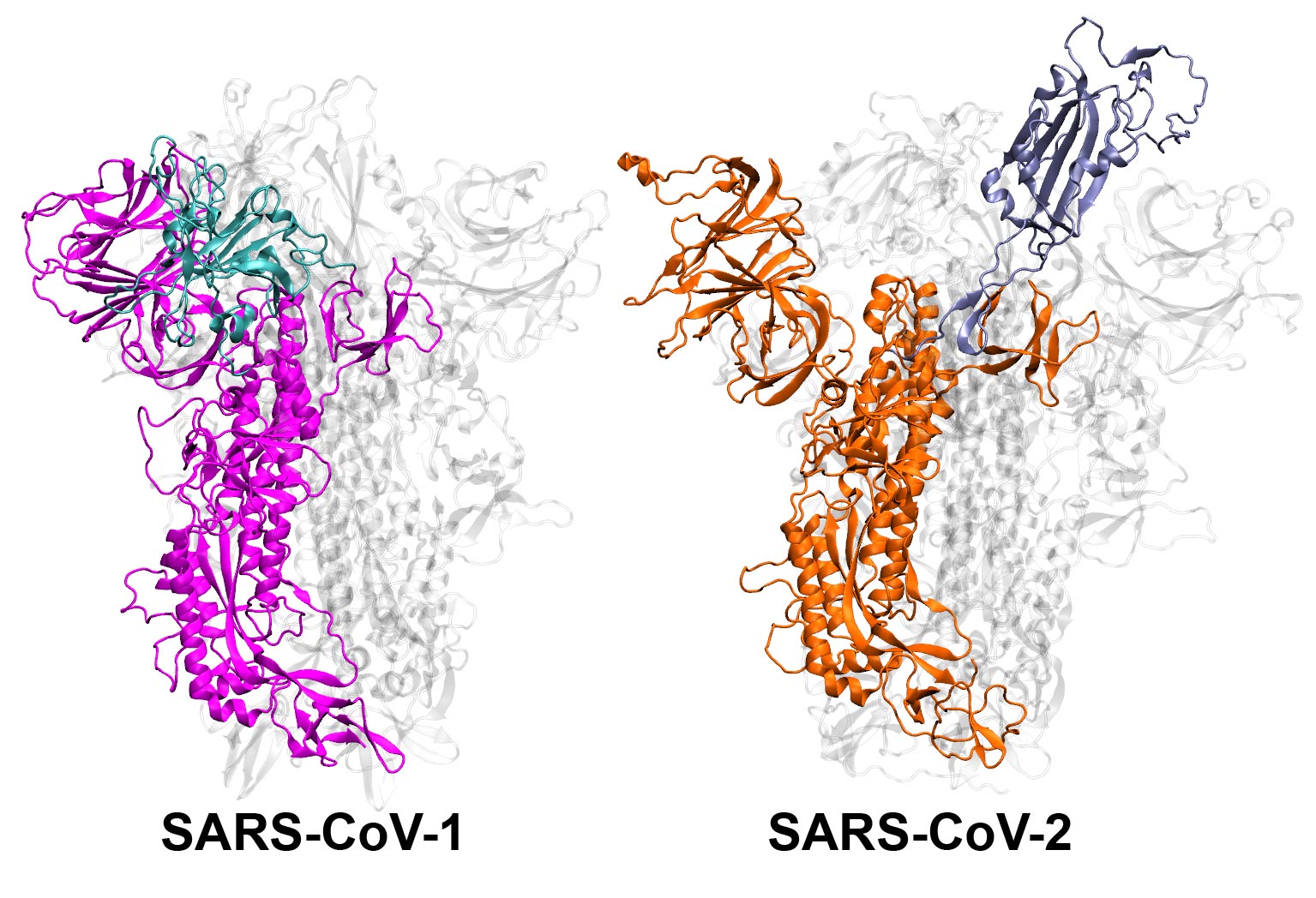
    A representation of the SARS-CoV spike protein structures. Credit: Image courtesy of Mahmoud Moradi

    The coronaviruses that cause SARS and COVID-19 have spike proteins that move into “active” and “inactive” positions, and new research indicates how those molecular movements may make the COVID-19 virus more infectious compared to the SARS virus.

    Coronavirus outbreaks have occurred periodically, but none have been as devastating as the COVID-19 pandemic. Vivek Govind Kumar, a graduate student, and colleagues in the lab of Mahmoud Moradi at the University of Arkansas, have discovered one reason that likely makes SARS-CoV-2, the virus that causes COVID-19, so much more infectious than SARS-CoV-1, which caused the 2003 SARS outbreak. Moradi will present the research on Thursday, February 25 at the 65th Annual Meeting of the Biophysical Society

    The first step in coronavirus infection is for the virus to enter cells. For this entry, the spike proteins on the outside of the SARS-CoV virus must reposition. Scientists know the position of the “inactive” and “active” states of the spike proteins of both the SARS-CoV-1 and -2 viruses, but Moradi and colleagues wanted to study how the spikes moved from one position to another and the dynamics of those movements. They turned to molecular simulations, performed at the Texas Advanced Computing Center and the Pittsburgh Supercomputing Center.

    “We discovered in these simulations that SARS-CoV-1 and SARS-CoV-2 have completely different ways of changing their shape, and on different time scales,” Moradi says. “SARS-CoV-1 moves faster, it activates and deactivates, which doesn’t give it as much time to stick to the human cell because it’s not as stable. SARS-CoV-2, on the other hand, is stable and ready to attack,” he added.

    Designing Therapeutics Based on Spike Behavior

    There is a region at the tail end of the spike protein that has largely been ignored in research, Moradi says, but that piece is important in the stability of the protein. Mutations in that region could affect the transmissibility, he says, and are worth paying attention to. The other implication for their research is “we could design therapeutics that alter the dynamics and make the inactive state more stable, thereby promoting the deactivation of SARS-CoV-2. That is a strategy that hasn’t yet been adopted,” Moradi explained.

    It is valuable to be able to do these kinds of simulations, Moradi says, in the event a new coronavirus emerges, or SARS-CoV-2 mutates so that they can predict if the new virus or variant could be higher in transmissibility and infection. They have now begun studying the new SARS-CoV-2 B.1.1.7 variant in the lab to detect differences in its movements.

    Never miss a breakthrough: Join the SciTechDaily newsletter.
    Follow us on Google and Google News.

    Biomechanics Biophysical Society Biophysics Cell Biology COVID-19 Infectious Diseases Popular Virology
    Share. Facebook Twitter Pinterest LinkedIn Email Reddit

    Related Articles

    Researchers Identify Insidious New Way COVID-19 Virus Uses To Invade Cells

    Deconstructing the Infectious Biological Weaponry of the COVID-19 Virus

    Scientists Have Discovered an Achilles Heel of the Coronavirus

    Scientists Discover Exactly How COVID-19 Wreaks Havoc on Human Lungs

    New Discovery Helps Explain How COVID-19 Overpowers the Immune System

    Sugar-Coated Shield Helps the COVID-19 Virus Become Activated and Infectious

    Infection Researchers Identify How Coronaviruses From Animals Need to Change to Spread to Humans

    Bad News – Coronavirus SARS-CoV-2 Infects Cells of the Intestine and Multiplies There

    Specialized Proteins May Halt the Severe Cytokine Storms Seen in COVID-19 Patients

    1 Comment

    1. slope game on July 10, 2025 2:48 am

      I found your post both informative and inspiring. Thank you for explaining everything in such a simple way. Keep up the great work!

      Reply
    Leave A Reply Cancel Reply

    • Facebook
    • Twitter
    • Pinterest
    • YouTube

    Don't Miss a Discovery

    Subscribe for the Latest in Science & Tech!

    Trending News

    Scientists Recreate a Nuclear Fireball and Uncover Fallout’s Hidden Chemistry

    These Tiny Gut Particles Could Be Accelerating Aging Throughout the Body

    Doctors Changed One Thing and Weight Gain Stopped

    Magnetic Fields May Solve a Longstanding Binary Star Mystery

    The Probiotic Breakthrough for Natural Anxiety Relief and Better Mental Health

    Animal vs. Plant Protein: Scientists Found a Surprising Nutritional Difference

    According to Scientists, This Simple Dietary Change Is Linked to Lower Depression Scores

    Researchers Discover a Hidden Vitamin D Problem That Persists Year-Round

    Follow SciTechDaily
    • Facebook
    • Twitter
    • YouTube
    • Pinterest
    • Newsletter
    • RSS
    SciTech News
    • Biology News
    • Chemistry News
    • Earth News
    • Health News
    • Physics News
    • Science News
    • Space News
    • Technology News
    Recent Posts
    • Scientists Uncover Why Walking Gets Slower and More Exhausting As We Age
    • 24 Hours Without Sleep Changes Your Saliva in Measurable Ways
    • A Major Update Just Hit Cholesterol Guidelines – Here’s What Every Adult Needs To Know
    • Scientists Tracked 4,500 Animals During COVID – What They Discovered Was Surprising
    • Hidden Phase of Matter Finally Captured After Decades of Predictions
    Copyright © 1998 - 2026 SciTechDaily. All Rights Reserved.
    • Science News
    • About
    • Contact
    • Editorial Board
    • Privacy Policy
    • Terms of Use

    Type above and press Enter to search. Press Esc to cancel.