
Close Menu
    Facebook X (Twitter) Instagram
    SciTechDaily
    • Biology
    • Chemistry
    • Earth
    • Health
    • Physics
    • Science
    • Space
    • Technology
    Facebook X (Twitter) Pinterest YouTube RSS
    SciTechDaily
    Home»Biology»Sugar-Coated Shield Helps the COVID-19 Virus Become Activated and Infectious
    Biology

    Sugar-Coated Shield Helps the COVID-19 Virus Become Activated and Infectious

    By Biophysical SocietyFebruary 25, 2021No Comments3 Mins Read
    Facebook Twitter Pinterest Telegram LinkedIn WhatsApp Email Reddit
    Share
    Facebook Twitter LinkedIn Pinterest Telegram Email Reddit
    SARS CoV2 Sugar Coated Shield
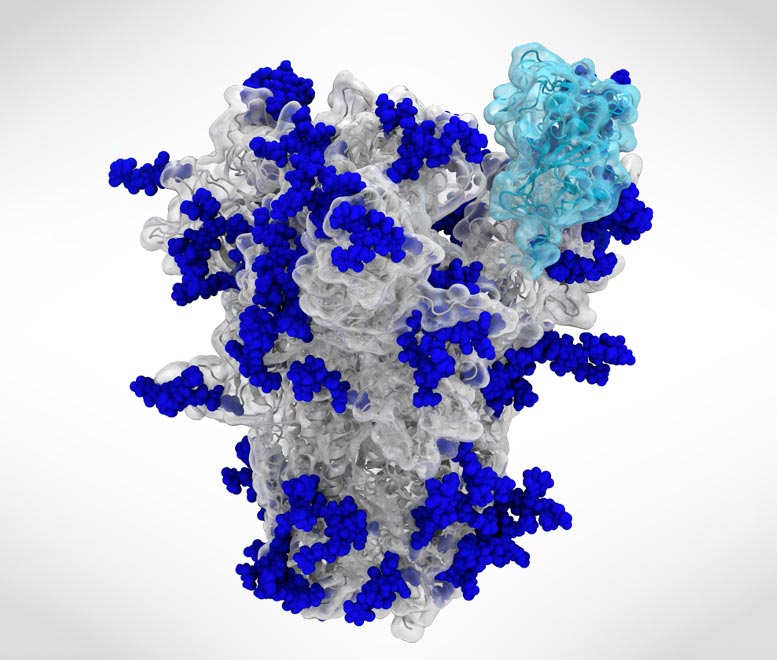
    Image of the SARS-CoV-2 spike in the active position. Dark blue glycans shield the spike from the immune system, participate in activation, and stabilize the active form. The receptor binding domain changes shape in order to bind human cells is shown in cyan. Credit: Lorenzo Casalino, Amaro Lab, UCSD

    SARS-CoV-2, the virus that causes COVID-19, is coated with sugars called glycans, which help it evade the immune system. New research shows precisely how those sugars help the virus become activated and infectious and could help with vaccine and drug discovery.

    One thing that makes SARS-CoV-2, the virus that causes COVID-19, elusive to the immune system is that it is covered in sugars called glycans. Once SARS-CoV-2 infects someone’s body, it becomes covered in that person’s unique glycans, making it difficult for the immune system to recognize the virus as something it needs to fight. Those glycans also play an important role in activating the virus. Terra Sztain-Pedone, a graduate student, and colleagues in the labs of Rommie Amaro at the University of California, San Diego and Lillian Chong at the University of Pittsburgh, studied exactly how the glycans activate SARS-CoV-2. Sztain-Pedone will present the research on Thursday, February 25, 2021, at the 65th Annual Meeting of the Biophysical Society.

    For SARS-CoV-2 to become activated and infectious, the spike proteins on the outside of the virus need to change shape so it can stick to our cells. Scientists knew that the glycans that coat these spikes help SARS-CoV-2 evade the immune system, but it was not known what role they played in the activation process. Studying these molecules is tricky because they are so small and have many parts that move in subtle ways. “There are half a million atoms in just one of these spike protein simulations,” Sztain-Pedone explained.

    Using advanced High Performance Computing algorithms that run many simulations in parallel, the research team examined how the positions of each of those atoms changes as the SARS-CoV-2 spike becomes activated. “Most computers wouldn’t be able to do this with half a million atoms,” Sztain-Pedone says.

    Identifying the Glycans That Trigger Infection

    The team was able to identify the glycans and molecules that are responsible for activating the spike protein. “Surprisingly, one glycan seems to be responsible for initiating the entire opening,” Sztain-Pedone says. Other glycans are involved in subsequent steps. To validate their findings, the team is currently working with Jason McLellan, a professor at the University of Texas, Austin, and colleagues who are performing experiments with spike proteins in the lab.

    There is potential to use the simulations developed by Sztain-Pedone and colleagues to identify treatments that will block or prevent SARS-CoV-2 activation. “Because we have all these structures, we can do small molecule screening with computational algorithms,” Sztain-Pedone explained. They can also study new virus mutations, such as the B.1.1.7 variant that is currently spreading, to “look at how that might affect the spike protein activation,” Sztain-Pedone says.

    Never miss a breakthrough: Join the SciTechDaily newsletter.
    Follow us on Google and Google News.

    Biomechanics Biophysical Society Biophysics COVID-19 Infectious Diseases Virology
    Share. Facebook Twitter Pinterest LinkedIn Email Reddit

    Related Articles

    Deconstructing the Infectious Biological Weaponry of the COVID-19 Virus

    SARS vs. COVID-19: Why Some Coronavirus Strains Are More Infectious Than Others

    New Insights Into Why COVID-19 Infects Some Animals, but Not Others

    SARS-CoV-2 Infection Revealed in “Mini-Lungs” Shows How COVID-19 Damages the Lungs

    The Latest Science on How to Keep COVID-19 Out of School Classrooms

    COVID-19 Impacts Some Organs, But Not Others – Here’s Why

    Advanced Cryo-EM Reveals Viral RNA Replication Complex Structure in “Game-Changing” Detail

    Genetic Comparison of 24 Coronaviruses – Including SARS-CoV-2 Viruses From the U.S. and China – Yields Clues to COVID-19 Treatments

    Specialized Proteins May Halt the Severe Cytokine Storms Seen in COVID-19 Patients

    Leave A Reply Cancel Reply

    • Facebook
    • Twitter
    • Pinterest
    • YouTube

    Don't Miss a Discovery

    Subscribe for the Latest in Science & Tech!

    Trending News

    Millions Take These IBS Drugs, But a New Study Finds Serious Risks

    Scientists Unlock Hidden Secrets of 2,300-Year-Old Mummies Using Cutting-Edge CT Scanner

    Bread Might Be Making You Gain Weight Even Without Eating More Calories

    Scientists Discover Massive Magma Reservoir Beneath Tuscany

    Europe’s Most Active Volcano Just Got Stranger – Here’s Why Scientists Are Rethinking It

    Alzheimer’s Symptoms May Start Outside the Brain, Study Finds

    Millions Take This Popular Supplement – Scientists Discover a Concerning Link to Heart Failure

    The Universe Is Expanding Too Fast and Scientists Can’t Explain Why

    Follow SciTechDaily
    • Facebook
    • Twitter
    • YouTube
    • Pinterest
    • Newsletter
    • RSS
    SciTech News
    • Biology News
    • Chemistry News
    • Earth News
    • Health News
    • Physics News
    • Science News
    • Space News
    • Technology News
    Recent Posts
    • Doctors Surprised by the Power of a Simple Drug Against Colon Cancer
    • Why Popular Diabetes Drugs Like Ozempic Don’t Work for Everyone: The “Genetic Glitch”
    • Scientists Create Improved Insulin Cells That Reverse Diabetes in Mice
    • Scientists Stunned After Finding Plant Thought Extinct for 60 Years
    • A Common Diabetes Drug May Hold the Key to Stopping HIV From Coming Back
    Copyright © 1998 - 2026 SciTechDaily. All Rights Reserved.
    • Science News
    • About
    • Contact
    • Editorial Board
    • Privacy Policy
    • Terms of Use

    Type above and press Enter to search. Press Esc to cancel.