
Open windows, use glass screens in front of desks; Aerosol spread of virus in classrooms with air conditioning poses issues for students, teachers.
As the COVID-19 virus continues to spread around the globe, studying aerosol and droplet transport within different environments can help establish effective, physics-informed measures for virus mitigation. One of the most important environments to gain a rapid understanding about COVID-19’s spread is inside the school classroom.
Flow velocity distribution and particle size are key in aerosol transport, which is one of the main ways COVID-19 spreads, when aerosol particles are released during exhalation, talking, coughing, or sneezing.
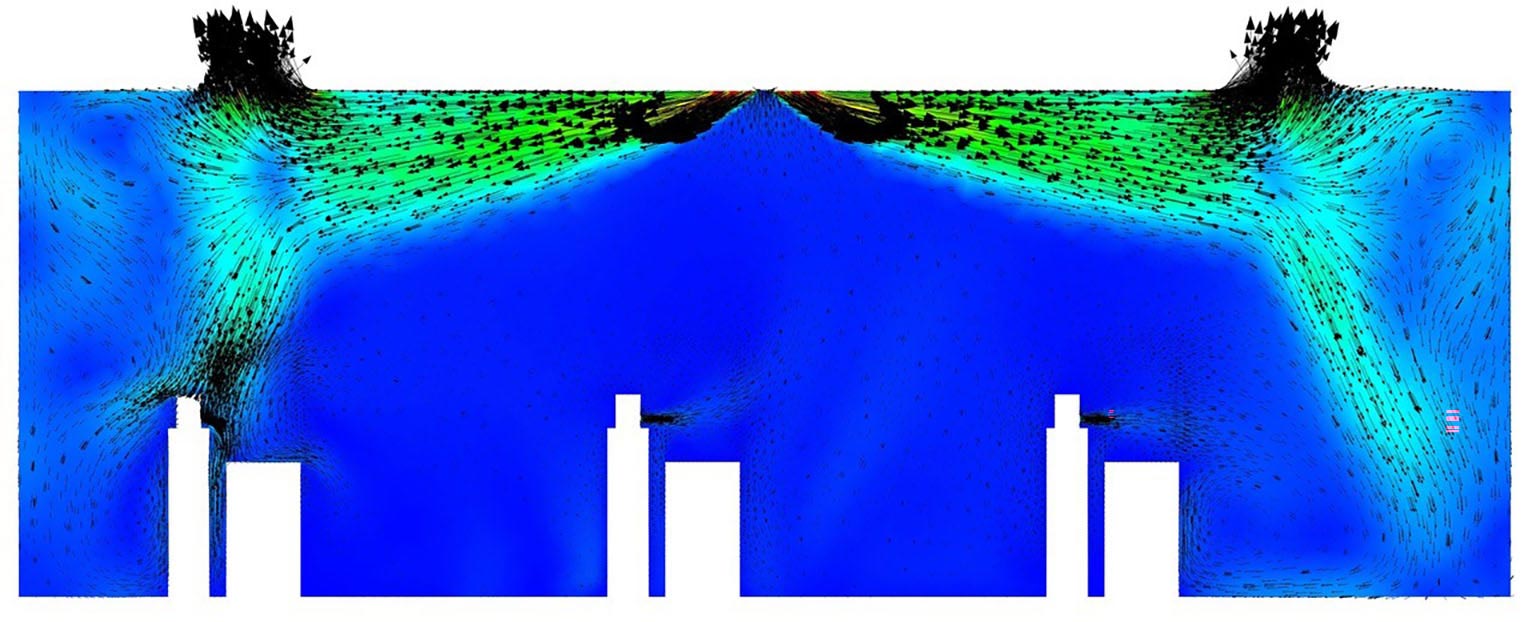
In Physics of Fluids, from AIP Publishing, University of New Mexico researchers used computational fluid-particle dynamics to explore aerosol transport within an air-conditioned classroom model. They discovered opening windows increases the fraction of particles that exit the system by nearly 40%, while also reducing aerosol transmission between people within.
“Nearly 70% of exhaled 1-micron particles exit the system when windows are open,” said Khaled Talaat, one of the authors. “And air conditioning removes up to 50% of particles released during exhalation and talking, but the rest get deposited onto surfaces within the room and may reenter the air.”
Particles are transmitted in significant quantities (up to 1% of exhaled particles) between students — even at 2.4 meters (7.8 feet) of separation distance because of airflow.
“The aerosol distribution within the room isn’t uniform, because of air conditioning and source location,” said Talaat. “Student position within the room affects the likelihood of transmitting particles to others and of receiving particles.”
The researchers were surprised to find that glass droplet screens placed in front of desks significantly reduced the transmission of 1-micron particles from one student to another, according to Talaat.
“Screens don’t stop 1-micron particles directly, but they affect the local air flow field near the source, which changes the particle trajectories,” he said. “Their effectiveness depends on the position of the source with respect to the air conditioning diffusers.”
For school reopenings, the group recommends keeping windows open when possible and installing glass screens in front of desks. Students at higher risk of COVID-19 complications can be seated where they are exposed to fewer particles, which will depend on the air conditioning layout within the room.
“In our model, the back corners are the safest spots,” Talaat said.
The group stresses the importance of sanitizing hands — even without contact with other people’s belongings — because “particles can be transmitted from one student to other students’ desks or clothes, etc., even when keeping separated by a distance of 2.4 meters,” he said.
Their work also highlights the importance of effective filtration and sterilization systems within air conditioners.
“Given the significance of air conditioning, there is potential for optimization of HVAC systems within classrooms to maximize particle removal, while providing adequate ventilation,” Talaat said.
Reference: “Numerical investigation of aerosol transport in a classroom with relevance to COVID-19” by Mohamed Abuhegazy, Khaled Talaat, Osman Anderoglu and Svetlana V. Poroseva, 20 October 2020, Physics of Fluids.
DOI: 10.1063/5.0029118
Never miss a breakthrough: Join the SciTechDaily newsletter.
Follow us on Google and Google News.
1 Comment
Good luck with not wearing a surgical mask in a public restroom, you’re going to need it.
As you walk into a public restroom, you cannot help but breath-in an invisible nano-fecal cloud, that’s just hanging out in the stagnant air.
This why public restrooms are usually more humid. It may or may not have the COVID-19 virus.
Ever heard of ‘toilet sneeze’? Nice visual, eh?
The flush toilet is a 100 year old technology-fail from the very start. You know, flushing away our poop with perfectly good drinking water?
And, with every flush, swirl, glub-glub-glub, into the stagnant air another nano-fecal cloud is sent.
Personally, I believe that the public restroom is one of the top reasons for its virulent spread.