
Close Menu
    Facebook X (Twitter) Instagram
    SciTechDaily
    • Biology
    • Chemistry
    • Earth
    • Health
    • Physics
    • Science
    • Space
    • Technology
    Facebook X (Twitter) Pinterest YouTube RSS
    SciTechDaily
    Home»Health»Where to Sit in a Car and Which Windows to Put Down to Prevent COVID-19 Transmission
    Health

    Where to Sit in a Car and Which Windows to Put Down to Prevent COVID-19 Transmission

    By American Association for the Advancement of ScienceDecember 13, 20202 Comments4 Mins Read
    Facebook Twitter Pinterest Telegram LinkedIn WhatsApp Email Reddit
    Share
    Facebook Twitter LinkedIn Pinterest Telegram Email Reddit
    Aerosol Particles Car
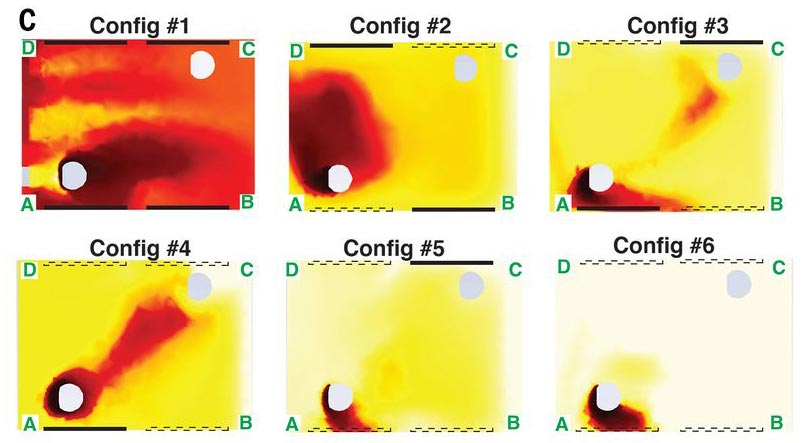
    A new study looks at how airflow patterns inside the passenger cabin of a car might affect the transmission of SARS-CoV-2 and other airborne pathogens. Using computer simulations, the study looked at the risk of aerosol particles being shared between a driver and a passenger in different window configurations. Redder shades indicate more particles. Risk was shown to be higher with windows closed (top left), and decreasing with each window opened. The best case was having all windows open (bottom right). Credit: Breuer lab / Brown University

    Airflows inside passenger cars and implications for airborne disease transmission.

    A new series of computational fluid dynamics simulations suggests that, for two people who must travel together in the same passenger car, the safest way to prevent possible transmission of COVID-19 in such a risky, enclosed environment is to do so with all four windows down and the passenger seated as far as possible from the driver, in the rear seat on the opposite side.

    Varghese Mathai and colleagues found that this modeled configuration created two distinct flows of air in the car’s cabin, separated along the midline of the car and moving — perhaps counterintuitively — from the rear towards the front of the car, due to exterior pressure differentials dictated by the car’s aerodynamics. This separated airflow configuration was the most effective at reducing the transmission of simulated infectious droplets from either driver to passenger, or vice versa.

    However, recognizing that such a breezy configuration may be less desirable for many travelers, the researchers also tested the opposite scenario — all four windows up — as well as four other scenarios with either one or two windows closed. The fully enclosed scenario, which relied only on simulated, non-recirculated airflow from the car’s air conditioning system, was the riskiest of all six simulated scenarios, conferring the highest risk of droplet transmission.
    Car Windows Airflow
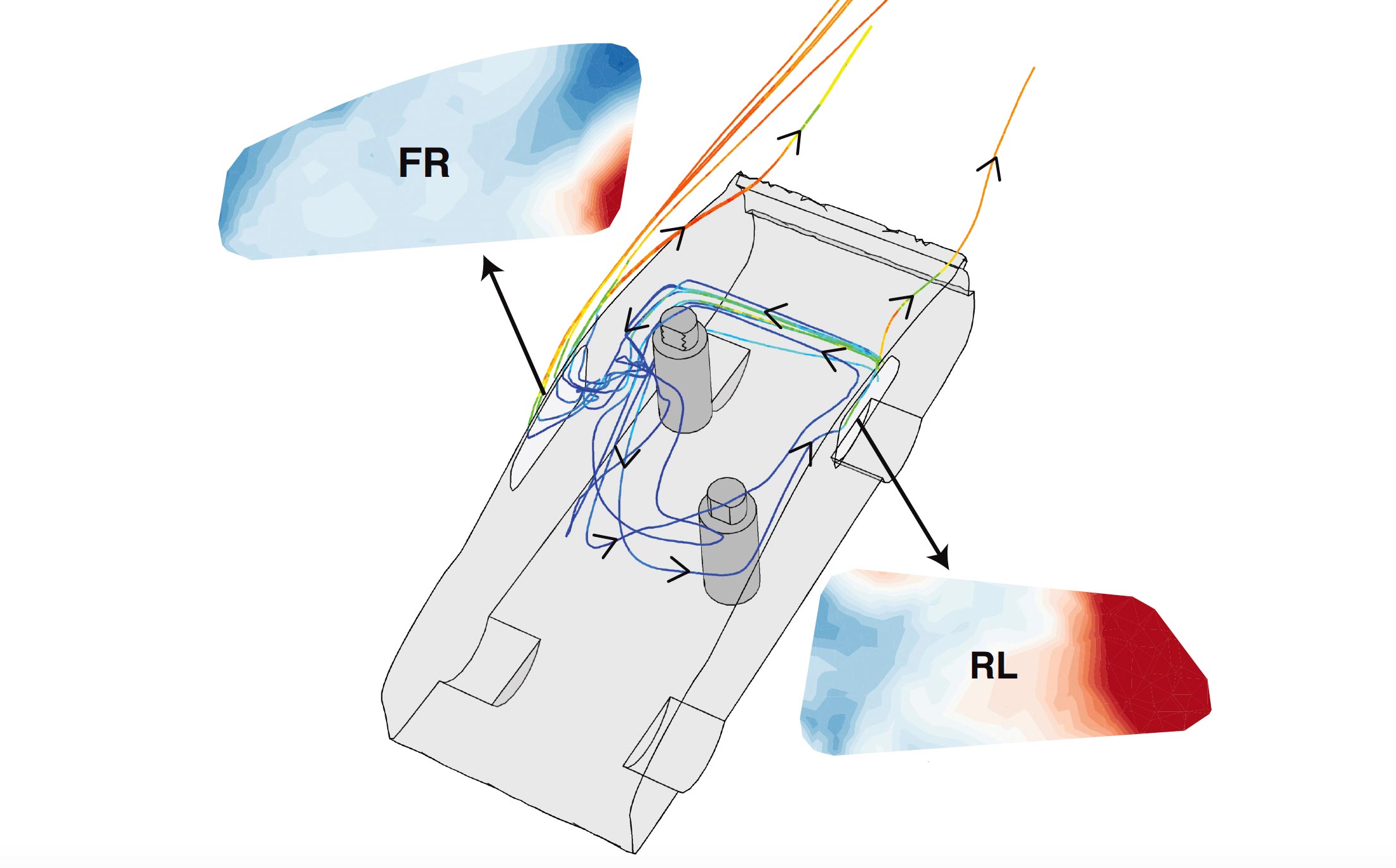
    A study published recently in Science Advances looks at how airflow patterns inside the passenger cabin of a car might affect the transmission of SARS-CoV-2 and other airborne pathogens. The simulations produced some potentially counterintuitive findings. For example, one might expect that opening windows directly beside each occupant might be the simplest way to reduce exposure. The simulations found that while this configuration is better than no windows down at all, it carries a higher exposure risk compared to putting down the window opposite each occupant. “When the windows opposite the occupants are open, you get a flow that enters the car behind the driver, sweeps across the cabin behind the passenger, and then goes out the passenger-side front window,” said Kenny Breuer, a professor of engineering at Brown and a senior author of the research. “That pattern helps to reduce cross-contamination between the driver and passenger.” Credit: Breuer lab / Brown University

    Traveling with three open windows fared better than only two open windows, but the researchers found that choosing which window to close may in fact matter a great deal. In scenarios that simulated either an infected driver or an infected passenger, closing only the window closest to the non-infected person conferred the greatest protection, second only to the scenario with all four windows open.

    Mathai et al. note that their simulations, based on an idealized model sedan patterned after the body shape of a Toyota Prius, may not accurately reflect airflow dynamics in other vehicles such as trucks, minivans, and cars with an open sunroof. They also note that their models may also miss some other nuances of airflow and particle residence times that may result from, for example, strong crosswinds or otherwise exceptionally windy conditions.

    All the same, the authors conclude that “these results will have a strong bearing on infection mitigation measures for the hundreds of millions of people driving in passenger cars and taxis worldwide, and potentially yield to safer and lower-risk approaches to personal transportation.”

    For more on this study, read How Airflow Inside a Car May Affect COVID-19 Transmission Risk.

    Reference: “Airflows inside passenger cars and implications for airborne disease transmission” by Varghese Mathai, Asimanshu Das, Jeffrey A. Bailey and Kenneth Breuer, 4 December 2020, Science Advances.
    DOI: 10.1126/sciadv.abe0166

    Never miss a breakthrough: Join the SciTechDaily newsletter.
    Follow us on Google and Google News.

    American Association for the Advancement of Science COVID-19 Infectious Diseases Public Health Transportation
    Share. Facebook Twitter Pinterest LinkedIn Email Reddit

    Related Articles

    Advantages of Intranasal COVID-19 Vaccinations Over Injections

    New Research Examines COVID-19 Spread on School Buses

    COVID Variant P.1 Is More Transmissible and More Lethal

    COVID-19: An Analysis of Coronavirus Mutations in More Than 1,000 People

    Portable Saliva-Based Smartphone Platform Could Rapidly Expand COVID-19 Testing

    How Airflow Inside a Car May Affect COVID-19 Transmission Risk – What Works Best for Windows and Ventilation

    COVID Virus Transmission From Human to Mink, As Well as From Mink to Human Revealed by Whole Genome Sequencing

    Long-Lived Antibodies Detected in Both Blood and Saliva of Patients With COVID-19

    FDA Approved Drug May Help Calm Cytokine Storm in COVID-19

    2 Comments

    1. kamir bouchareb st on December 14, 2020 12:12 am

      very good thanks

      Reply
    2. kamir bouchareb st on December 14, 2020 2:41 am

      very good

      Reply
    Leave A Reply Cancel Reply

    • Facebook
    • Twitter
    • Pinterest
    • YouTube

    Don't Miss a Discovery

    Subscribe for the Latest in Science & Tech!

    Trending News

    Popular Sugar-Free Sweetener Linked to Liver Disease, Study Warns

    What Is Hantavirus? The Deadly Disease Raising Alarm Worldwide

    Scientists Just Discovered How the Universe Builds Monster Black Holes

    Scientists Unveil New Treatment Strategy That Could Outsmart Cancer

    A Simple Vitamin May Hold the Key to Treating Rare Genetic Diseases

    Scientists Think the Real Fountain of Youth May Be Hiding in Your Gut

    Ravens Don’t Follow Wolves, They Predict Them

    This Common Knee Surgery May Be Doing More Harm Than Good

    Follow SciTechDaily
    • Facebook
    • Twitter
    • YouTube
    • Pinterest
    • Newsletter
    • RSS
    SciTech News
    • Biology News
    • Chemistry News
    • Earth News
    • Health News
    • Physics News
    • Science News
    • Space News
    • Technology News
    Recent Posts
    • Popular Supplement Ingredient Linked to Shorter Lifespan in Men
    • Scientists May Have Found a Way To Repair Nerve Damage in Multiple Sclerosis
    • GLP-1 Weight Loss Linked To Dramatically Lower Risk of Sleep Apnea, Kidney Disease and More
    • Scientists Uncover the Surprising Source of Strange Clouds Near the Milky Way’s Supermassive Black Hole
    • This Dazzling Green Snake Was Hiding in Plain Sight for Decades
    Copyright © 1998 - 2026 SciTechDaily. All Rights Reserved.
    • Science News
    • About
    • Contact
    • Editorial Board
    • Privacy Policy
    • Terms of Use

    Type above and press Enter to search. Press Esc to cancel.