
Close Menu
    Facebook X (Twitter) Instagram
    SciTechDaily
    • Biology
    • Chemistry
    • Earth
    • Health
    • Physics
    • Science
    • Space
    • Technology
    Facebook X (Twitter) Pinterest YouTube RSS
    SciTechDaily
    Home»Health»See How Strategic Air Purifier Placement Reduces COVID Virus Spread Within Music Classrooms
    Health

    See How Strategic Air Purifier Placement Reduces COVID Virus Spread Within Music Classrooms

    By American Institute of PhysicsMarch 9, 2021No Comments4 Mins Read
    Facebook Twitter Pinterest Telegram LinkedIn WhatsApp Email Reddit
    Share
    Facebook Twitter LinkedIn Pinterest Telegram Email Reddit
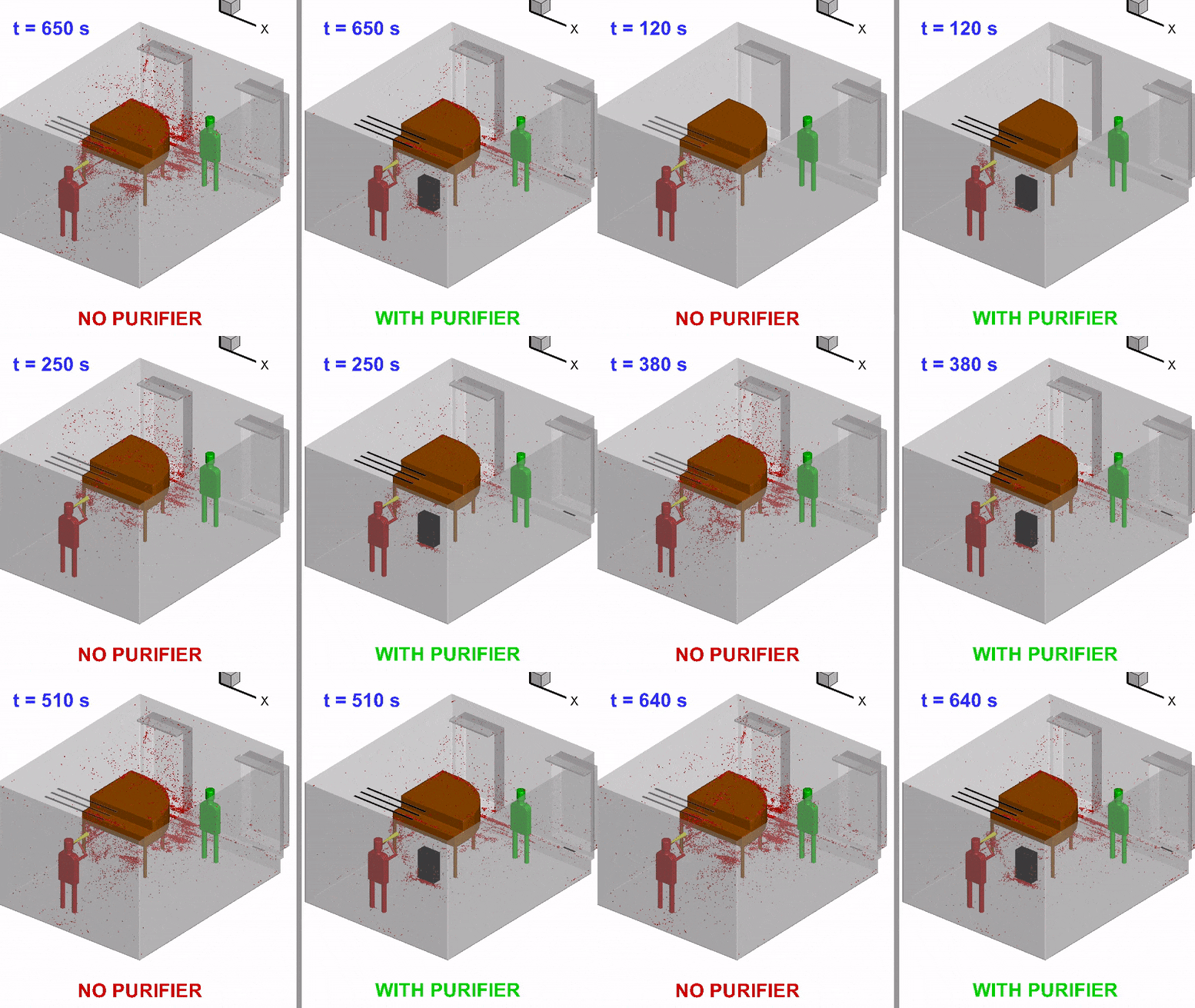
    Virus Aerosols Spread Throughout Music Classroom
    Aerosol simulations depict the spread of SARS-CoV-2 particles in a music classroom and highlight the effectiveness of portable HEPA air purifiers in reducing their dispersion.

    Correct HEPA purifier use cuts airborne COVID risks in music classrooms.

    Aerosol simulations show how airborne particles containing SARS-CoV-2 spread within a music classroom and how to use portable HEPA air purifiers to reduce their spread.

    The University of Minnesota School of Music was concerned about one-on-one teaching during the COVID-19 pandemic and wondered if it should supplement its ventilation system with portable HEPA air purifiers.

    So, school officials reached out to Suo Yang, a professor at the College of Science and Engineering, and his team to figure it out. In Physics of Fluids, from AIP Publishing, Yang and the researchers describe their work to predict how virus particles spread within a music classroom.

    “The airborne transmission of COVID-19 through droplets or droplet nuclei can be modeled as a typical particle-laden flow, and simulation work needs to accurately capture the movement of particles within the turbulent flow environment,” said Yang. “Particle deposition onto the walls and other surfaces also needs to be captured accurately, and we wanted to explore whether particles are trapped in some recirculation zones, ventilated out, or removed by an air purifier.”

    HEPA Purifier Placement Is Key to Effectiveness

    Their simulations suggest that a HEPA air purifier should be placed directly in front of the person or instrument expelling aerosols and located away from other people who are to be protected within the room.


    The spread of virus aerosols throughout a music classroom, with one student and one faculty member, shown with and without a portable air purifier. Credit: Sai Ranjeet Narayanan and Suo Yang, University of Minnesota

    The researchers’ goal was a ventilation rate of 288 cubic meters per hour, per World Health Organization guidelines, for each person within the room. To their knowledge, this is the most comprehensive investigation of using HEPA air purifiers to combat COVID-19.

    “The key thing is that while portable purifiers can be very helpful, their placement is critical,” said Yang.

    Misplaced Purifiers Can Worsen Aerosol Dispersion

    It is absolutely critical to not spread aerosols further by inducing a very dispersive flow, according to Sai Ranjeet Narayanan, a graduate research assistant working with Yang.

    One big surprise for the researchers was that portable HEPA air purifiers reduce in-air aerosols so much faster than just ventilation — offering orders of magnitude higher aerosol removal compared to not using a purifier.

    Guidelines for Classroom Safety and Break Durations

    If the flow rate of the HVAC system is known, this work can serve as a guideline for the size and number of portable purifiers needed, as well as where to place them.
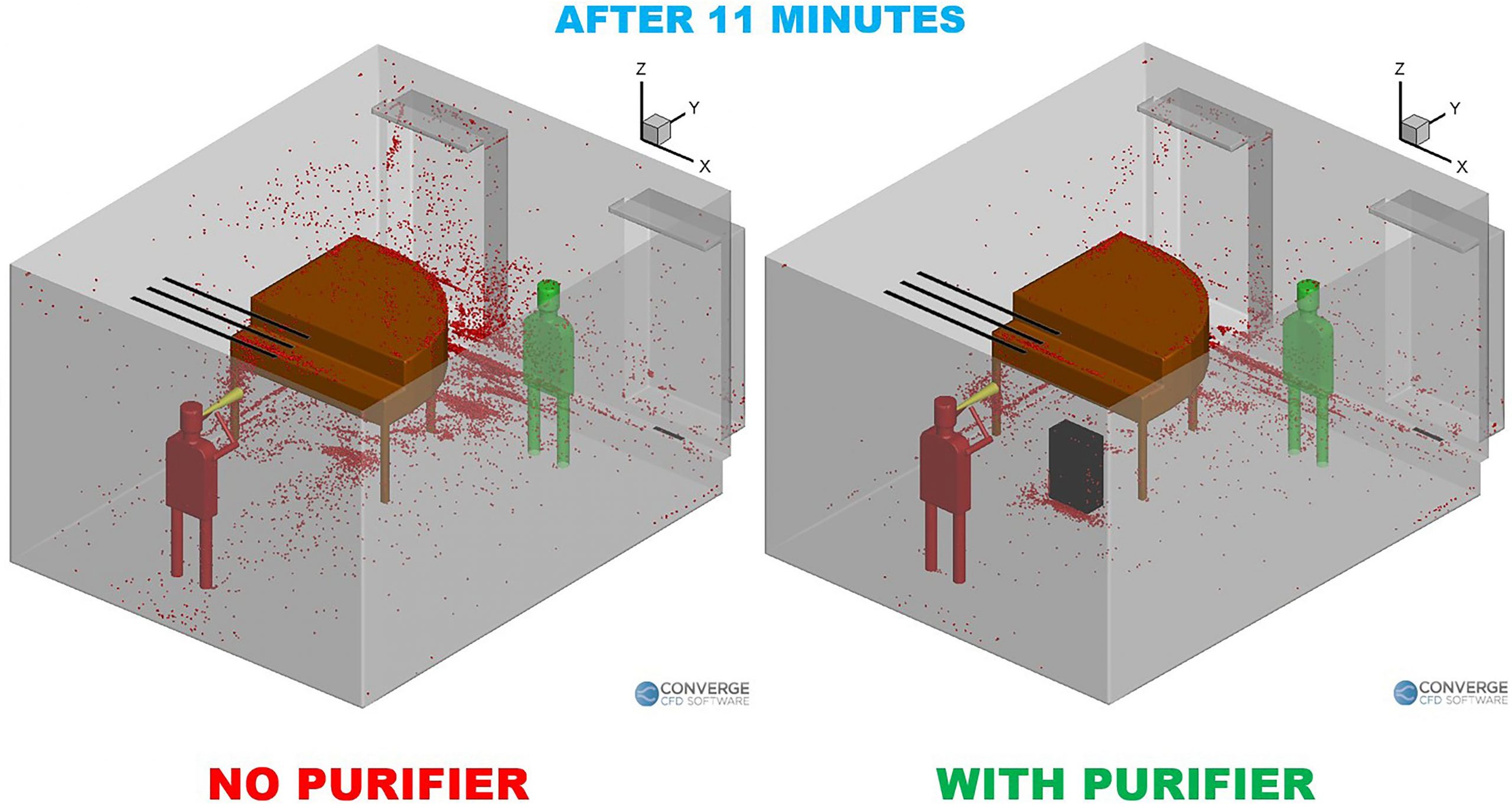
    Spread of Virus Aerosols Throughout a Music Classroom
    The spread of virus aerosols throughout a music classroom, with one student and one faculty member, shown with and without a portable air purifier. Credit: Sai Ranjeet Narayanan and Suo Yang, University of Minnesota

    “Our work also provides a guideline for how long of a break between classes is necessary to ensure the safety of the next class, which is about 25 minutes for this case,” said Yang.

    “And it provides an analytic function, found to be a linear function, to make predictions for the aerosol removal, deposition, or suspension rate in almost any scenario: breathing, speaking, singing, coughing, sneezing, different wind instruments, with and without masks.”

    In the future, “we plan to model larger domains with more people, such as bands, orchestras, or any group gathering,” Narayanan said. “And we may also compare the performance of different types of purifiers.”

    Reference: “Airborne transmission of virus-laden aerosols inside a music classroom: Effects of portable purifiers and aerosol injection rates” by Sai Ranjeet Narayanan and Suo Yang, 9 March 2021, Physics of Fluids.
    DOI: 10.1063/5.0042474

    Never miss a breakthrough: Join the SciTechDaily newsletter.
    Follow us on Google and Google News.

    American Institute of Physics Biophysics COVID-19 Fluid Dynamics Fluid Mechanics Infectious Diseases
    Share. Facebook Twitter Pinterest LinkedIn Email Reddit

    Related Articles

    Researchers Find Leakage of Airborne Droplets Escaping From COVID Masks – Even When Just Breathing

    Simply Talking While Infected Can Spread COVID-19 – Even While Wearing Masks

    Some Masks Can Be Worse Than Not Wearing One at All: Physics of How Masks Affect Airflow and COVID-19 Protection

    Social Distancing Isn’t Enough to Prevent Infection – How to Detect COVID-19 Super-Spreaders

    Contagion Transmission Model: Estimating Risk of Airborne COVID-19 With Mask Usage, Social Distancing

    Aerosol Microdroplets Not Very Effective at Spreading the COVID-19 Virus

    The Latest Science on How to Keep COVID-19 Out of School Classrooms

    Scientists Compare How COVID-19 Cough Clouds Travel With and Without Face Masks

    Evaporation Critical to Coronavirus Transmission As Weather Changes: Effects of Humidity, Temperature, and Wind on COVID-19

    Leave A Reply Cancel Reply

    • Facebook
    • Twitter
    • Pinterest
    • YouTube

    Don't Miss a Discovery

    Subscribe for the Latest in Science & Tech!

    Trending News

    Artificial Sweeteners May Harm Future Generations, Study Suggests

    Splashdown! NASA Artemis II Returns From Record-Breaking Moon Mission

    What If Consciousness Exists Beyond Your Brain

    Scientists Finally Crack the 100-Million-Year Evolutionary Mystery of Squid and Cuttlefish

    Beyond “Safe Levels”: Study Challenges What We Know About Pesticides and Cancer

    Researchers Have Found a Dietary Compound That Increases Longevity

    Scientists Baffled by Bizarre “Living Fossil” From 275 Million Years Ago

    Your IQ at 23 Could Predict Your Wealth at 27, Study Finds

    Follow SciTechDaily
    • Facebook
    • Twitter
    • YouTube
    • Pinterest
    • Newsletter
    • RSS
    SciTech News
    • Biology News
    • Chemistry News
    • Earth News
    • Health News
    • Physics News
    • Science News
    • Space News
    • Technology News
    Recent Posts
    • What if Dark Matter Has Two Forms? Bold New Hypothesis Could Explain a Cosmic Mystery
    • Researchers Expose Hidden Chemistry of “Ore-Forming” Elements in Biology
    • Geologists Reveal the Americas Collided Earlier Than We Thought
    • 20x Difference: Study Reveals True Source of Airborne Microplastics
    • Scientists Uncover Hidden Force Powering Yellowstone’s Supervolcano
    Copyright © 1998 - 2026 SciTechDaily. All Rights Reserved.
    • Science News
    • About
    • Contact
    • Editorial Board
    • Privacy Policy
    • Terms of Use

    Type above and press Enter to search. Press Esc to cancel.