
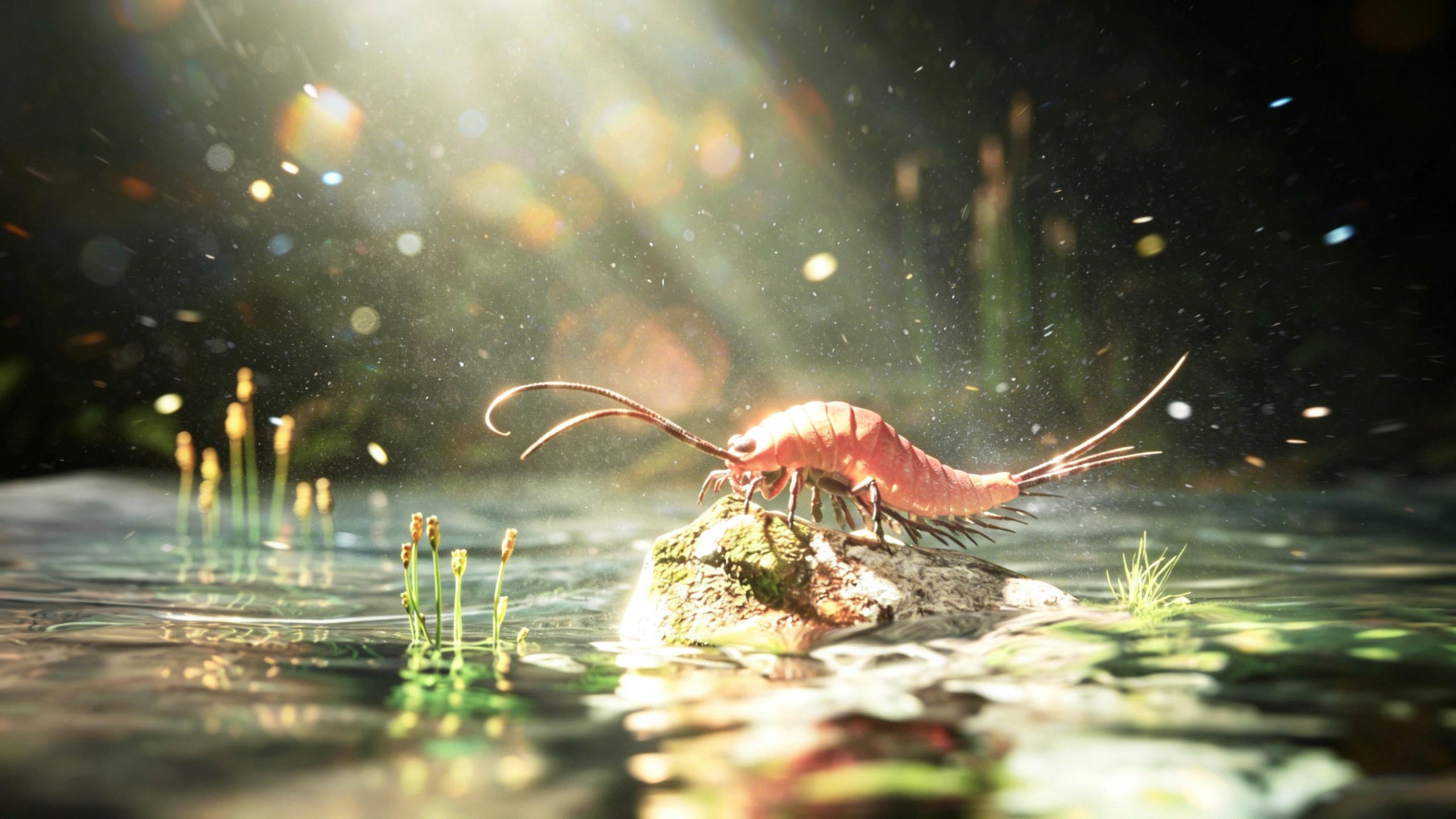
Before insects ruled the skies and reshaped life on land, some of their ancestors may have paddled through shallow coastal water on rows of abdominal limbs.
Today, insects occupy nearly every terrestrial environment and account for more described species than any other animal group. Their rise helped transform early land ecosystems by moving nutrients, breaking down organic matter, and eventually forming complex relationships with plants. Yet the origins of this extraordinary success have remained difficult to trace because the earliest stages of insect evolution are poorly represented in the fossil record.
A newly identified species from western Texas now offers a rare view of that missing history. Named Chosha praecursor, the animal lived about 324 million years ago during the Late Mississippian and combined the defining anatomy of an insect with paddle-shaped abdominal limbs suited to life in water.
Rather than showing a creature that had completed the move onto land, the fossils point to a prolonged amphibious stage. Early insects appear to have retained, modified, and gradually discarded structures inherited from aquatic ancestors as they adapted to humid environments between water and land.
A Rare Fossil Rewrites Insect Origins
The study was led by Chenyang Cai of the Nanjing Institute of Geology and Paleontology of the Chinese Academy of Sciences (NIGPAS) and Erik Tihelka, a jointly trained Ph.D. student at the University of Cambridge. The international team also included researchers from the United States, Spain, and other countries. Its findings were published in Nature.
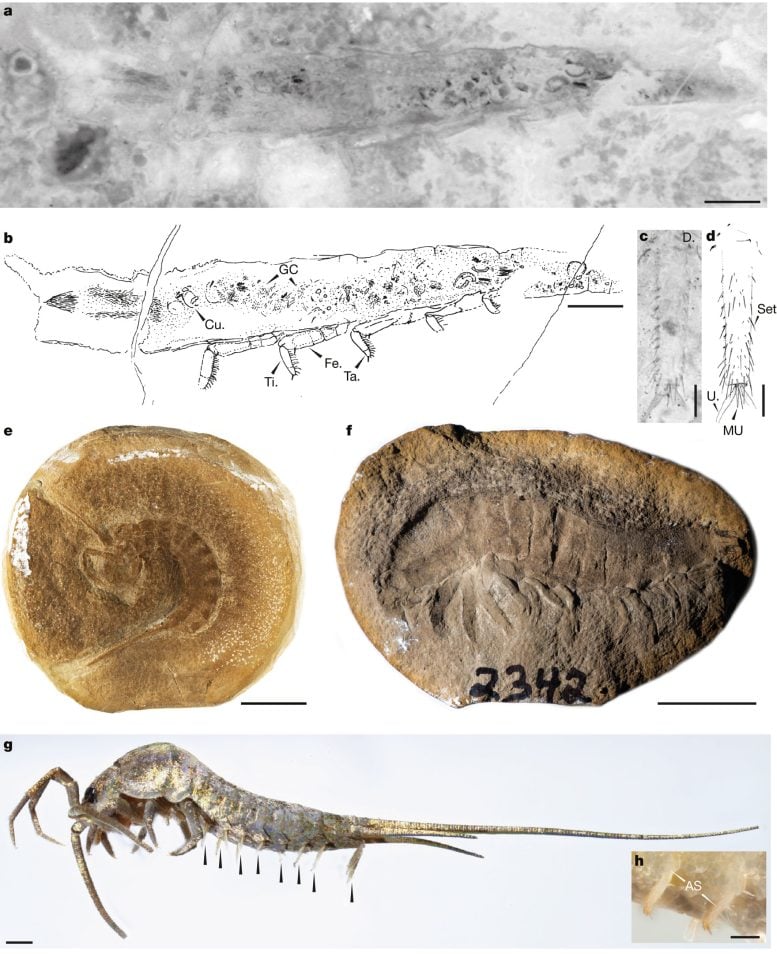
The researchers did more than describe C. praecursor. They compared it with enigmatic hexapod material from Britain’s Early Devonian chert deposits and the Late Carboniferous Mazon Creek biota in the United States. This broader analysis allowed them to recognize a primitive stem insect lineage that had previously gone undetected.
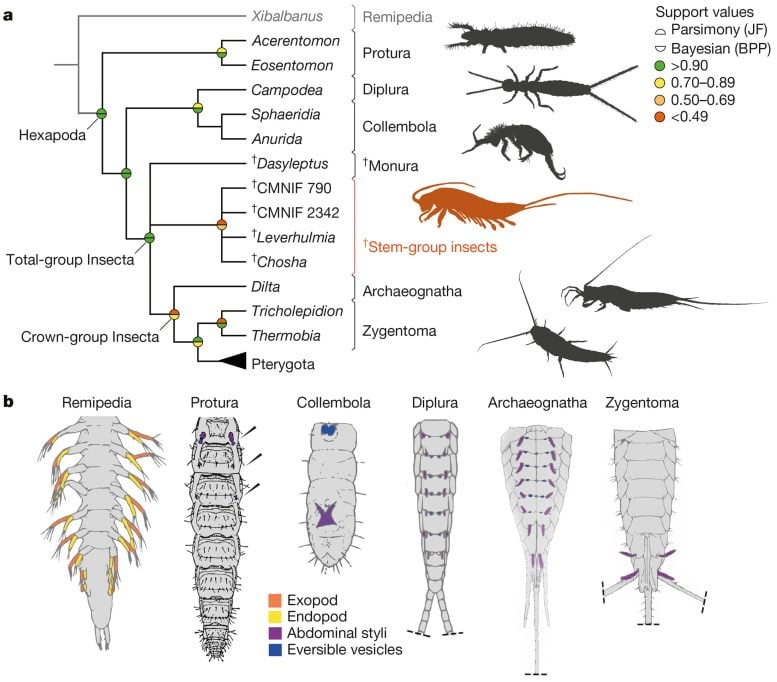
Stem insects are not members of the modern insect group, but they are more closely related to living insects than to other animals. Fossils from this part of the evolutionary tree can preserve combinations of ancestral and advanced traits that later disappeared, making them especially valuable for reconstructing how the familiar insect body evolved.
The 80 Million Year Fossil Gap
Genetic estimates suggest that hexapods separated from their marine crustacean relatives and began adapting to land during the Cambrian–Ordovician interval. The oldest undisputed hexapod body fossils, however, come from Scotland’s Rhynie Chert and date to about 405 million years ago. Unambiguous insects do not become abundant until the Late Carboniferous, leaving roughly 80 million years of their early history sparsely documented.
That gap has made it difficult to determine when insects acquired their six-legged body plan, lost the swimming limbs of their ancestors, and became fully terrestrial. It has also created a mismatch between molecular clock estimates, which place insect origins relatively early, and a fossil record in which recognizable insects appear much later.
By identifying Leverhulmia from Early Devonian Scotland, an unnamed hexapod from Mazon Creek in Illinois, USA, and C. praecursor as members of the same primitive stem lineage, the researchers extended early insect diversification back into the Early Devonian. Together, the fossils form the oldest documented insect assemblage and help bring the physical fossil record closer to genetic estimates.
An Insect Built for Water and Land
The C. praecursor specimens were found inside calcareous claystone concretions in the Tesnus Formation of the Marathon Uplift in western Texas. Such concretions can form around buried organisms and protect delicate structures from compression and decay, helping explain the fossils’ unusually detailed preservation.
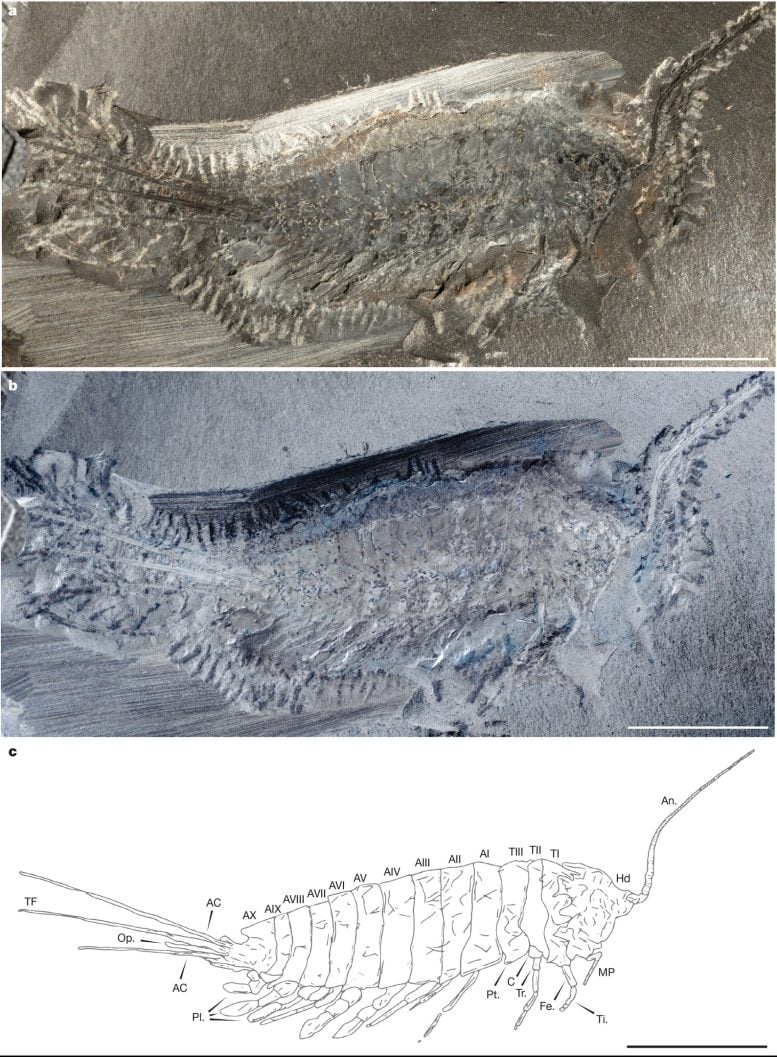
Using cross-polarized light imaging, the researchers examined anatomical features that had previously been overlooked. The specimens had long been interpreted as crustacean larvae, but the new analysis showed that they were adult female stick insects.
Their bodies measured 32.09 millimeters (1.26 inches) long. Including a median tail filament and two cerci, the animals reached 49.66 millimeters (1.96 inches). They had a segmented trunk, six walking legs, an ovipositor, and a terminal tail filament, combining features associated with insects and hexapods with more ancient characteristics.
The most revealing structures appeared on the abdomen. Segments 1 through 9 carried jointed appendages, and those toward the rear formed broad, paddle-shaped limbs. No living crown insect retains comparable abdominal appendages, although some aquatic insect larvae possess entirely different structures that assist with swimming or respiration.
Life Along a Paleozoic Coast
Geological evidence shows that C. praecursor lived in a shallow delta near an ancient coastline. Its paddles would have been useful in water, while its six thoracic legs and increasingly insectlike body could have supported movement through wet shoreline habitats. The animal was therefore not simply aquatic or terrestrial but adapted to an ecological boundary between the two.
This amphibious lifestyle offers a plausible intermediate stage in insect terrestrialization. Instead of abandoning the water in one rapid transition, early insects may have spent millions of years exploiting marshes, deltas, damp soils, and other humid settings where aquatic and terrestrial adaptations remained useful at the same time.
These animals probably consumed humus, decaying vegetation, and fungal spores. By feeding on organic debris, they would have acted as consumers and decomposers, returning nutrients to environments that were still developing into complex terrestrial ecosystems.
How Insects Lost Their Extra Limbs
Modern hexapods have six walking legs, all attached to the thorax, while the abdomen has lost nearly all of the limb structures present in their crustacean relatives. The Texas fossils indicate that this streamlined arrangement developed gradually. Early stem insects could retain a full series of segmented abdominal appendages even after acquiring other recognizable insect traits.
As insect ancestors relied less on swimming, their abdominal limbs were progressively reduced. Losing these appendages may have made movement on land more efficient and freed abdominal segments to take on other functions. The result was the sharply divided insect body seen today, with the thorax specialized for locomotion and the abdomen largely dedicated to digestion, reproduction, and other internal processes.
The preserved ovipositor adds another important piece to the story. C. praecursor shows that specialized egg-laying structures had already appeared in early insects. The ability to place eggs in protected or resource-rich locations may later have helped insects colonize a wide range of terrestrial microhabitats and contributed to their enormous diversification.
An Amphibious Route to Insect Success
The fossils challenge the idea that insect terrestrialization was a straightforward move from sea to land. Aquatic structures remained useful long after the basic insect body had emerged, then changed or disappeared as these animals became increasingly independent of water.
This gradual transition also helps explain how insects could participate in terrestrial ecosystems before becoming fully terrestrial themselves. Living along the margins of ponds, deltas, and coastlines would have allowed early insects to process organic material from both environments while adapting to new food sources and ecological opportunities.
Reference: “Amphibious stem-insect sheds light on colonization of land” by Erik Tihelka, Carlos Vásquez, Michael S. Engel, Frederick R. Schram, Jesus Lozano-Fernandez and Chenyang Cai, 26 August 2026, Nature.
DOI: 10.1038/s41586-026-10961-2
Never miss a breakthrough: Join the SciTechDaily newsletter.
Follow us on Google and Google News.