
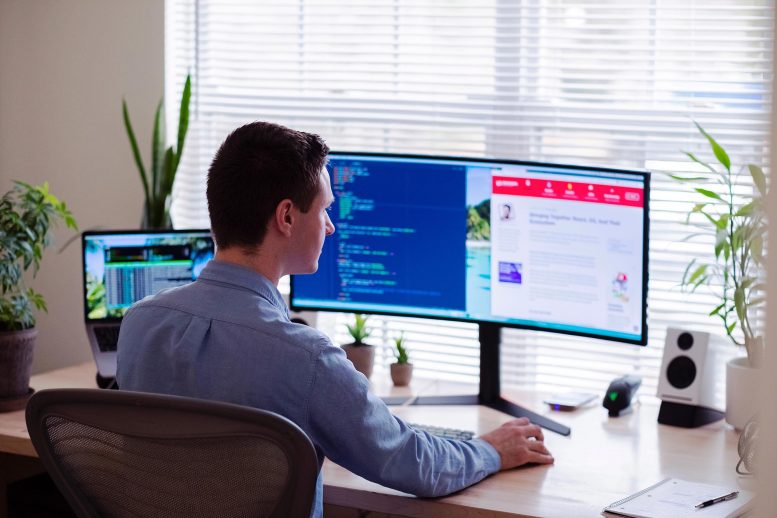
Yes, there are benefits to working from the home office; but there are traps, too.
Working at home has given many people the opportunity to arrange their working hours more freely than usual. But has it really given us more freedom?
It may seem a bit contradictory at first glance, but increased flexibility in our workday may have given us less flexibility in the work itself.
Benefits highlighted
The daily press and the nascent research literature on COVID-19 speculate on the long-term consequences of the coronavirus situation. These could change the way we think about the methods we employ in our working life, especially with regard to home offices and digital collaboration.

Several large companies, both internationally and nationally, have announced that they plan to continue the option of working from home for anyone who also wishes after the pandemic. The arguments for this include:
- Greater flexibility in organizing work and family life situations seems to significantly reduce stress for many people.
- Time that was previously used for commuting or traveling between meetings can now be used for other things, which in turn may lead to higher productivity.
- One argument we hear is that a home office situation provides fewer distractions and can make us more efficient.
- Employers, for their part, see an opportunity for reduced travel costs and less need for office space.
Working from home is also happening in academia, and several universities have said that the home office option will continue.
On the other hand, it has been pointed out that people cannot work exclusively in physically separate environments. We need opportunities to meet with colleagues and experience the social cohesion and replenishment this provides.
Practices are changing
The consequences of this kind of distributed work situation for workplace practices constitute an important aspect that has received less attention so far. How does working from home affect collaborative efforts and the quality of work, both in smaller teams and in larger work communities?
In the article “Learning of academics in the time of the Coronavirus pandemic,” we describe how one academic’s practices changed, quite significantly, under the conditions we have worked under since March.
While working from a home office, or as a distributed team, provides significantly increased flexibility for the work situation, it could provide less flexibility in carrying out the work, both in terms of meeting colleagues, collaborating, and teaching.
One of our conclusions is that we cannot expect work practices to remain the same when we move them. As conditions change around practices, so do the practices themselves.
Not everyone becomes more efficient
In two parallel projects, we collected data from students and academic staff. We focused on their work and study situations during the corona pandemic.
The data includes 1600 students and 16 lecturers in a course called Experts in Teamwork. Students provided feedback through questionnaires, written exam reports, and in-depth interviews. The lecturers represented different faculties and departments and were also interviewed in depth.

The preliminary findings show great variations in the consequences that the new work and study situations have had for individuals and for groups.
- Some groups became more effective, others less.
- Some people became more efficient in their new work setting, for example, because they had fewer distractions and work became easier to prioritize. But others became less efficient, for example, due to lower motivation and lack of daily structure.
- Some individuals thought it was beneficial to have more peace and flexibility in their daily life, while others felt lonelier and less motivated due to the lack of social and physical contact with fellow students and colleagues.
A number of the academic staff also had a much busier schedule due to home schooling their children. This factor is less relevant in a situation without a pandemic.
In our study, we also found many of the positive elements of distributed teamwork and working digitally that are mentioned at the beginning of our article.
The paradox: increased flexibilty and less freedom
However, one finding stands out as a paradox.
While working from a home office, or as a distributed team, provides significantly increased flexibility for the work situation, it could provide less flexibility in carrying out the work, both in terms of meeting colleagues, collaborating, and teaching.
This flexibility issue, or paradox, is largely related to a much greater need for structure, planning, and clear communication in the digital modality. Meetings and teaching need to be planned in much more detail, and the digital form makes it difficult to deviate from the plan.
We lose the ability to pick up cues from the room, like we do when we are in a physical space together. Several communication-related aspects of working digitally also make it difficult to achieve a good flow, as well as to make spontaneous and necessary changes.
Higher threshold makes teamwork less flexible
We also find that the threshold for making small and necessary clarifications with collaborators is significantly higher in the digital realm. The flexibility to complete a task is therefore reduced and can affect the quality of what we do.
For example, we risk working alone with a task for too long, assuming rather than clarifying along the way. We don’t want to disturb people, and we don’t know what they are doing right now. We found this to be the case both for students who worked synchronously, and for academics who mostly worked asynchronously.
Home offices may offer benefits for many, but it is hardly advantageous for everyone. More people will probably choose to work from home more than they did before, even when the pandemic has subsided. But having the opportunity to convene physically is still important, not only for each of us to meet our social needs, but also for the employer and for the quality of the work.
Reference: “Learning of academics in the time of the Coronavirus pandemic” by Ela Sjølie, Susanne Francisco, Kathleen Mahon, Mervi Kaukko and Stephen Kemmis, 10 July 2020, Journal of Praxis in Higher Education, Vol. 2 No. 1 (2020).
DOI: 10.47989/kpdc61
PDF
Never miss a breakthrough: Join the SciTechDaily newsletter.
Follow us on Google and Google News.