
Close Menu
    Facebook X (Twitter) Instagram
    SciTechDaily
    • Biology
    • Chemistry
    • Earth
    • Health
    • Physics
    • Science
    • Space
    • Technology
    Facebook X (Twitter) Pinterest YouTube RSS
    SciTechDaily
    Home»Physics»Using the Universe’s Coldest Material in a New Search for Dark Matter
    Physics

    Using the Universe’s Coldest Material in a New Search for Dark Matter

    By ICFO-The Institute of Photonic SciencesMay 2, 2020No Comments3 Mins Read
    Facebook Twitter Pinterest Telegram LinkedIn WhatsApp Email Reddit
    Share
    Facebook Twitter LinkedIn Pinterest Telegram Email Reddit
    Bose-Einstein Condensate Comagnetometer
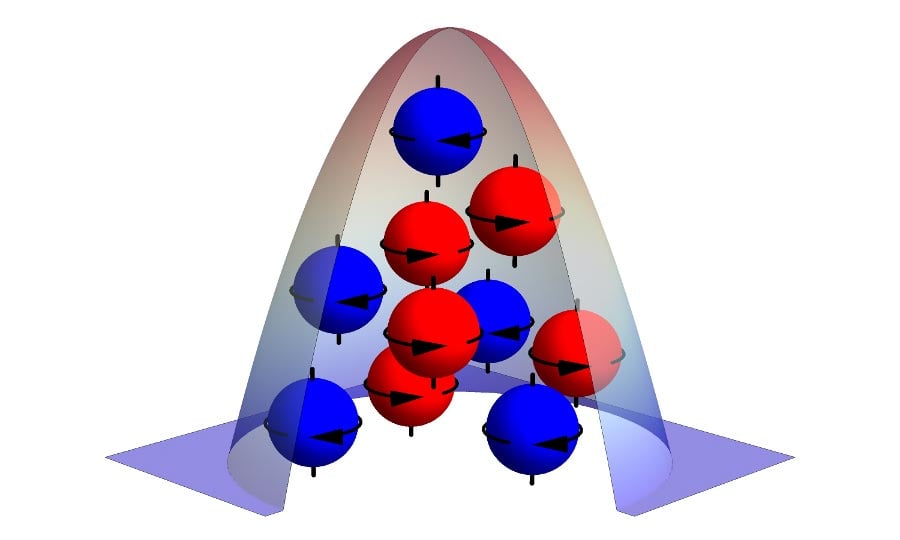
    Bose-Einstein condensate comagnetometer, formed by two distinct atomic internal states of 87Rb which are contained in the same spatial wavefunction. Credit: ICFO/ P. Gomez & M. Mitchell

    Scientists have been able to observe the universe and determine that about 80% of its mass appears to be “dark matter,” which exerts a gravitational pull but does not interact with light, and thus can’t be seen with telescopes. Our current understanding of cosmology and nuclear physics suggests that dark matter could be made of axions, hypothetical particles with unusual symmetry properties.

    In a new article published in Physical Review Letters and highlighted as an Editor’s suggestion, ICFO researchers Pau Gomez, Ferran Martin, Chiara Mazzinghi, Daniel Benedicto Orenes, and Silvana Palacios, led by ICREA Prof. at ICFO Morgan W. Mitchell, report on how to search for axions using the unique properties of Bose-Einstein condensates (BECs).

    The axion, if it exists, would imply “exotic spin-dependent forces.” Magnetism, the best-known spin-dependent force, causes electrons to point their spins along the magnetic field, like a compass needle that points north. Magnetism is carried by virtual photons, whereas “exotic” spin-dependent forces would be carried by virtual axions (or axion-like particles). These forces would act on both electrons and nuclei, and would be produced not just by magnets, but also by ordinary matter. To know if axions do exist, a good way is to look and see if nuclei prefer to point toward other matter.

    Several experiments are already searching for these forces, using “comagnetometers,” which are paired magnetic sensors in the same place. By comparing the two sensors’ signals, the effect of the ordinary magnetic field can be canceled out, leaving just the effect of the new force. So far, comagnetometers have only been able to look for spin-dependent forces that reach about a meter or more. To look for short-range spin-dependent forces, a smaller comagnetometer is needed.

    Bose Einstein Condensates (BECs) are gases cooled nearly to absolute zero. Because BECs are superfluid, their constituent atoms are free to rotate for several seconds without any friction, making them exceptionally sensitive to both magnetic fields and new exotic forces. A BEC is also very small, about 10 micrometers in size. To make a BEC comagnetometer, however, requires solving a tricky problem: how to put two BEC magnetometers in the same small volume.

    In their study, Gomez and his colleagues report that they were able to solve this problem by using two different internal states of the same 87Rb BEC, each one acting as a separate but co-located magnetometer. The results of the experiment confirm the predicted high immunity to noise from the ordinary magnetic field and the ability to look for exotic forces with much shorter ranges than in previous experiments. Besides looking for axions, the technique may also improve precision measurements of ultracold collision physics and studies of quantum correlations in BECs.

    Reference: “Bose-Einstein Condensate Comagnetometer” by Pau Gomez, Ferran Martin, Chiara Mazzinghi, Daniel Benedicto Orenes, Silvana Palacios and Morgan W. Mitchell, 29 April 2020, Physical Review Letters.
    DOI: 10.1103/PhysRevLett.124.170401

    Never miss a breakthrough: Join the SciTechDaily newsletter.
    Follow us on Google and Google News.

    Astrophysics Dark Matter ICFO Optics Popular
    Share. Facebook Twitter Pinterest LinkedIn Email Reddit

    Related Articles

    Kinetic Misalignment: Case for Axion Origin of Dark Matter Gains Traction

    Physicist’s 50-Year-Old Magnetic Structure Prediction Evidenced at Surprisingly Large Scales

    Quantum Entanglement of 15 Trillion Atoms at 450 Kelvin With “Surprising Results”

    First High Sensitivity Dark Matter Axion Hunting Results From CAPP-8TB Haloscope

    An Exotic Analysis Technique Places Another Piece in the Dark Matter Puzzle

    Physicists Present a New Theory on the Origin of Dark Matter

    Theoretical Physicists Suggest Dark Matter May Be Massive

    Physicists Propose Higgs Boson ‘Portal’ to Help Explain Dark Energy

    Search for Dark Matter Reveals First Hint of WIMP

    Leave A Reply Cancel Reply

    • Facebook
    • Twitter
    • Pinterest
    • YouTube

    Don't Miss a Discovery

    Subscribe for the Latest in Science & Tech!

    Trending News

    Largest-Ever Study Finds Medicinal Cannabis Ineffective for Anxiety, Depression, PTSD

    250-Million-Year-Old Egg Solves One of Evolution’s Biggest Mysteries

    Living With Roommates Might Be Changing Your Gut Microbiome Without You Knowing

    Century-Old Cleaning Chemical Linked to 500% Increased Risk of Parkinson’s Disease

    What if Your Memories Never Happened? Physicists Take a New Look at the Boltzmann Brain Paradox

    One of the Universe’s Largest Stars May Be Getting Ready To Explode

    Scientists Discover Enzyme That Could Supercharge Ozempic-Like Weight Loss Drugs

    Popular Sweetener Linked to DNA Damage – “It’s Something You Should Not Be Eating”

    Follow SciTechDaily
    • Facebook
    • Twitter
    • YouTube
    • Pinterest
    • Newsletter
    • RSS
    SciTech News
    • Biology News
    • Chemistry News
    • Earth News
    • Health News
    • Physics News
    • Science News
    • Space News
    • Technology News
    Recent Posts
    • A Simpler Path to Super-Resolution: Scientists Reinvent Microscopy
    • Scientists Uncover Hidden Genetic Cause of Diabetes in Babies
    • Amazonian Chocolate Could Become the Next Superfood, Scientists Say
    • Challenging the Narrative: New Study Shows U.S. Life Expectancy Is Rising Across All States
    • Mystery Illness Kills 5 in Burundi As Doctors Scramble for Answers
    Copyright © 1998 - 2026 SciTechDaily. All Rights Reserved.
    • Science News
    • About
    • Contact
    • Editorial Board
    • Privacy Policy
    • Terms of Use

    Type above and press Enter to search. Press Esc to cancel.