

Particles smaller than an atom hurtle through the universe nearly at the speed of light, blasted into space from something, somewhere, in the cosmos.
A scientific collaboration of the Pierre Auger Observatory, including researchers from the University of Delaware, has measured the most powerful of these particles — ultra-high-energy cosmic rays — with unprecedented precision. In doing so, they have found a “kink” in the energy spectrum that is shining more light on the possible origins of these subatomic space travelers.
The team’s findings are based on the analysis of 215,030 cosmic ray events with energies above 2.5 quintillion electron volts (eV), recorded over the past decade by the Pierre Auger Observatory in Argentina. It is the largest observatory in the world for studying cosmic rays.
The new spectral feature, a kink in the cosmic-ray energy spectrum at about 13 quintillion electron volts, represents more than points plotted on a graph. It brings humanity a step closer to solving the mysteries of the most energetic particles in nature, according to Frank Schroeder, assistant professor at the Bartol Research Institute in UD’s Department of Physics and Astronomy, who was involved in the study with the support of the University of Delaware Research Foundation. The research is published in Physical Review Letters and Physics Review D.

“Since cosmic rays were discovered 100 years ago, the longstanding question has been, what accelerates these particles?” Schroeder said. “The Pierre Auger Collaboration’s measurements provide important hints about what we can exclude as the source. From previous work, we know the accelerator is not in our galaxy. Through this latest analysis, we can further corroborate our earlier indications that ultra-high-energy cosmic rays are not just protons of hydrogen, but also a mix of nuclei from heavier elements, and this composition changes with energy.”
Between the “ankle” and the “toe”
Schroeder and UD postdoctoral researcher Alan Coleman, who contributed to the data analysis, have been members of the Pierre Auger Collaboration for several years. UD officially joined the collaboration as an institutional member in 2018. This team of more than 400 scientists from 17 countries operates the observatory, which occupies a 1,200-square-mile area, about the size of Rhode Island.

The observatory has more than 1,600 detectors called water-Cherenkov stations spread across the high plains of the Pampa Amarilla (Yellow Prairie), overlooked by 27 fluorescence telescopes. Collectively, these instruments measure the energy that an ultrahigh-energy cosmic ray particle releases in the atmosphere and provide an indirect evaluation of its mass. All of these data — energy, mass, and the direction from which these extraordinary particles arrived — yield important clues about their origins.
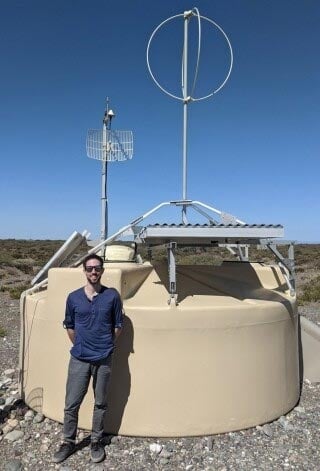
Previously, scientists thought these ultra-high-energy cosmic ray particles were mostly protons of hydrogen, but this latest analysis confirms that the particles have a mix of nuclei — some heavier than oxygen or helium, such as silicon and iron, for example.
Plotted on the curving graph representing the cosmic-ray energy spectrum, you can see the kink — a steep, flattened section — between the area referred to by scientists as “the ankle,” and the beginning point of the graph, called “the toe.”
“We don’t have a specific name for it,” said Coleman, who was on the 20-person team that wrote the computer code and did the number crunching required for the extensive data analysis. “I guess we are running out of parts of the anatomy to call it,” he said, joking.
Directly involved in the finding, Coleman improved reconstruction of the particle cascade, which cosmic-rays create when impinging the atmosphere, in order to estimate the energy. He also performed detailed studies to ensure that this new inflection point was real and not an artifact of the detector. The data group’s work took more than two years.
“Obviously, it’s pretty slight,” Coleman said of the spectral kink. “But every time you see a bump like this, that signals the physics is changing and that’s very exciting.”
It’s very hard to determine the mass of incoming cosmic rays, Coleman said. But the collaboration’s measurement is so robust and precise that a number of other theoretical models for where ultra-high-energy cosmic rays are coming from can now be eliminated, while other pathways can be pursued with more vigor.
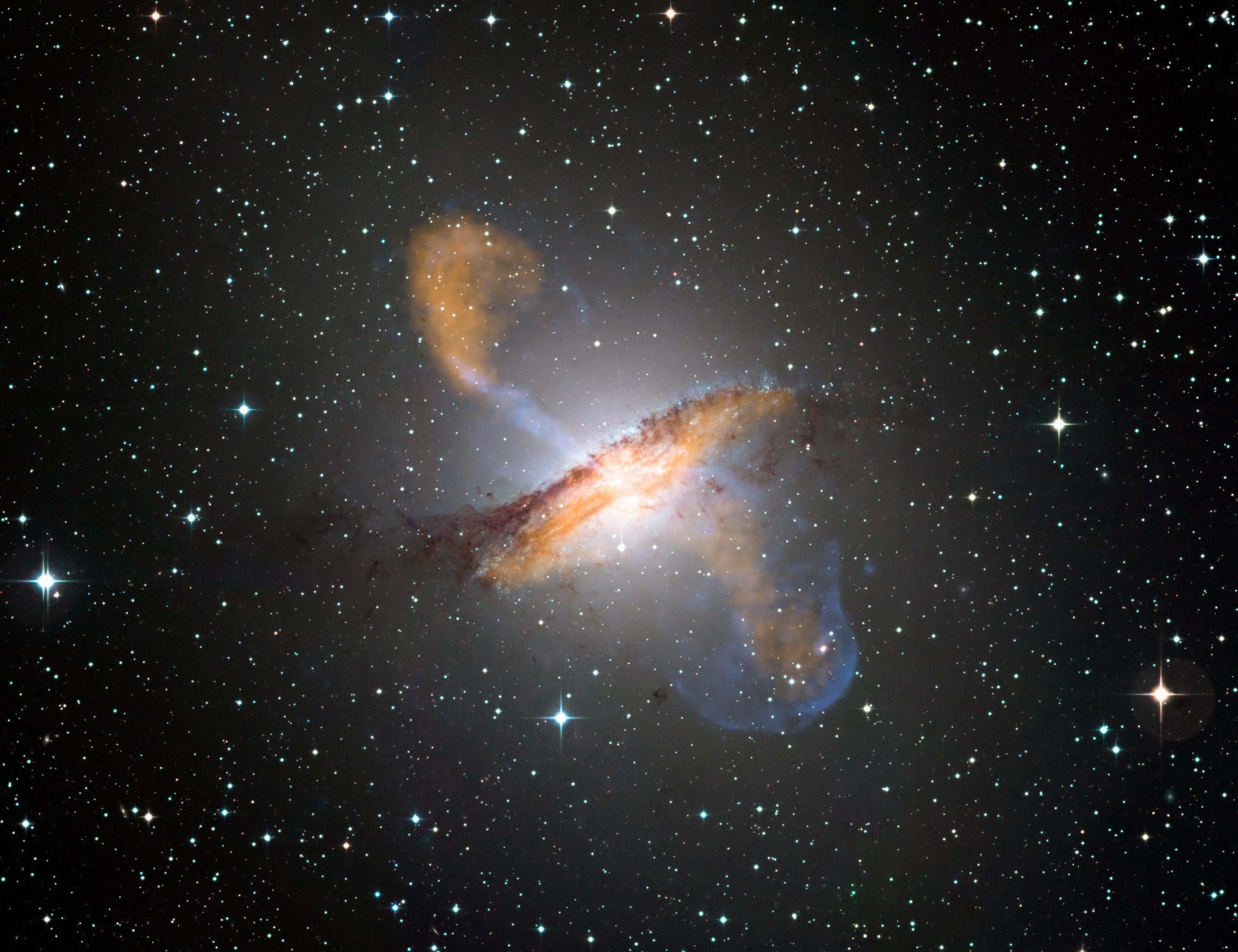
Active galactic nuclei (AGN) and starburst galaxies are now in the running as potential sources. While their typical distance is some 100 million light-years away, a few candidates are within 20 million light-years.
“If we learned what the sources were, we could look into new details about what is going on,” Coleman said. What’s happening that allows these incredibly high energies? These particles may be coming from something we don’t even know.”
Ongoing research by the UD team focuses on further increasing the measurement accuracy of ultra-high-energy cosmic rays and extending the precise measurement of the cosmic ray spectrum down to lower energies. That would create a better overlap with other experiments, Schroeder said, such as the cosmic ray measurements of IceCube at the South Pole — another unique astroparticle observatory with major involvement of the University of Delaware.
References:
“Features of the Energy Spectrum of Cosmic Rays above 2.5×10¹⁸ eV Using the Pierre Auger Observatory” by A. Aab et al. (The Pierre Auger Collaboration), 16 September 2020, Physical Review Letters.
DOI: 10.1103/PhysRevLett.125.121106
“Measurement of the cosmic-ray energy spectrum above 2.5×10¹⁸ eV using the Pierre Auger Observatory” by A. Aab et al. (The Pierre Auger Collaboration), 16 September 2020, Physics Review D.
DOI: 10.1103/PhysRevD.102.062005
Article by Tracey Bryant with additional material from Pierre Auger Collaboration.
Never miss a breakthrough: Join the SciTechDaily newsletter.
Follow us on Google and Google News.
3 Comments
And what if you could rely on biology as physics sensoring, using observable changes in living creatures – e.g. cells, bacteria, viruses, &c. and how they are affected by each single kind of radiation as sensors and monitors, where mere particles would not respond, for instance, in detecting WIMPs? It worked… on my planet.
Ah, so the interpretations of the “knee”, and now “second knee”, “ankle” and “toe”, are consecutively massier elements from hydrogen (protons) over helium, carbon, silicon and now latest iron. That empties out the usual fusion products – and the fluxes are orders of magnitude lower – so hopefully they have “nailed” it. Active galactic nuclei with supermassive black holes would be a likely suspect, tearing down mostly low mass main sequence stars and jetting out the result.
Great article. Title gave me whiplash for a second until I remembered that kink has different meanings.