
A tiny grain from asteroid Ryugu has revealed djerfisherite, a mineral that normally forms in scorching, oxygen-poor settings—conditions Ryugu was never thought to experience.
The surprise find hints that the asteroid either endured unexpected heat spikes or captured exotic material transported across the early Solar System. Microscopy and chemical clues now challenge the idea that Ryugu is compositionally uniform and point to a far more chaotic mixing of planetary building blocks. Scientists are turning to isotopic “fingerprints” to trace the grain’s true origin and decode how primitive asteroids really formed.
Hayabusa2 Brings Ryugu Samples & Surprising Mineral Clues
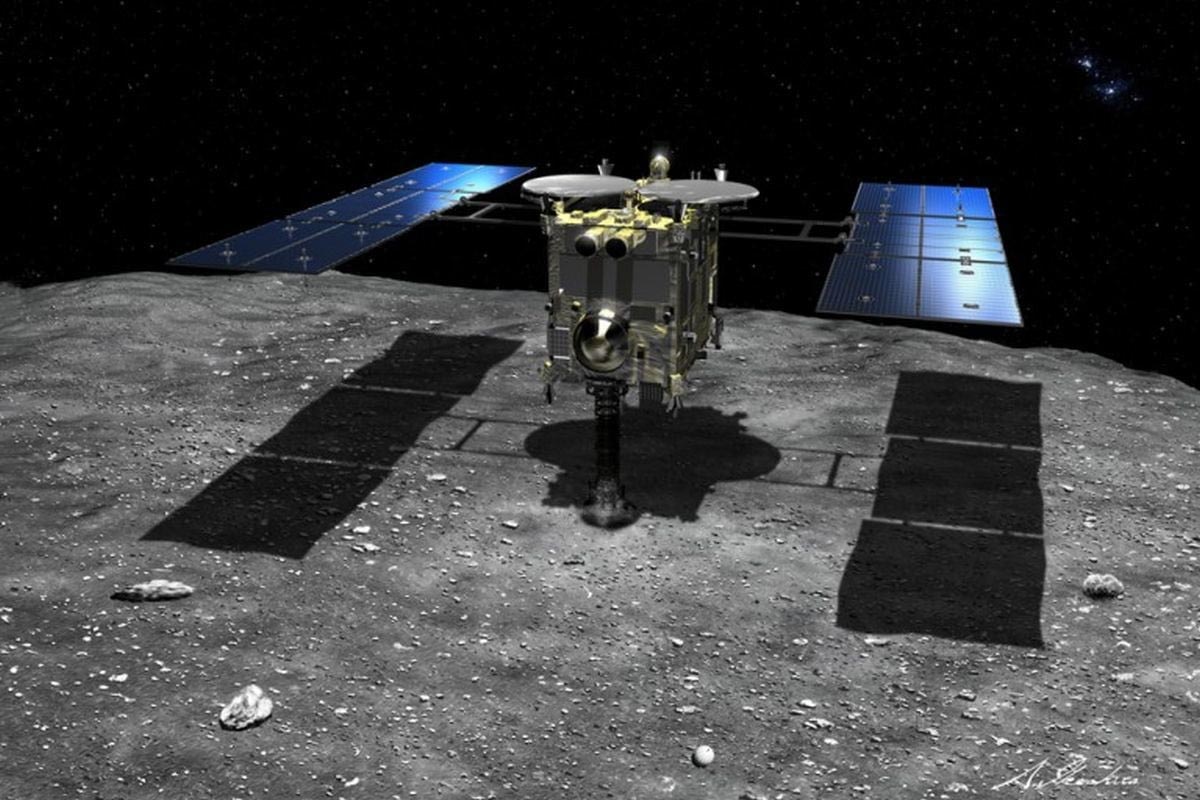
Pristine grains from asteroid Ryugu, delivered to Earth by Japan’s Hayabusa2 probe in December 2020, are turning planetary science on its head. Ryugu belongs to the carbon-rich “C-type” family of asteroids, and its rocks resemble rare CI chondrite meteorites that once soaked in water. These samples act like frozen time capsules from the dawn of the Solar System.
Now a team at Hiroshima University has spotted something no one expected: specks of the mineral djerfisherite—a potassium-bearing iron-nickel sulfide—inside one Ryugu grain. Djerfisherite normally forms in extremely oxygen-poor, high-temperature settings found deep inside other, very different meteorites. Discovering it in Ryugu is like finding a palm seed buried in Arctic ice. The study was published in the journal Meteoritics & Planetary Science.
“Djerfisherite is a mineral that typically forms in very reduced environments, like those found in enstatite chondrites, and has never been reported in CI chondrites or other Ryugu grains,” says first and corresponding author Masaaki Miyahara, associate professor at the Graduate School of Advanced Science and Engineering, Hiroshima University. “Its occurrence is like finding a tropical seed in Arctic ice—indicating either an unexpected local environment or long-distance transport in the early solar system.”

Microscopy Uncovers Djerfisherite and Questions Ryugu’s Uniformity
Miyahara’s team had been carrying out experiments to understand the effects of terrestrial weathering on Ryugu grains. While observing the grains by field-emission transmission electron microscopy (FE-TEM) for effects of weathering, they found djerfisherite in the number 15 grain of sample plate C0105-042.
“The discovery of djerfisherite in a Ryugu grain suggests that materials with very different formation histories may have mixed early in the solar system’s evolution, or that Ryugu experienced localized, chemically heterogeneous conditions not previously recognized. This finding challenges the notion that Ryugu is compositionally uniform and opens new questions about the complexity of primitive asteroids,” Miyahara elaborates.
Ryugu is a part of a larger parent body that formed between 1.8 to 2.9 million years after the beginning of the Solar System. This parent body is thought to have originated in the outer region of the solar system, where water and carbon dioxide existed in the form of ice. Inside the parent body, heat generated by the decay of radioactive elements caused the ice to melt around 3 million years after its formation. The temperature during this process is estimated to have remained below approximately 50℃.

High-Temperature Origins Debate & Next Steps for Ryugu Research
In contrast, the parent bodies of enstatite chondrites, which are known to contain djerfisherite, are believed to have formed in the inner region of the solar system. Thermodynamic calculations indicate that djerfisherite in enstatite chondrites formed directly from high-temperature gas. In addition, hydrothermal synthesis experiments have shown that djerfisherite can also form through reactions between potassium-bearing fluids and Fe-Ni sulfides at temperatures above 350 ℃.
This led the team to propose two hypotheses for its presence in the Ryugu grain: either it arrived from another source during the formation of Ryugu’s parent body; or, it was formed intrinsically when the temperature of Ryugu was raised to above 350 ℃.
Preliminary evidence indicates that the intrinsic formation hypothesis is more likely to be true. The next steps will be to conduct isotopic studies of this and other Ryugu grains, to determine their origins. “Ultimately, our goal is to reconstruct the early mixing processes and thermal histories that shaped small bodies like Ryugu, thereby improving our understanding of planetary formation and material transport in the early solar system,” Miyahara concludes.
Reference: “Djerfisherite in a Ryugu grain: A clue to localized heterogeneous conditions or material mixing in the early solar system” by Masaaki Miyahara, Takaaki Noguchi, Akira Yamaguchi, Toru Nakahashi, Yuto Takaki, Toru Matsumoto, Naotaka Tomioka, Akira Miyake, Yohei Igami and Yusuke Seto, 28 May 2025, Meteoritics & Planetary Science.
DOI: 10.1111/maps.14370
Never miss a breakthrough: Join the SciTechDaily newsletter.
Follow us on Google and Google News.