
Close Menu
    Facebook X (Twitter) Instagram
    SciTechDaily
    • Biology
    • Chemistry
    • Earth
    • Health
    • Physics
    • Science
    • Space
    • Technology
    Facebook X (Twitter) Pinterest YouTube RSS
    SciTechDaily
    Home»Space»Next Target Asteroid for Hayabusa2 Photographed by Subaru Telescope
    Space

    Next Target Asteroid for Hayabusa2 Photographed by Subaru Telescope

    By National Institutes of Natural SciencesDecember 19, 2020No Comments3 Mins Read
    Facebook Twitter Pinterest Telegram LinkedIn WhatsApp Email Reddit
    Share
    Facebook Twitter LinkedIn Pinterest Telegram Email Reddit
    Asteroid 1998 KY26
    The asteroid 1998 KY26 (the point of light located at where the two lines would cross) captured by Hyper Suprime-Cam mounted on the Subaru Telescope. The blurring of the background stars is due to the motion of the telescope tracking the asteroid. Five shots, each with a 2-minute exposure time, taken during 2:04-2:16 on December 10, 2020 (Hawai?i Standard Time) were stacked to create this image. The field of view is 30 x 15 arcseconds. Credit: NAOJ

    On December 10, 2020 (Hawaiʻi Standard Time), the Subaru Telescope imaged the small asteroid 1998 KY26, the target of Hayabusa2’s extended mission. The positional data for 1998 KY26 collected during the observations will be used to more accurately determine the orbital elements of this object.

    Operated by the Japan Aerospace Exploration Agency (JAXA), the asteroid explorer Hayabusa2 delivered a reentry capsule to Earth containing samples from the asteroid (162173) Ryugu on December 6 (Japan Standard Time). After this drop-off, Hayabusa2 set out again, this time for the extended mission utilizing its remaining fuel. In this extended mission, Hayabsa2 is supposed to approach and observe its next target, the small asteroid 1998 KY26.

    This asteroid is predicted to approach to within 0.47 AU of Earth in mid to late December 2020, giving us a rare opportunity that comes only once every three and a half years. However, the diameter of 1998 KY26 is estimated to be no more than 30 meters, and thus its brightness is so dim that ground-based observations of the asteroid are difficult without a very large telescope.
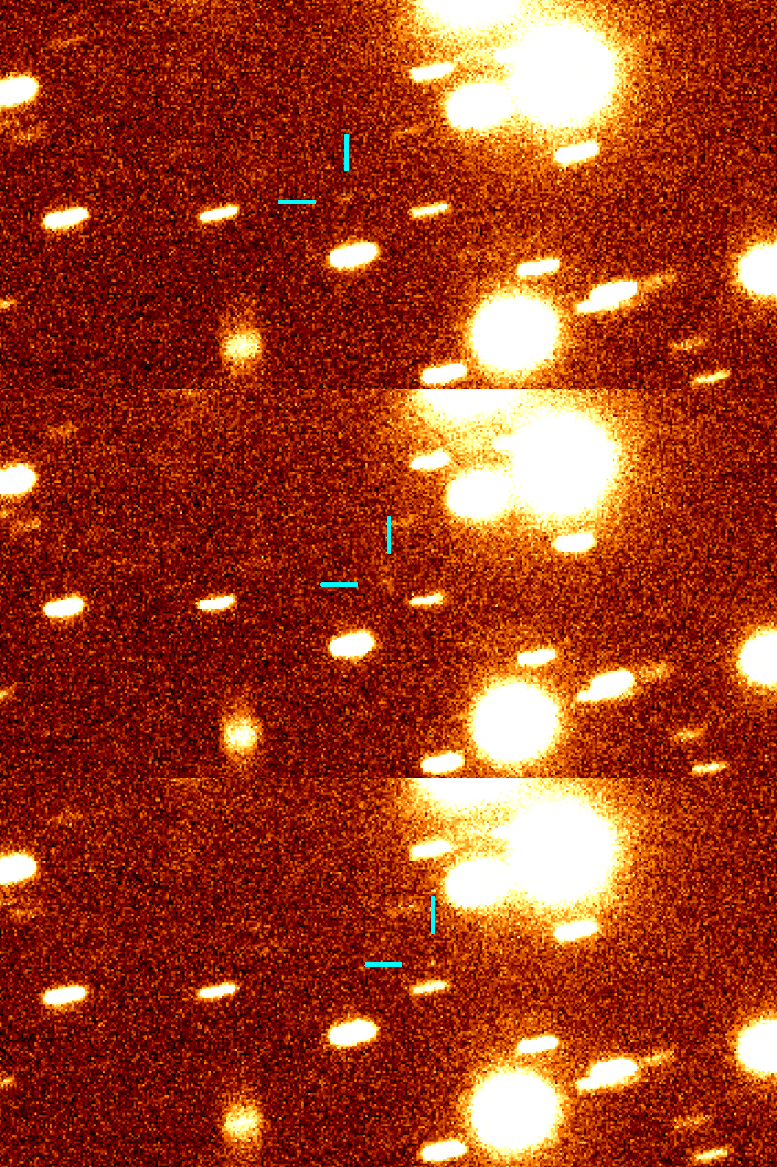
    Asteroid 1998 KY26
    Animation made from three (out of five) images captured during the observations. The point of light (marked with two lines) moving from left to right near the center of the image is 1998 KY26. The field of view is 30 x 15 arcseconds. Credit: NAOJ

    The observations with the Subaru Telescope were conducted upon the request of the Institute for Space and Astronautical Science (ISAS), JAXA. And as a result, 1998 KY26 was photographed in the direction of the constellation Gemini as a 25.4-magnitude point of light with a measurement uncertainty of 0.7 mag. The positional data collected during these observations will be used to improve the accuracy of the orbital elements of the asteroid. Similar observations were conducted with the Very Large Telescope (VLT) of the European Southern Observatory (ESO).

    “We successfully photographed the next target asteroid for Hayabusa2. We hope that these data will facilitate Hayabusa2’s new mission,” says Dr. Michitoshi Yoshida, Director of Subaru Telescope.

    “After returning its reentry capsule to Earth, Hayabusa2 departed for a new target object, a small asteroid known as 1998 KY26. This will be the first mission to this small of an asteroid, so it is very meaningful both in terms of planetary science and planetary defense (protecting Earth from collisions with stellar objects). These Subaru Telescope observations will not only become very important data for Hayabusa2’s extended mission, they will also give a boost to future missions. We are grateful to everyone at Subaru Telescope.” says Dr. Makoto Yoshikawa, the Hayabusa2 Mission Manager at ISAS, JAXA.

    These results appeared on December 15, 2020, in the Minor Planet Electronic Circular issued by the IAU Minor Planet Center (MPEC 2020-X181 : 1998 KY26).

    Never miss a breakthrough: Join the SciTechDaily newsletter.
    Follow us on Google and Google News.

    Asteroid Astronomy Astrophysics Hayabusa2 Mission JAXA National Institutes of Natural Sciences Subaru Telescope
    Share. Facebook Twitter Pinterest LinkedIn Email Reddit

    Related Articles

    Giant Planet 18 Times Jupiter’s Mass Discovered in Distant Star System

    ‘Ammonite’: A Mysterious Deep Space Fossil That Could Rewrite Solar System History

    Evolved Binary Star System Wolf-Rayet 112: Unraveling a Spiral Stream of Dusty Embers From a Massive Stellar Forge

    Artificial Intelligence Identifies 80,000 Spiral Galaxies – Promises More Astronomical Discoveries in the Future

    Surprisingly Recent Galaxy Discovered Using Machine Learning – May Be the Last Generation Galaxy in the Long Cosmic History

    C60 Detected in Planetary Nebula M1-11

    Finding the Asteroids That Threaten Earth

    Direct Infrared Image of the Protoplanetary Disk Around a Young Star

    Trajectory Models of Refractory Particles Help Solve Two Solar System Puzzles

    Leave A Reply Cancel Reply

    • Facebook
    • Twitter
    • Pinterest
    • YouTube

    Don't Miss a Discovery

    Subscribe for the Latest in Science & Tech!

    Trending News

    Scientists Discover How Coffee Impacts Memory, Mood, and Gut Health

    Why Did the Neanderthals Disappear? Scientists Reveal Humans Had a Hidden Advantage

    Physicists Propose Strange Experiment Where Time Goes Quantum

    Magnesium Magic: New Drug Melts Fat Even on a High-Fat, High-Sugar Diet

    Weight-Loss Drugs Like Ozempic May Come With an Unexpected Cost

    Mezcal “Worm” in a Bottle Mystery: DNA Testing Reveals a Surprise

    New Research Reveals That Your Morning Coffee Activates an Ancient Longevity Switch

    This Is What Makes You Irresistible to Mosquitoes

    Follow SciTechDaily
    • Facebook
    • Twitter
    • YouTube
    • Pinterest
    • Newsletter
    • RSS
    SciTech News
    • Biology News
    • Chemistry News
    • Earth News
    • Health News
    • Physics News
    • Science News
    • Space News
    • Technology News
    Recent Posts
    • Harvard Scientists Reveal Secret Structure Behind How You Smell
    • Scientists Just Discovered the Hidden Trick That Keeps Your Cells Alive
    • This Simple Movement Could Be Secretly Cleaning Your Brain
    • Male Birth Control Breakthrough: Scientists Find Way To Turn Sperm Production Off and Back On
    • A Common Vitamin Could Hold the Key to Treating Fatty Liver Disease
    Copyright © 1998 - 2026 SciTechDaily. All Rights Reserved.
    • Science News
    • About
    • Contact
    • Editorial Board
    • Privacy Policy
    • Terms of Use

    Type above and press Enter to search. Press Esc to cancel.