
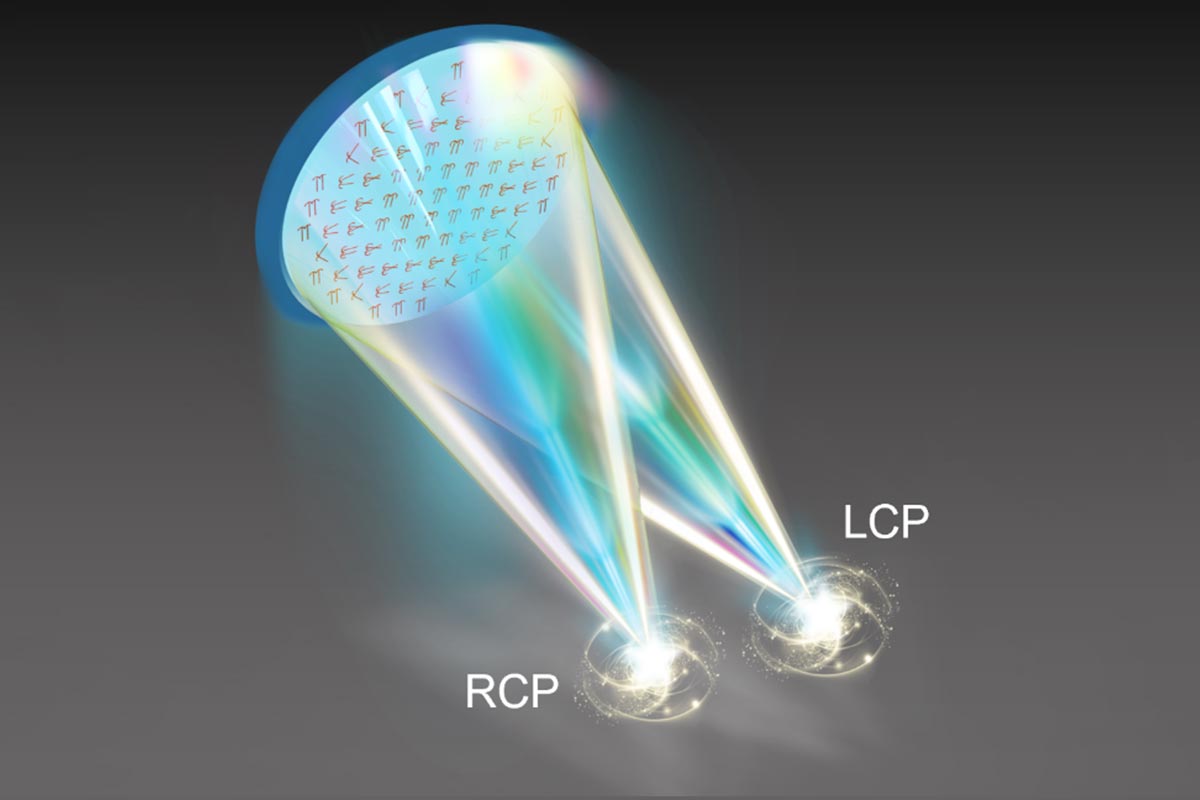
A paper-thin surface now lets light follow two independent paths without losing color clarity.
Broadband achromatic wavefront control plays a central role in next-generation photonic technologies, including full-color imaging and multi-spectral sensing. A research team led by Professor Yijun Feng and Professor Ke Chen at Nanjing University has now reported a significant advance in this field in PhotoniX.
The researchers introduced a hybrid-phase cooperative dispersion-engineering approach that combines Aharonov–Anandan (AA) and Pancharatnam–Berry (PB) geometric phases within a single-layer metasurface. This strategy enables independent achromatic control of wavefronts for two different light spin states.
Why Dispersion Makes Light Hard to Control
Dispersion is an inherent feature of electromagnetic waves. It allows light to behave differently at different wavelengths, which can be useful, but it also creates chromatic aberrations. As bandwidth increases, these effects can cause steering angles to drift, focal points to shift, and spatial accuracy to decline.
Metasurfaces, which are flat structures made from carefully engineered arrays of subwavelength meta-atoms, have become an important tool for shaping light. Yet most achromatic metasurface designs are effectively limited to a single spin channel. In other cases, both spin channels are considered but are forced to share the same dispersion behavior. This has made it difficult to achieve truly independent control of phase and group delay for both spins within a compact platform, even though such capability is crucial for multi-channel integration and functional multiplexing.
How Hybrid Geometric Phases Unlock Dual-Spin Control
To overcome this limitation at the meta-atom level, the researchers developed a hybrid-phase framework in which each geometric phase serves a distinct purpose. In this design, the AA phase provides what the team calls “spin unlocking,” while the PB phase enables “phase extension.” Asymmetric current distributions inside each meta-atom cause right- and left-handed circularly polarized (RCP and LCP) waves to reflect along different paths. This separation allows their phase and dispersion properties to be controlled independently.
The researchers then used resonant-strength engineering to adjust the group delay for each spin separately. Phase control was achieved through frequency tuning and local structural rotation, which minimized unwanted crosstalk. The PB phase, introduced through global rotation, expanded the accessible phase range toward a full 2π without significantly altering the group delay design. Together, these elements form a practical single-layer design approach for achieving dual-spin achromatic performance.
Experimental Devices and Frequency Range Demonstrations
The team experimentally demonstrated their approach using two types of devices operating in the 8–12 GHz range. One set consisted of spin-unlocked achromatic beam deflectors that maintained stable, spin-dependent steering across the entire band. The second set included achromatic metalenses that assigned different focusing functions to RCP and LCP light while preserving strong focusing performance across the same frequency range.
In addition, the researchers presented designs that extend the same principles into the 0.8–1.2 THz terahertz range. These results show that the method is not limited to a specific frequency band, but instead represents a broadly applicable dispersion-engineering strategy.
Toward More Flexible and Compact Meta-Optics
Overall, this work moves achromatic metasurfaces beyond single-channel correction and toward independently designable dual-spin meta-optics. By treating the two spin channels as genuinely independent degrees of freedom, the approach enables compact, multi-functional optical systems within a single platform.
Looking ahead, the hybrid-phase design concept could be extended into the visible spectrum for polarization-multiplexed imaging and broadband integrated meta-optical devices. The authors also note that inverse-design methods, including genetic algorithms and deep learning, may further speed up device optimization and support practical system-level applications.
Reference: “Broadband spin-unlocked achromatic meta-devices empowered by hybrid-phase cooperative dispersion engineering” by Jiahao Wang, Kai Qu, Junzhe Ni, Weixu Yang, Kui Tang, Shufang Dong, Shaojie Wang, Junming Zhao, Tian Jiang, Ke Chen and Yijun Feng, 16 December 2025, PhotoniX.
DOI: 10.1186/s43074-025-00217-z
Never miss a breakthrough: Join the SciTechDaily newsletter.
Follow us on Google and Google News.
3 Comments
If you think a scientific observation broke an existing physics rule, then you/we didn’t understand the rules in the first place.
Could make a good design series for telescopes – and abused, possibly, in “3D” movies, computer screens and smart glasses, as surreptitious information carriers. (This isn’t the CCP is it?)
thanks for this