
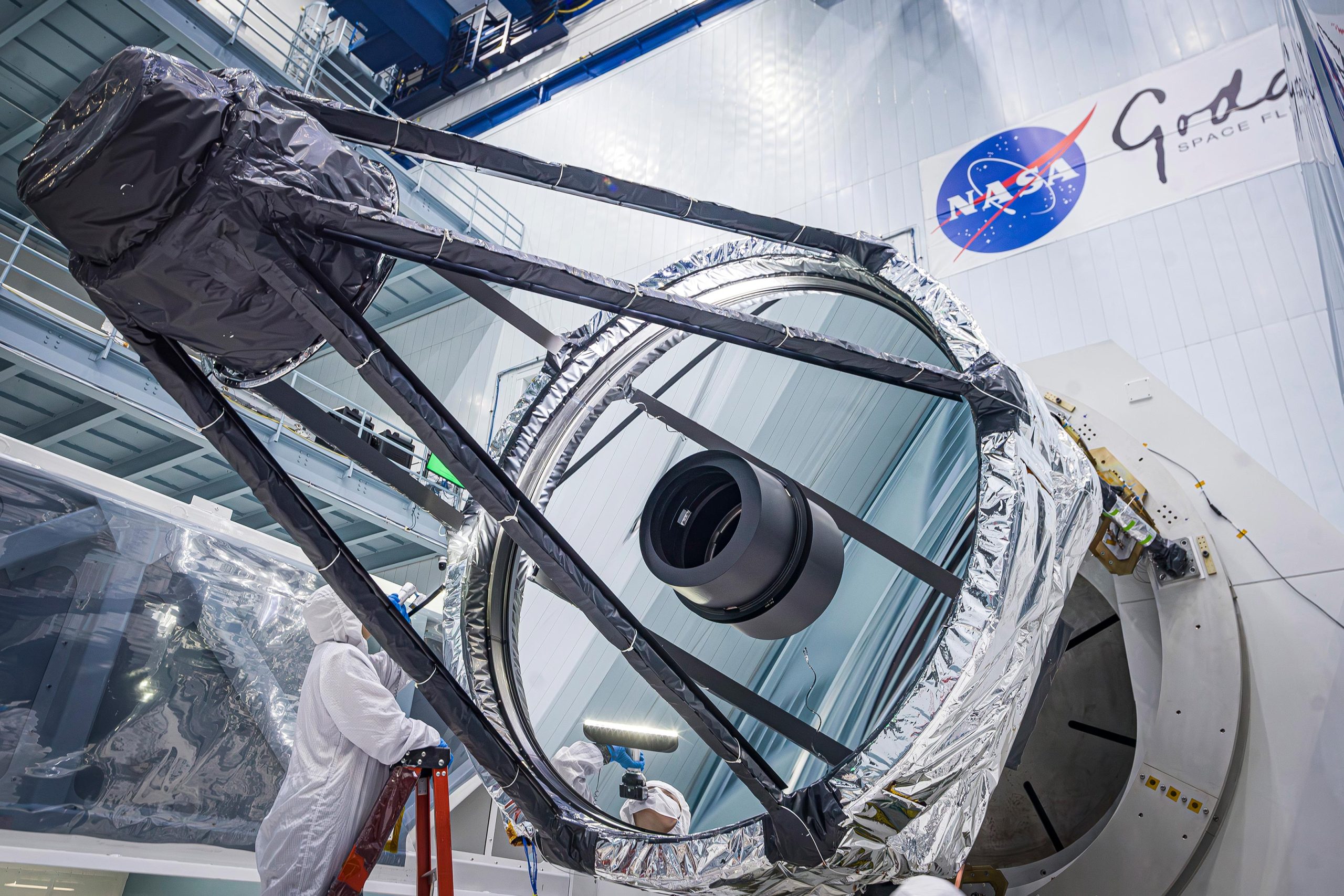
NASA’s Roman Space Telescope has received its Optical Telescope Assembly, paving the way for its mission to explore the cosmos with unprecedented detail.
The assembly’s advanced optics and rigorous testing regimes ensure readiness for a 2027 launch, setting the stage for groundbreaking astronomical discoveries.
Arrival of the Optical Telescope Assembly
NASA’s Nancy Grace Roman Space Telescope has taken a significant step forward in its journey to explore the universe. The mission recently received its final major component: the Optical Telescope Assembly. This crucial delivery includes a 7.9-foot (2.4-meter) primary mirror, nine additional mirrors, and supporting structures and electronics. On November 7, the assembly was delivered to NASA’s largest clean room at the Goddard Space Flight Center in Greenbelt, Maryland, where the observatory is being constructed.

Advanced Technologies and Cosmic Discoveries
This state-of-the-art telescope is designed to capture cosmic light and direct it to Roman’s instruments, enabling scientists to observe billions of celestial objects across vast stretches of space and time. With its Wide Field Instrument, a powerful 300-megapixel infrared camera, astronomers will survey the cosmos—from the outer edges of our solar system to the farthest reaches of the observable universe. Additionally, Roman’s Coronagraph Instrument will test groundbreaking technologies for blocking out light from host stars, allowing for unprecedented imaging of distant planets and dusty disks with remarkable clarity.
“We have a top-notch telescope that’s well aligned and has great optical performance at the cold temperatures it will see in space,” said Bente Eegholm, optics lead for Roman’s Optical Telescope Assembly at NASA Goddard. “I am now looking forward to the next phase where the telescope and instruments will be put together to form the Roman observatory.”

Crafting the Optics
Designed and built by L3Harris Technologies in Rochester, New York, the assembly incorporates key optics (including the primary mirror) that were made available to NASA by the National Reconnaissance Office. The team at L3Harris then reshaped the mirror and built upon the inherited hardware to ensure it would meet Roman’s specifications for expansive, sensitive infrared observations.
“The telescope will be the foundation of all of the science Roman will do, so its design and performance are among the largest factors in the mission’s survey capability,” said Josh Abel, lead Optical Telescope Assembly systems engineer at NASA Goddard.
The team at Goddard worked closely with L3Harris to ensure these stringent requirements were met and that the telescope assembly will integrate smoothly into the rest of the Roman observatory.
Testing for Space Endurance
The assembly’s design and performance will largely determine the quality of the mission’s results, so the manufacturing and testing processes were extremely rigorous. Each optical component was tested individually prior to being assembled and assessed together earlier this year. The tests helped ensure that the alignment of the telescope’s mirrors will change as expected when the telescope reaches its operating temperature in space.
Then, the telescope was put through tests simulating the extreme shaking and intense sound waves associated with launch. Engineers also made sure that tiny components called actuators, which will adjust some of the mirrors in space, move as predicted. And the team measured gases released from the assembly as it transitioned from normal air pressure to a vacuum – the same phenomenon that has led astronauts to report that space smells gunpowdery or metallic. If not carefully controlled, these gases could contaminate the telescope or instruments.
Finally, the telescope underwent a month-long thermal vacuum test to ensure it will withstand the temperature and pressure environment of space. The team closely monitored it during cold operating conditions to ensure the telescope’s temperature will remain constant to within a fraction of a degree. Holding the temperature constant allows the telescope to remain in stable focus, making Roman’s high-resolution images consistently sharp. Nearly 100 heaters on the telescope will help keep all parts of it at a very stable temperature.
“It is very difficult to design and build a system to hold temperatures to such a tight stability, and the telescope performed exceptionally,” said Christine Cottingham, thermal lead for Roman’s Optical Telescope Assembly at NASA Goddard.
Towards the Final Assembly
Now that the assembly has arrived at Goddard, it will be installed onto Roman’s Instrument Carrier, a structure that will keep the telescope and Roman’s two instruments optically aligned. The assembly’s electronics box –– essentially the telescope’s brain –– will be mounted within the spacecraft along with Roman’s other electronics.
With this milestone, Roman remains on track for launch by May 2027.
“Congratulations to the team on this stellar accomplishment!” said J. Scott Smith, the assembly’s telescope manager at NASA Goddard. “The completion of the telescope marks the end of an epoch and incredible journey for this team, and yet only a chapter in building Roman. The team’s efforts have advanced technology and ignited the imaginations of those who dream of exploring the stars.”
Virtually tour an interactive version of the telescope
The Nancy Grace Roman Space Telescope is managed at NASA’s Goddard Space Flight Center in Greenbelt, Maryland, with participation by NASA’s Jet Propulsion Laboratory and Caltech/IPAC in Southern California, the Space Telescope Science Institute in Baltimore, and a science team comprising scientists from various research institutions. The primary industrial partners are BAE Systems Inc. in Boulder, Colorado; L3Harris Technologies in Rochester, New York; and Teledyne Scientific & Imaging in Thousand Oaks, California.
Never miss a breakthrough: Join the SciTechDaily newsletter.
Follow us on Google and Google News.