
The ATLAS collaboration has reported evidence for Higgs bosons decaying into muons and has enhanced the ability to detect Higgs boson decays involving a Z boson and a photon.
At the 2025 European Physical Society Conference on High Energy Physics (EPS-HEP) in Marseille, France, research on the Higgs boson was a central focus. Among the highlights, the ATLAS collaboration unveiled two detailed studies that targeted exceptionally uncommon Higgs-boson decay processes.
Higgs decay into muons
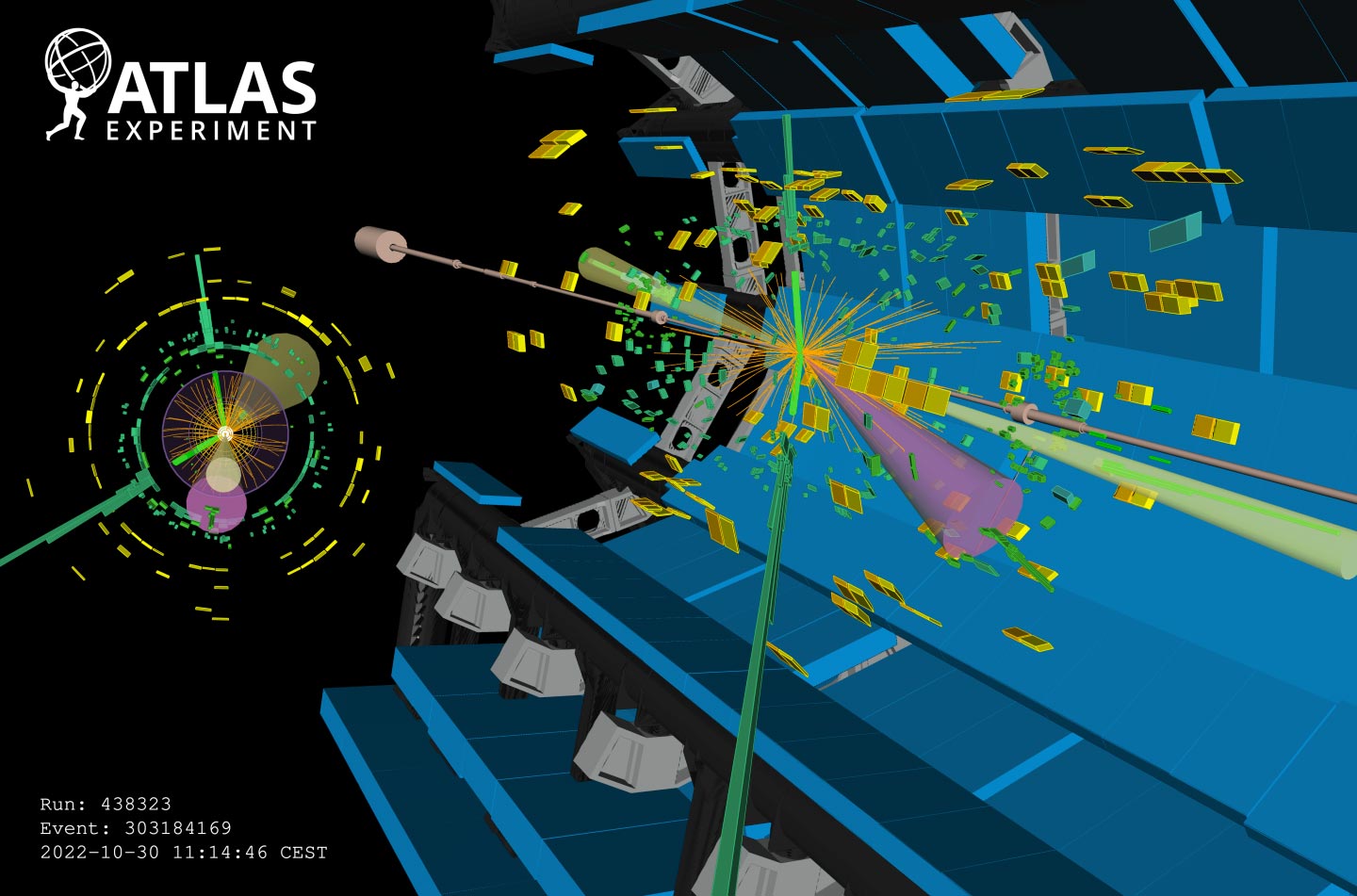
One of the decay modes examined was when the Higgs boson transforms into a pair of muons (H→μμ). Although this event is extremely uncommon—happening in roughly one out of every 5000 Higgs decays—it offers the most direct way to investigate how the Higgs interacts with second-generation fermions. Such studies can help reveal how mass originates across different particle generations. Until now, scientists have only confirmed the Higgs boson’s interactions with third-generation particles, which include the tau lepton as well as the top and bottom quarks.
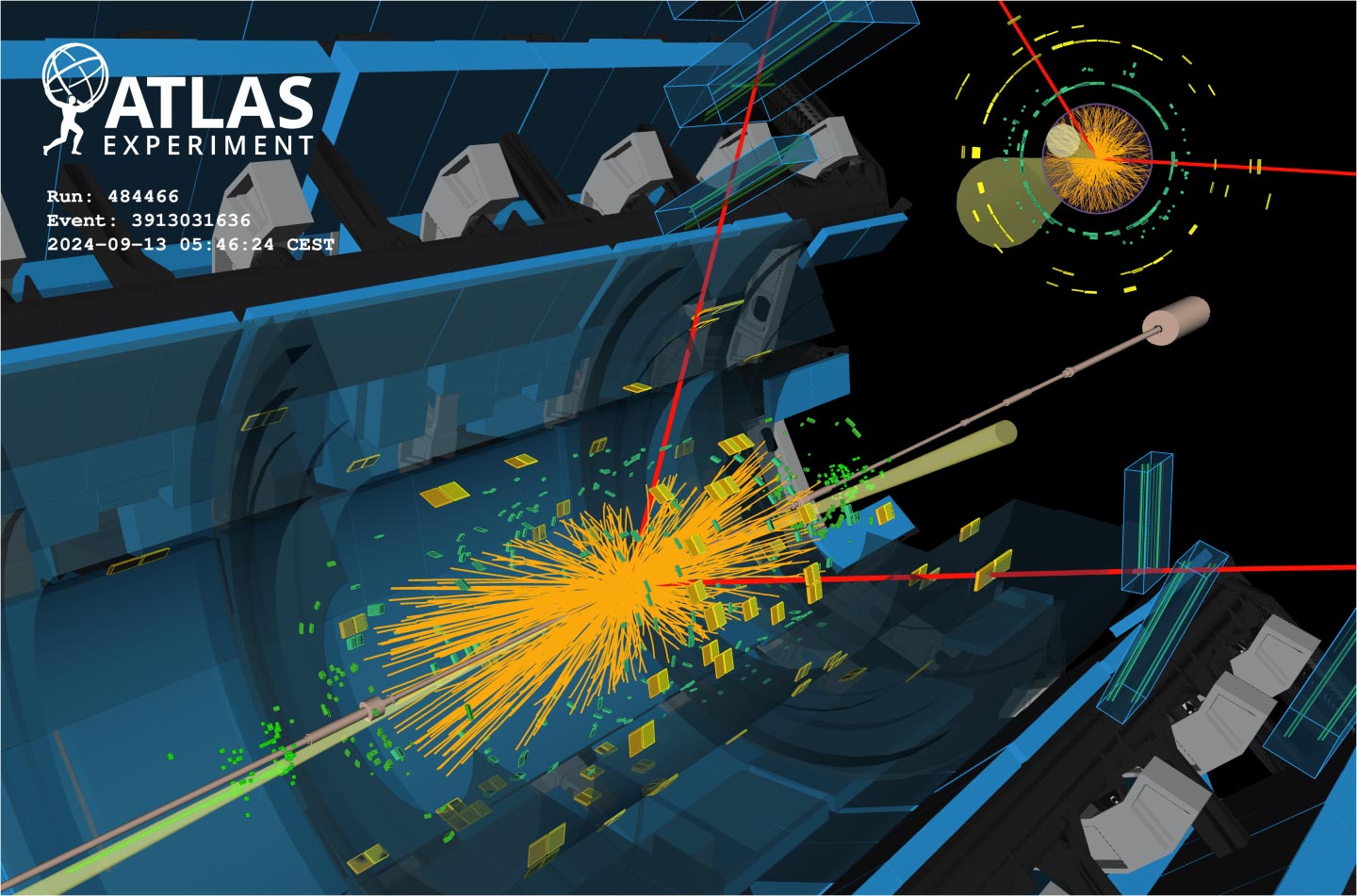
The other decay process explored was the transformation of the Higgs boson into a Z boson and a photon (H→Zγ), with the Z boson later decaying into pairs of electrons or muons. This decay pathway is particularly compelling because it occurs through an intermediate “loop” of virtual particles. If undiscovered particles are involved in this loop, the process could provide valuable clues pointing toward physics beyond the Standard Model.
The challenge of identifying rare events
Detecting these uncommon decay modes is a demanding task. In the case of H→μμ, scientists searched for a subtle excess of events concentrated around a muon-pair mass of 125 GeV, which matches the Higgs boson’s mass. This faint signal can be difficult to distinguish, as it is often obscured by the large number of muon pairs generated through unrelated processes (“background”). The H→Zγ decay, where the Z boson subsequently transforms into electron or muon pairs, is even more challenging to pick out. This is partly because the Z boson decays in this way only about 6% of the time, and because photons can be easily mistaken for particle jets.
To enhance the precision of their search, ATLAS researchers combined data from the first three years of LHC Run 3 with the complete Run 2 dataset. They also introduced an advanced approach to better simulate background events, sorted the recorded data according to the Higgs-production mechanisms, and refined their event-selection strategies.
Evidence for H→μμ
In previous searches for H→μμ using the full Run 2 data set, the ATLAS collaboration saw its first hint of this process at the level of 2 standard deviations, while the CMS collaboration reached a significance of 3 standard deviations with 2.5 standard deviations expected. Now, with the combined Run 2 and Run 3 data sets, the ATLAS collaboration has found evidence for H→μμ with an expected significance of 2.5 standard deviations and an observed significance of 3.4 standard deviations. This means that the chance that the result is a statistical fluctuation is less than 1 in 3000!
As for the H→Zγ process, a previous ATLAS and CMS combined analysis used Run 2 data to find evidence of this decay mode. It reported an excess over the background-only hypothesis of 3.4 standard deviations with 1.6 standard deviations expected. The latest ATLAS result, combining Run 2 and Run 3 data, reported an excess of 2.5 standard deviations. The expected sensitivity of this analysis is 1.9 standard deviations, providing the most stringent expected sensitivity to date for measuring the decay probability (“branching fraction”) of H→Zγ.
These achievements were made possible by the large, excellent data set provided by the LHC, the outstanding efficiency and performance of the ATLAS experiment and the use of novel analysis techniques. With more data on the horizon, the journey of exploration continues!
Meeting: 2025 European Physical Society Conference on High Energy Physics
Never miss a breakthrough: Join the SciTechDaily newsletter.
Follow us on Google and Google News.
7 Comments
These achievements were made possible by the large, excellent data set provided by the LHC, the outstanding efficiency and performance of the ATLAS experiment and the use of novel analysis techniques.With more data on the horizon, the journey of exploration continues in the Meeting: 2025 European Physical Society Conference on High Energy Physics.
Please ask researchers to think deeply:
1. Are you observing the entirety of the universe?
2. Is something that you cannot observe undoubtedly non-existent?
A generation severely poisoned by so-called peer-reviewed publications. In today’s physics, so-called peer-reviewed publications, including Physical Review Letters, Nature, Science, etc., stubbornly insist on and promote:
1. Although θ and τ particles show differences in experiments, physics can assume that they are the same type of particle. This is science.
2. Although topological vortices have the same structure and opposite rotation direction as their anti vortices, physics can define their structures and directions as completely different. This is science.
3. Although two sets of cobalt-60 reverse rotation experiments showed asymmetry, physics can still define them as two objects that are mirror images of each other. This is science.
, etc. They openly define the Differences as the Same while the Same as the Differences, and deceive the public with so-called impact factors (IF), never knowing what shame is.
The universe is not a God, nor is it merely Particles; moreover, it is not Algebra, Formulas, or Fractions. The universe is the superposition, deflection, entanglement, and locking of spacetime vortex geometries, the interaction and balance of topological vortices and their fractal structures. Topological invariants are the identical intrinsic properties between two isomorphic topological spaces. Different civilizations may create distinct mathematical codes or tools to describe the universality and specificity of these topological invariants under different physical laws.
Topology provides stability blueprints, but specific physics (spatial features, gravitational collapse, fluid viscosity, quantum measurement) dictates vortex generation, evolution, and decay. If researchers are interested in this, please visit https://zhuanlan.zhihu.com/p/1933484562941457487 and https://zhuanlan.zhihu.com/p/1925124100134790589.
Imagine that nothing contains potential, and that potential can be represented mathematically as the space between -0 and +0.
Picture a number line that bends at the center, where zero isn’t alone but mirrored:
-0.1 -0 -⋈.9 -⋈.8 … -⋈.2 -⋈.1
⋈
⋈.1 ⋈.2 … ⋈.8 ⋈.9 +0 0.1
Pause at the fold. Where does minus-zero end and plus-zero begin? What might ⋈ be? a boundary, a bridge, or something stranger? And what could our observations look like if we only ever see one side of nothing?
Call it a singularity.
When Higg’s boson transforms into Z-boson+photon and then into pairs of muons+electrons, in the presence of virtual particles in the loop, what are THESE VIRTUAL particles ?
Are these PARTICLES those still elusive and NON-DETECTIBLE ?
Can we take the help of De-Broglie or may be extension of Plank’s theory to theoretically establish the presence of the virtual particle ?
With ALL RESPECT and malice towards none
@Rajubhai: “Virtual particles” are fleeting field perturbations and should not be thought of as particles. In comparison, field “particles” are more persistent resonant perturbations and have real valued mass, while non-resonant “virtual particles” have imaginary valued mass.
“Virtual particles” are present in many situations of the field theory (as the text implies) and has long been experimentally established. For example, when a quantum wavicle (“particle” – but lacking some particle properties in the same way that it lacks some wave properties) propagates it will sometimes do so as a pair of “virtual particles” of other fields that the particle field interacts with. https://profmattstrassler.com/articles-and-posts/particle-physics-basics/virtual-particles-what-are-they/
“The best way to approach this concept, I believe, is to forget you ever saw the word “particle” in the term. A virtual particle is not a particle at all. It refers precisely to a disturbance in a field that is not a particle. A particle is a nice, regular ripple in a field, one that can travel smoothly and effortlessly through space, like a clear tone of a bell moving through the air. A “virtual particle”, generally, is a disturbance in a field that will never be found on its own, but instead is something that is caused by the presence of other particles, often of other fields.
Analogy time (and a very close one mathematically); think about a child’s swing. If you give it a shove and let it go, it will swing back and forth with a time period that is always the same, no matter how hard was the initial shove you gave it. This is the natural motion of the swing. Now compare that regular, smooth, constant back-and-forth motion to what would happen if you started giving the swing a shove many times during each of its back and forth swings. Well, the swing would start jiggling around all over the place, in a very unnatural motion, and it would not swing smoothly at all. The poor child on the swing would be furious at you, as you’d be making his or her ride very uncomfortable. This unpleasant jiggling motion — this disturbance of the swing — is different from the swing’s natural and preferred back-and-forth regular motion just as a “virtual particle” disturbance is different from a real particle. If something makes a real particle, that particle can go off on its own across space. If something makes a disturbance, that disturbance will die away, or break apart, once its cause is gone. So it’s not like a particle at all, and I wish we didn’t call it that.”
Virtual particles are also, besides the particle scattering described in the article, involved in force interactions such as the Coulomb force, in spontaneous emission, the Lamb shift, et cetera. The Lamb shift is a good example of an experimental test observing them. https://en.wikipedia.org/wiki/Virtual_particle
Yout request for questiins is irrelevant to the presented work which can be appreciated as is.
[That was a reply to Bao-hua ZHANG.]