
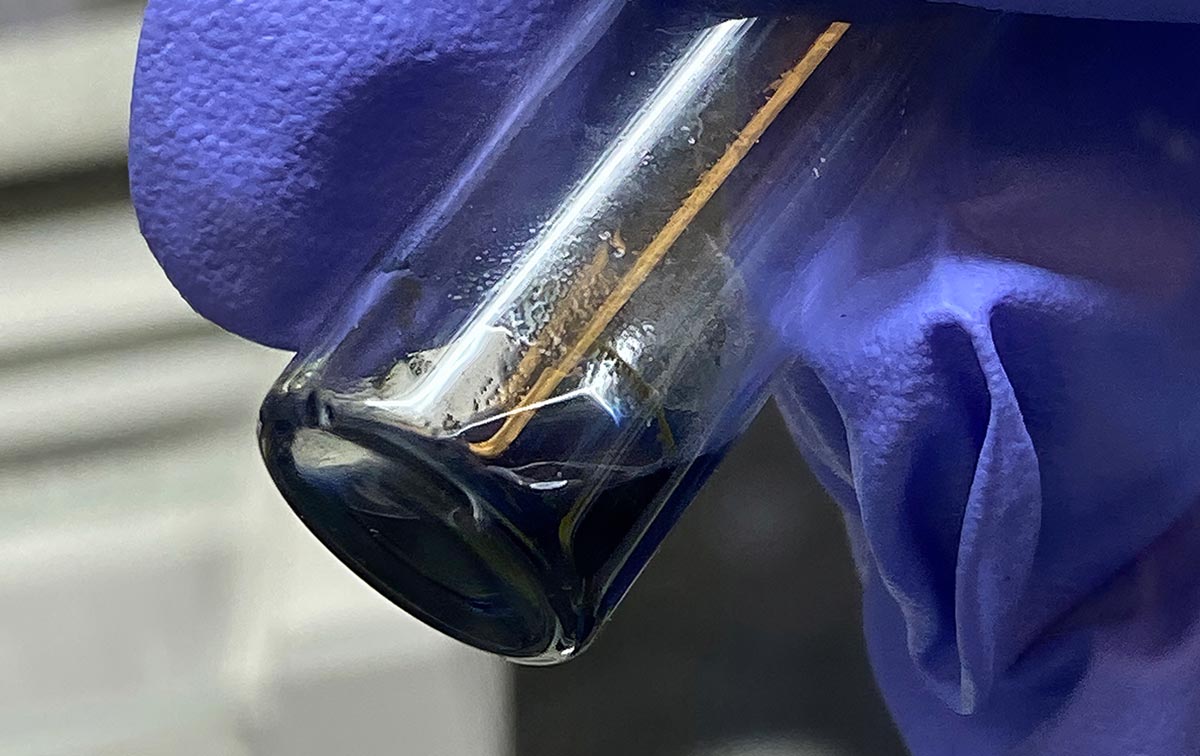
A breakthrough in heavy-element chemistry shatters long-held assumptions about transuranium elements.
- Researchers have discovered “berkelocene,” the first organometallic molecule to be characterized containing the heavy element berkelium.
- The molecule was synthesized using just 0.3 milligram of berkelium-249, requiring specialized facilities to handle its extreme sensitivity to oxygen, water, and radioactivity.
- This discovery challenges long-standing theories about the chemistry of transuranium elements, particularly those beyond uranium on the periodic table.
Berkelium: A Mysterious Element
A team of researchers from the Department of Energy’s Lawrence Berkeley National Laboratory (Berkeley Lab) has discovered “berkelocene,” the first-ever organometallic molecule containing the heavy element berkelium.
Organometallic molecules, structures where a metal ion is bonded within a carbon-based framework, are well known for early actinide elements like uranium (atomic number 92). However, they are extremely rare for later actinides, such as berkelium (atomic number 97).
“This is the first time that evidence for the formation of a chemical bond between berkelium and carbon has been obtained. The discovery provides new understanding of how berkelium and other actinides behave relative to their peers in the periodic table,” said Stefan Minasian, a scientist in Berkeley Lab’s Chemical Sciences Division and one of four co-corresponding authors of a new study published in the journal Science.
A Heavy Metal Molecule with Berkeley Roots
Berkelium is one of 15 actinides in the periodic table’s f-block. One row above the actinides are the lanthanides.
The pioneering nuclear chemist Glenn Seaborg discovered berkelium at Berkeley Lab in 1949. It would become just one of many achievements that led to his winning the 1951 Nobel Prize in Chemistry with fellow Berkeley Lab scientist Edwin McMillan for their discoveries in the chemistry of the transuranium elements.
“This is the first time that evidence for the formation of a chemical bond between berkelium and carbon has been obtained.”
Stefan Minasian, Chemical Sciences Division staff scientist
The Challenge of Studying Berkelium
For many years, the Heavy Element Chemistry group in Berkeley Lab’s Chemical Sciences Division has been dedicated to preparing organometallic compounds of the actinides, because these molecules typically have high symmetries and form multiple covalent bonds with carbon, making them useful for observing the unique electronic structures of the actinides.
“When scientists study higher symmetry structures, it helps them understand the underlying logic that nature is using to organize matter at the atomic level,” Minasian said.
But berkelium is not easy to study because it is highly radioactive. And only very minute amounts of this synthetic heavy element are produced globally every year. Adding to the difficulty, organometallic molecules are extremely air-sensitive and can be pyrophoric.
“Only a few facilities around the world can protect both the compound and the worker while managing the combined hazards of a highly radioactive material that reacts vigorously with the oxygen and moisture in air,” said Polly Arnold, a co-corresponding author on the paper who is a UC Berkeley professor of chemistry and director of Berkeley Lab’s Chemical Sciences Division.
Breaking Down the Berkelium Barrier
So Minasian, Arnold, and co-corresponding author Rebecca Abergel, a UC Berkeley associate professor of nuclear engineering and of chemistry who leads the Heavy Element Chemistry Group at Berkeley Lab, assembled a team to overcome these obstacles.
At Berkeley Lab’s Heavy Element Research Laboratory, the team custom-designed new gloveboxes enabling air-free syntheses with highly radioactive isotopes. Then, with just 0.3 milligram of berkelium-249, the researchers conducted single-crystal X-ray diffraction experiments. The isotope that was acquired by the team was initially distributed from the National Isotope Development Center, which is managed by the DOE Isotope Program at Oak Ridge National Laboratory.
A Surprising Chemical Structure
The results showed a symmetrical structure with the berkelium atom sandwiched between two 8-membered carbon rings. The researchers named the molecule “berkelocene,” because its structure is analogous to a uranium organometallic complex called “uranocene.” (UC Berkeley chemists Andrew Streitwieser and Kenneth Raymond discovered uranocene in the late 1960s.)
In an unexpected finding, electronic structure calculations performed by co-corresponding author Jochen Autschbach at the University of Buffalo revealed that the berkelium atom at the center of the berkelocene structure has a tetravalent oxidation state (positive charge of +4), which is stabilized by the berkelium–carbon bonds.
Rethinking the Periodic Table
“Traditional understanding of the periodic table suggests that berkelium would behave like the lanthanide terbium,” said Minasian.
“But the berkelium ion is much happier in the +4 oxidation state than the other f-block ions we expected it to be most like,” Arnold said.
A New Perspective on Nuclear Science
The researchers say that more accurate models showing how actinide behavior changes across the periodic table are needed to solve problems related to long-term nuclear waste storage and remediation. “This clearer portrait of later actinides like berkelium provides a new lens into the behavior of these fascinating elements,” Abergel said.
Reference: “Berkelium–carbon bonding in a tetravalent berkelocene” by Dominic R. Russo, Alyssa N. Gaiser, Amy N. Price, Dumitru-Claudiu Sergentu, Jennifer N. Wacker, Nicholas Katzer, Appie A. Peterson, Jacob A. Branson, Xiaojuan Yu, Sheridon N. Kelly, Erik T. Ouellette, John Arnold, Jeffrey R. Long, Wayne W. LukensJr, Simon J. Teat, Rebecca J. Abergel, Polly L. Arnold, Jochen Autschbach and Stefan G. Minasian, 27 February 2025, Science.
DOI: 10.1126/science.adr3346
This work was supported by the DOE Office of Science.
Never miss a breakthrough: Join the SciTechDaily newsletter.
Follow us on Google and Google News.