
Close Menu
    Facebook X (Twitter) Instagram
    SciTechDaily
    • Biology
    • Chemistry
    • Earth
    • Health
    • Physics
    • Science
    • Space
    • Technology
    Facebook X (Twitter) Pinterest YouTube RSS
    SciTechDaily
    Home»Space»A Scattering of Stars Shows Us Something New About the Universe and the Hubble Space Telescope
    Space

    A Scattering of Stars Shows Us Something New About the Universe and the Hubble Space Telescope

    By ESA/HubbleJune 27, 20212 Comments2 Mins Read
    Facebook Twitter Pinterest Telegram LinkedIn WhatsApp Email Reddit
    Share
    Facebook Twitter LinkedIn Pinterest Telegram Email Reddit
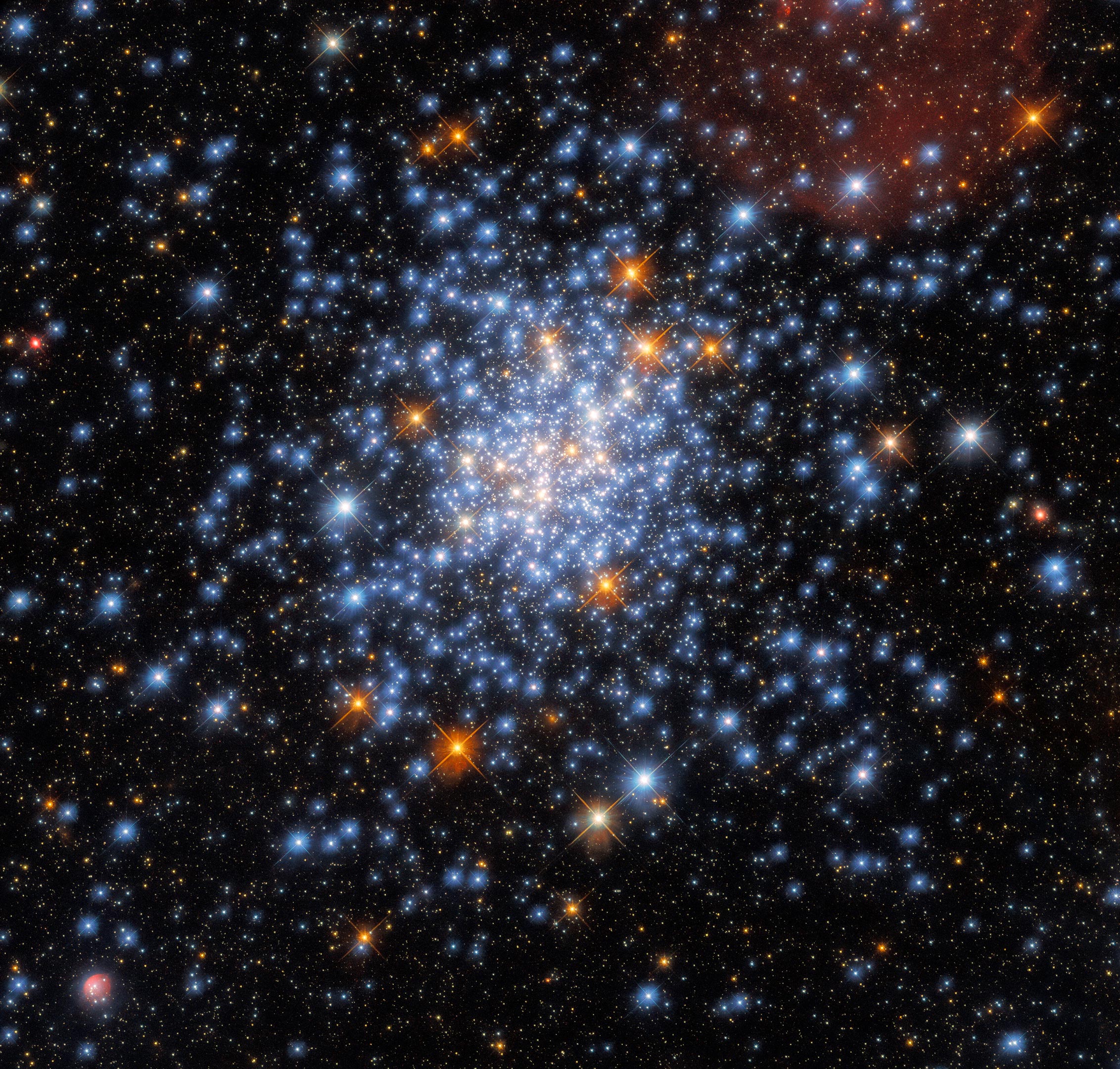
    Open Star Cluster NGC 330
    Hubble Space Telescope image of the open star cluster NGC 330, which lies around 180,000 light-years away inside the Small Magellanic Cloud. Credit: ESA/Hubble & NASA, J. Kalirai, A. Milone

    This Hubble Space Telescope Picture of the Week depicts the open star cluster NGC 330, which lies around 180,000 light-years away inside the Small Magellanic Cloud. The cluster — which is in the constellation Tucana (The Toucan) — contains a multitude of stars, many of which are scattered across this striking image.

    Pictures of the Week from the NASA/ESA Hubble Space Telescope show us something new about the Universe. This image, however, also contains clues about the inner workings of Hubble itself. The criss-cross patterns surrounding the stars in this image — known as diffraction spikes — were created when starlight interacted with the four thin vanes supporting Hubble’s secondary mirror.

    As star clusters form from a single primordial cloud of gas and dust, all the stars they contain are roughly the same age. This makes them useful natural laboratories for astronomers to learn how stars form and evolve. This image uses observations from Hubble’s Wide Field Camera 3, and incorporates data from two very different astronomical investigations. The first aimed to understand why stars in star clusters appear to evolve differently from stars elsewhere, a peculiarity first observed by the Hubble Space Telescope. The second aimed to determine how large stars can be before they become doomed to end their lives in cataclysmic supernova explosions.

    Never miss a breakthrough: Join the SciTechDaily newsletter.
    Follow us on Google and Google News.

    Astronomy European Space Agency Hubble Space Telescope NASA Stars
    Share. Facebook Twitter Pinterest LinkedIn Email Reddit

    Related Articles

    Hubble Find Surprises Astronomers: White Dwarfs Can Still Undergo Stable Thermonuclear Activity

    Hubble Space Telescope Captures a frEGGS-Plosion of Star Formation

    Hubble Space Telescope Helps Uncover the Mystery of Betelgeuse Dimming

    Hubble Views a Giant, Smoldering Star

    A Spiral Within a Spiral, Galaxy ESO 498-G5

    Panoramic View of 30 Doradus – The Brightest Star-Forming Region in Our Galactic Neighborhood

    Hubble Captures New Image of Messier 9

    Researchers Discover First Intermediate-Mass Black Hole

    Hubble Observes Rare Blue Stars in Andromeda’s Core

    2 Comments

    1. BibhutibhusanPatel on June 29, 2021 7:08 am

      The technology meant for watchig small galaxy orbiting to milkyway has comparable science of scattering light having dynamism.This phenomena is natural.

      Reply
    2. BibhutibhusanPatel on June 29, 2021 7:20 am

      The technology meant for watchig small galaxy orbiting to milkyway has comparable science of scattering light having dynamism.This phenomena is natural.As the star cluster in Small Magellanic Cloud is in constant motion relative to our galaxy,so a constant dynamic force is experienced to obtain a static picture of the cluster of starsNGC 330.

      Reply
    Leave A Reply Cancel Reply

    • Facebook
    • Twitter
    • Pinterest
    • YouTube

    Don't Miss a Discovery

    Subscribe for the Latest in Science & Tech!

    Trending News

    Mezcal “Worm” in a Bottle Mystery: DNA Testing Reveals a Surprise

    New Research Reveals That Your Morning Coffee Activates an Ancient Longevity Switch

    This Is What Makes You Irresistible to Mosquitoes

    Shockingly Powerful Giant Octopuses Ruled the Seas 100 Million Years Ago

    Scientists Stunned by New Organic Molecules Found on Mars

    Rewriting Dinosaur Evolution: Scientists Unearth Remarkable 150-Million-Year-Old Stegosaur Skull

    Omega-3 Supplements Linked to Cognitive Decline in Surprising New Study

    First-of-Its-Kind Discovery: Homer’s Iliad Found Embedded in a 1,600-Year-Old Egyptian Mummy

    Follow SciTechDaily
    • Facebook
    • Twitter
    • YouTube
    • Pinterest
    • Newsletter
    • RSS
    SciTech News
    • Biology News
    • Chemistry News
    • Earth News
    • Health News
    • Physics News
    • Science News
    • Space News
    • Technology News
    Recent Posts
    • This Gene Tweak Turns Strawberries Into Healthier, Tastier Superfruit
    • This New Chip Could Make GPUs Far More Efficient
    • This Tiny World in the Outer Solar System Should Be Airless, but It Has an Atmosphere
    • NASA’s Webb Space Telescope Reveals a Dark Airless Super-Earth That Looks Like Mercury
    • These Simple Daily Habits Can Quickly Improve Blood Pressure and Heart Risk Factors
    Copyright © 1998 - 2026 SciTechDaily. All Rights Reserved.
    • Science News
    • About
    • Contact
    • Editorial Board
    • Privacy Policy
    • Terms of Use

    Type above and press Enter to search. Press Esc to cancel.