
Leaving water inside a sodium battery material boosts performance and enables desalination.
Sodium-ion batteries could play a major role in the future of sustainable energy storage and may even help turn seawater into safe drinking water. Researchers at the University of Surrey have found a straightforward way to improve how these batteries perform by keeping water inside a key battery material instead of removing it.
Lithium-ion batteries currently dominate the energy storage market, but they depend on materials that are costly and can cause environmental harm. Sodium, by contrast, is abundant and widely available, making it an attractive alternative. The main obstacle has been achieving performance levels that match or approach those of lithium-based systems.
Rethinking a familiar material
In a study published in the Journal of Materials Chemistry A, the research team explains how a well-known sodium-based compound, sodium vanadium oxide, performs far better when its naturally occurring water content is preserved.
The material, known as a nanostructured sodium vanadate hydrate (NVOH), showed marked improvements in energy storage capacity, charging speed, and long term stability, remaining effective for more than 400 charge cycles.
Laboratory tests revealed that the ‘wet’ version of the material was able to store nearly twice as much charge as conventional sodium-ion materials, placing it among the highest-performing cathodes reported so far.
Dr. Daniel Commandeur, Research Fellow at the University of Surrey School of Chemistry and Chemical Engineering, and lead author of the paper, said: “Our results were completely unexpected. Sodium vanadium oxide has been around for years, and people usually heat-treat it to remove the water because it’s thought to cause problems. We decided to challenge that assumption, and the outcome was far better than we anticipated. The material showed much stronger performance and stability than expected and could even create exciting new possibilities for how these batteries are used in the future.”
Energy storage meets desalination
The research team also tested how the material behaved in salt water – one of the most challenging environments possible. Results showed it not only continued to function effectively but also removed sodium from the solution while a graphite electrode extracted chloride – a process known as electrochemical desalination.
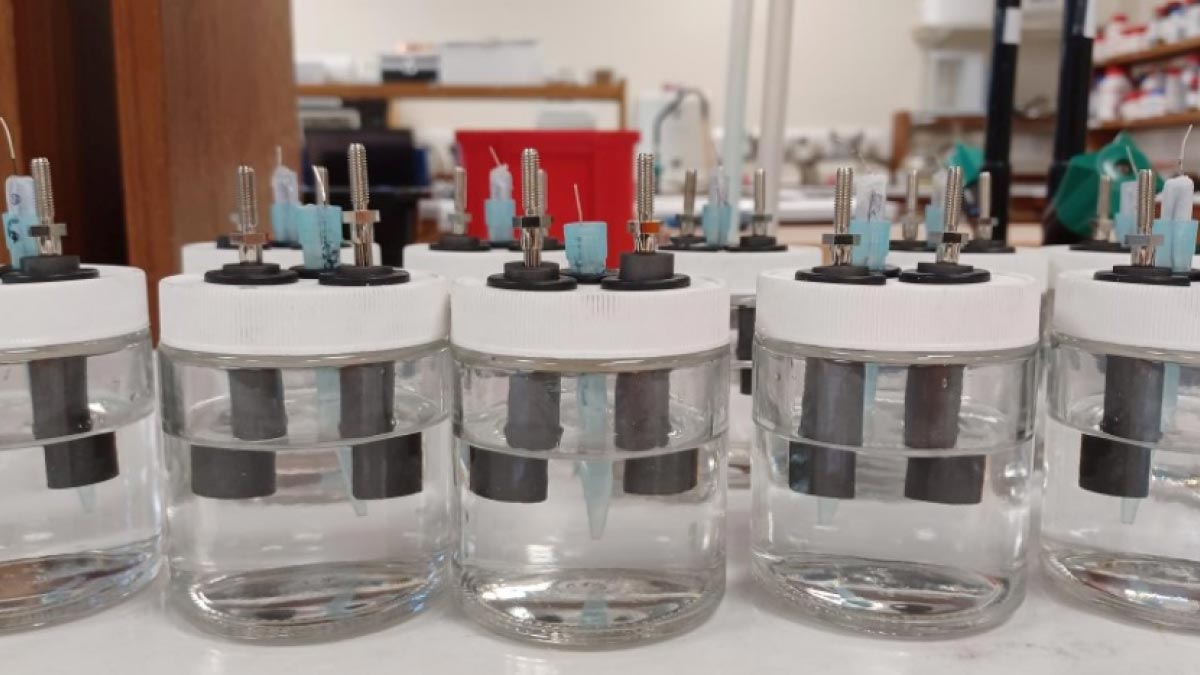
Salt water with universal indicator turns red at the counter electrode, showing that the new electrode isn’t evolving gas. Credit: University of Surrey
Dr. Commandeur added: “Being able to use sodium vanadate hydrate in salt water is a really exciting discovery, as it shows sodium-ion batteries could do more than just store energy – they could also help remove salt from water. In the long term, that means we might be able to design systems that use seawater as a completely safe, free, and abundant electrolyte, while also producing fresh water as part of the process.”
Toward practical, low cost batteries
The breakthrough could accelerate the development of sodium-ion batteries as a viable alternative to current lithium-based technology.
Using abundant, low-cost materials makes these batteries safer and more sustainable, with potential applications ranging from storing renewable energy on the grid to powering electric vehicles. The Surrey team’s approach also simplifies how high-performance sodium batteries are made, helping to bring large-scale, commercially viable energy storage a step closer.
Reference: “Nanostructured sodium vanadate hydrate as a versatile sodium ion cathode material for use in organic media and for aqueous desalination” by Daniel Commandeur, Vlad Stolojan, Monica Felipe-Sotelo, James Wright, David Watson and Robert C. T. Slade, 15 September 2025, Journal of Materials Chemistry A.
DOI: 10.1039/D5TA05128B
Funding: Royal Society (grant code RG\R1\251473)
Never miss a breakthrough: Join the SciTechDaily newsletter.
Follow us on Google and Google News.