
Close Menu
    Facebook X (Twitter) Instagram
    SciTechDaily
    • Biology
    • Chemistry
    • Earth
    • Health
    • Physics
    • Science
    • Space
    • Technology
    Facebook X (Twitter) Pinterest YouTube RSS
    SciTechDaily
    Home»Technology»A Spreadable Interlayer Could Make Solid-State Batteries More Stable and Improve Density Tenfold
    Technology

    A Spreadable Interlayer Could Make Solid-State Batteries More Stable and Improve Density Tenfold

    By Chalmers University of TechnologyMay 25, 2020No Comments4 Mins Read
    Facebook Twitter Pinterest Telegram LinkedIn WhatsApp Email Reddit
    Share
    Facebook Twitter LinkedIn Pinterest Telegram Email Reddit
    Spreadable Interlayer Solid State Batteries
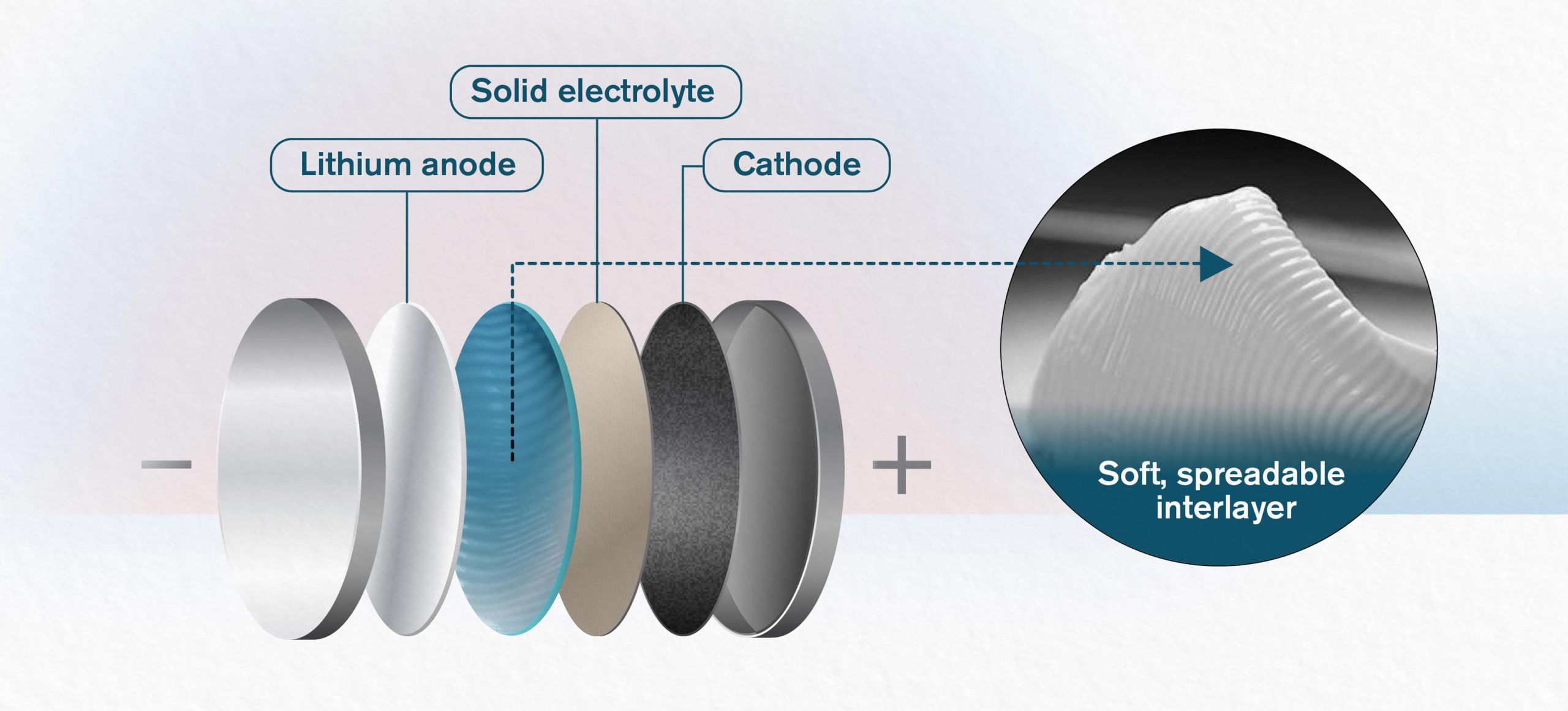
    Solid-state batteries are of great interest to the electric vehicle industry. Scientists at Chalmers University of Technology, Sweden, and Xi’an Jiaotong University, China now present a new way of taking this promising concept closer to large-scale application. An interlayer, made of a spreadable, ‘butter-like’ material helps improve the current density tenfold, while also increasing performance and safety. Credit: Yen Strandqvist/Chalmers University of Technology

    Solid-state batteries are of great interest to the electric vehicle industry. Scientists at Chalmers and Xi’an Jiaotong University, China now present a new way of taking this promising concept closer to large-scale application. An interlayer, made of a spreadable, ‘butter-like’ material helps improve the current density tenfold, while also increasing performance and safety.​​​​​​​​

    Shizhao Xiong
    ‘This interlayer makes the battery cell significantly more stable, and therefore able to withstand much higher current density. What is also important is that it is very easy to apply the soft mass onto the lithium metal anode in the battery — like spreading butter on a sandwich,’ says researcher Shizhao Xiong at the Department of Physics at Chalmers. Credit: Mia Halleröd Palmgren/Chalmers University of Technology

    “This interlayer makes the battery cell significantly more stable, and therefore able to withstand much higher current density. What is also important is that it is very easy to apply the soft mass onto the lithium metal anode in the battery – like spreading butter on a sandwich,” says researcher Shizhao Xiong at the Department of Physics at Chalmers.

    Alongside Chalmers Professor Aleksandar Matic and Professor Song’s research group in Xi’an, Shizhao Xiong has been working for a long time on crafting a suitable interlayer to stabilize the interface for solid-state battery. The new results were recently presented in the prestigious scientific journal Advanced Functional Materials.

    Solid-state batteries could revolutionize electric transport. Unlike today’s lithium-ion batteries, solid-state batteries have a solid electrolyte and therefore contain no environmentally harmful or flammable liquids.

    Simply put, a solid-state battery can be likened to a dry sandwich. A layer of the metal lithium acts as a slice of bread, and a ceramic substance is laid on top like a filling. This hard substance is the solid electrolyte of the battery, which transports lithium ions between the electrodes of the battery. But the ‘sandwich’ is so dry, it is difficult to keep it together – and there are also problems caused by the compatibility between the ‘bread’ and the ‘topping’. Many researchers around the world are working to develop suitable resolutions to address this problem.
    Aleksandar Matic
    ‘This is an important step on the road to being able to manufacture large-scale, cost-effective, safe and environmentally friendly batteries that deliver high capacity and can be charged and discharged at a high rate,’ says Aleksandar Matic, Professor at the Department of Physics at Chalmers. Credit: MIa Halleröd Palmgren/Chalmers University of Technology

    The material which the researchers in Gothenburg and Xi’an are now working with is a soft, spreadable, ‘butter-like’ substance, made of nanoparticles of the ceramic electrolyte, LAGP, mixed with an ionic liquid. The liquid encapsulates the LAGP particles and makes the interlayer soft and protective. The material, which has a similar texture to butter from the fridge, fills several functions and can be spread easily.

    Although the potential of solid-state batteries is very well known, there is as yet no established way of making them sufficiently stable, especially at high current densities, when a lot of energy is extracted from a battery cell very quickly, that is at fast charge or discharge. The Chalmers researchers see great potential in the development of this new interlayer.

    “This is an important step on the road to being able to manufacture large-scale, cost-effective, safe, and environmentally friendly batteries that deliver high capacity and can be charged and discharged at a high rate,” says Aleksandar Matic, Professor at the Department of Physics at Chalmers, who predicts that solid-state batteries will be on the market within five years.

    Reference: ”Design of a Multifunctional Interlayer for NASCION‐Based Solid‐State Li Metal Batteries”  by Shizhao Xiong, Yangyang Liu, Piotr Jankowski, Qiao Liu, Florian Nitze, Kai Xie, Jiangxuan Song and Aleksandar Matic, 6 April 2020, Advanced Functional Materials.
    DOI: 10.1002/adfm.202001444

    The researchers are active at Chalmers University of Technology, Xi’an Jiaotong University, China, the Technical University of Denmark and the National University of Defense Technology, Changsha, Hunan, China.

    Never miss a breakthrough: Join the SciTechDaily newsletter.
    Follow us on Google and Google News.

    Battery Technology Chalmers University of Technology Energy
    Share. Facebook Twitter Pinterest LinkedIn Email Reddit

    Related Articles

    Big Breakthrough for “Massless” Energy Storage: Structural Battery That Performs 10x Better Than All Previous Versions

    Next-Generation Energy Storage Breakthrough: Fast-Charging, Long-Running, Flexible

    New Aqueous Lithium-Ion Battery – Low Cost & Improved Safety

    New Concept Enables More Eco-Friendly Batteries With Twice the Energy Density

    Iron-Air Batteries Promise Higher Energy Density Than Lithium-Ion Batteries

    New Aluminum Batteries Increase the Range of UUVs Tenfold

    MIT Engineers Look Toward All-Solid Lithium Batteries

    Engineers Design Calcium-Based Multi-Element for Liquid Batteries

    Power Conserving Chip May Increase Smartphone Battery Life

    Leave A Reply Cancel Reply

    • Facebook
    • Twitter
    • Pinterest
    • YouTube

    Don't Miss a Discovery

    Subscribe for the Latest in Science & Tech!

    Trending News

    Enormous Prehistoric Insects Puzzle Scientists

    Scientists Develop Bioengineered Chewing Gum That Could Help Fight Oral Cancer

    After 37 Years, the World’s Longest-Running Soil Warming Experiment Uncovers a Startling Climate Secret

    NASA Satellite Captures First-Ever High-Res View of Massive Pacific Tsunami

    ADHD Isn’t Just a Deficit: Study Reveals Powerful Hidden Strengths

    Scientists Discover Stem Cells That Could Regrow Teeth and Bone

    Early Cannabis Use May Stall Key Brain Skills in Teens

    Popular Vitamin D Supplement Has “Previously Unknown” Negative Effect, Study Finds

    Follow SciTechDaily
    • Facebook
    • Twitter
    • YouTube
    • Pinterest
    • Newsletter
    • RSS
    SciTech News
    • Biology News
    • Chemistry News
    • Earth News
    • Health News
    • Physics News
    • Science News
    • Space News
    • Technology News
    Recent Posts
    • Beyond Inflammation: Scientists Uncover New Cause of Persistent Rheumatoid Arthritis
    • Cancer-Like Mutations Found in the Brain May Be Driving Alzheimer’s Disease
    • A Simple Molecule Could Unlock Safer, Easier Weight Loss
    • Stretching Diamonds Unlocks Powerful New Quantum Sensing Abilities
    • This Robot Could Explore Mars 3x Faster Than Today’s Rovers
    Copyright © 1998 - 2026 SciTechDaily. All Rights Reserved.
    • Science News
    • About
    • Contact
    • Editorial Board
    • Privacy Policy
    • Terms of Use

    Type above and press Enter to search. Press Esc to cancel.