
Close Menu
    Facebook X (Twitter) Instagram
    SciTechDaily
    • Biology
    • Chemistry
    • Earth
    • Health
    • Physics
    • Science
    • Space
    • Technology
    Facebook X (Twitter) Pinterest YouTube RSS
    SciTechDaily
    Home»Earth»A Super View of Los Angeles – From New NASA Satellite
    Earth

    A Super View of Los Angeles – From New NASA Satellite

    By Michael Carlowicz, NASA Earth ObservatoryFebruary 13, 20221 Comment3 Mins Read
    Facebook Twitter Pinterest Telegram LinkedIn WhatsApp Email Reddit
    Share
    Facebook Twitter LinkedIn Pinterest Telegram Email Reddit
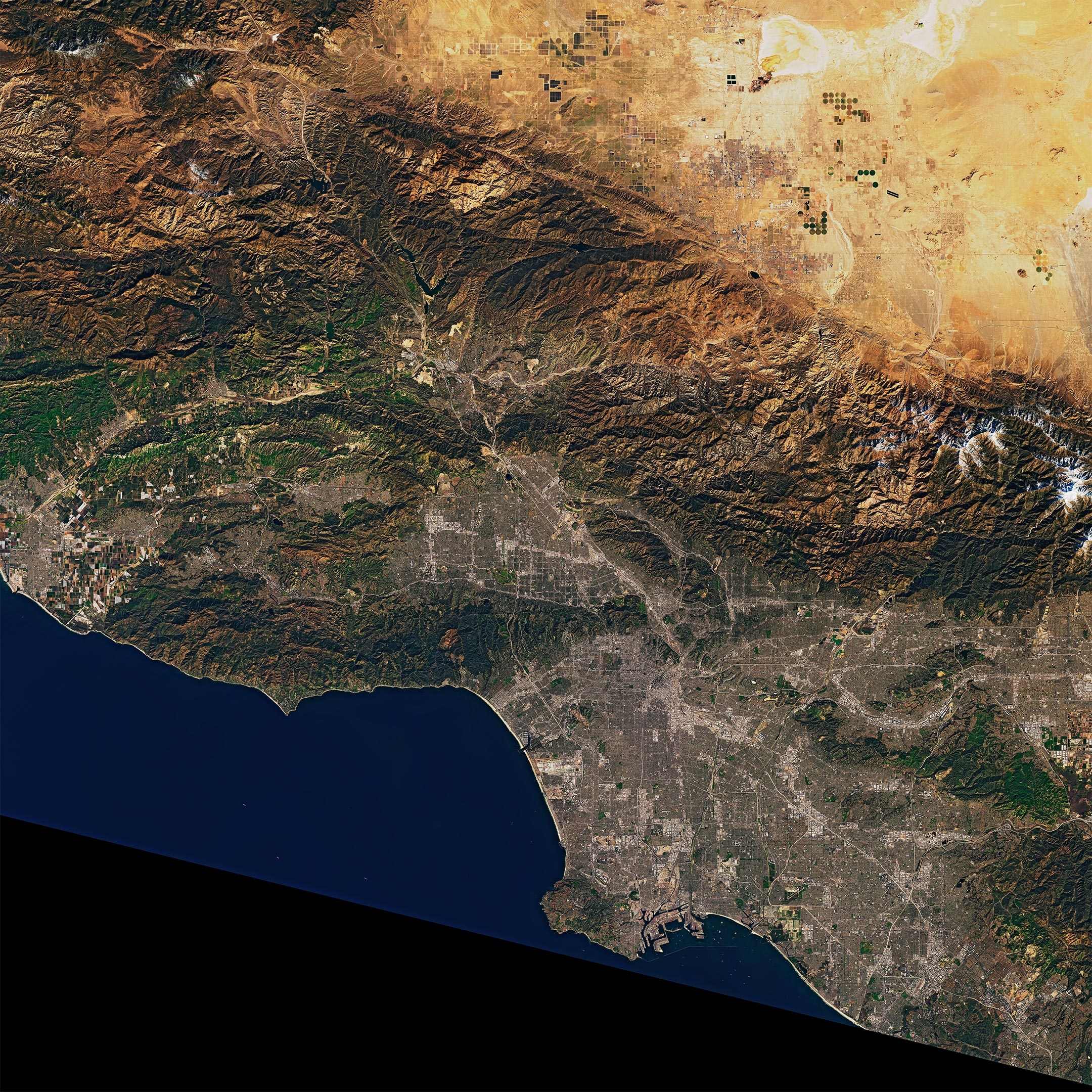
    Landsat 9 Los Angeles Annotated
    February 7, 2022

    Landsat 9 completed its own pass last week in time for the big game.

    Passes will be flying today in Los Angeles at the Super Bowl, one of the most-watched sporting events each year in the United States. Earlier this week, one of the science community’s newest satellites also flew over LA, continuing 50 years of watching the city—and the planet—from above.

    On February 7, 2022, the Operational Land Imager-2 (OLI-2) on Landsat 9 acquired these natural-color views of the Los Angeles area. The Super Bowl, the championship of American football, will be played in SoFi Stadium in Inglewood, California. It will be the eighth time the Los Angeles area has hosted the Super Bowl, but the first since 1993.

    NASA launched Landsat 9 in September 2021 from the Vandenberg Space Force Base, about 150 miles (240 kilometers) up the road from Los Angeles. The satellite took its “first light” images on October 31, and mission operators have since been testing the satellite’s systems and subsystems and calibrating its instruments. In late January 2022, NASA transferred operation of Landsat 9 to the U.S. Geological Survey (USGS).
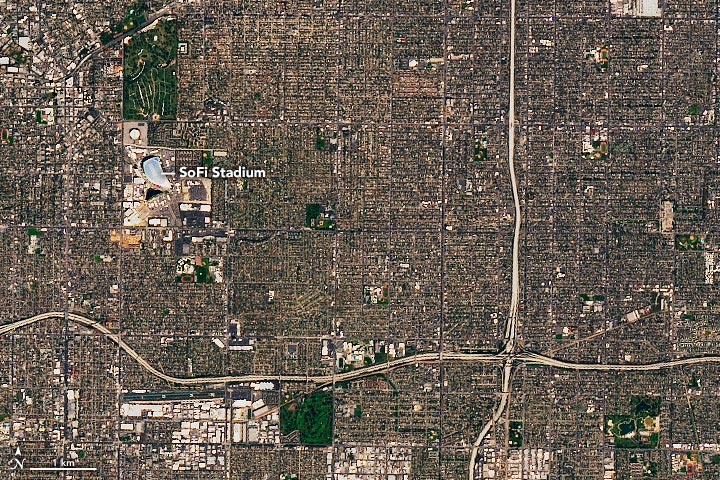
    Landsat 9 Los Angeles SoFi Stadium
    February 7, 2022

    On February 10, USGS announced that Landsat 9 data is now available for free download from EarthExplorer, Machine to Machine (M2M), and LandsatLook. Since October 31, 2021, Landsat 9 has collected more than 57,000 images of Earth. The images will be processed, archived, and distributed from the USGS Earth Resources Observation and Science Center.

    Landsat 9 carries two main instruments: OLI-2, which detects visible, near-infrared, and shortwave-infrared light in nine wavelengths, and the Thermal Infrared Sensor 2 (TIRS-2), which detects thermal radiation in two wavelengths used to measure Earth’s surface temperatures. The new satellite and instruments are quite similar in design to Landsat 8, which was launched in 2013 and remains in orbit. Together the satellites will collect approximately 1,500 images of Earth’s surface every day, observing the entire planet every eight days.

    Landsat 9 features several improvements, including higher radiometric resolution, allowing OLI-2 to detect more subtle differences in surface features, especially over darker areas like water or dense forests. With 14-bit radiometric resolution, Landsat 9 can differentiate more than 16,000 shades of a given wavelength; Landsat 8 provides 12-bit data and 4,096 shades. Landsat 7, the satellite being replaced, detects only 256 shades with its 8-bit resolution.
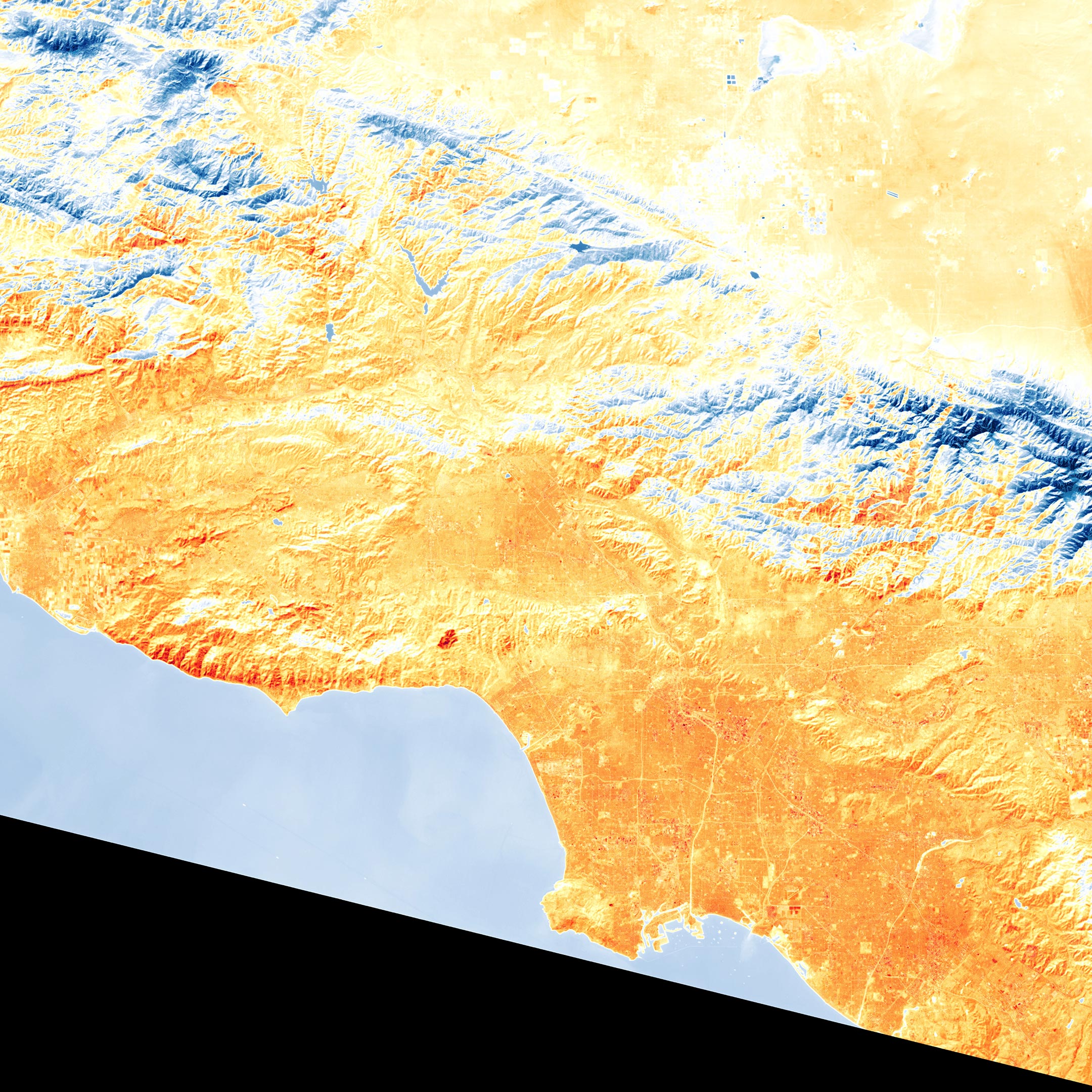
    Los Angeles Land Surface Temperature February 2022 Annotated
    February 7, 2022

    The third image was acquired on February 7 with the TIRS-2 instrument on Landsat 9. It shows land surface temperatures just before a winter heat wave hit Southern California. Temperatures have been 15 to 20 degrees Fahrenheit (8° to 11° Celsius) above normal this week in many parts of California, and several towns and cities (including Burbank) set new daily temperature records in February. The National Weather Service declared a heat advisory for February 9–13. Some forecasters are suggesting this Super Bowl could see some of the warmest game-time temperatures on record.

    NASA Earth Observatory images by Joshua Stevens, using Landsat data from the U.S. Geological Survey.

    Never miss a breakthrough: Join the SciTechDaily newsletter.
    Follow us on Google and Google News.

    Geography Landsat 9 NASA NASA Earth Observatory Weather
    Share. Facebook Twitter Pinterest LinkedIn Email Reddit

    Related Articles

    Exceptional Heat Hits Pacific Northwest – “Historic and Dangerous”

    California Reservoirs Reflect Deepening Drought – Worst They Have Been Since the 1970s

    Mesoscale Convective Weather System Sends Massive African Dust Cloud Into Europe

    Wild Swings in Great Lakes Ice Captured From Space

    A Deadly Torrent of Debris Flows From a Himalayan Mountain

    Trading Surfboards for Snowboards: Storms Have Left Abundant Snow Atop Hawaii’s Tallest Volcanic Mountains

    Massive Snowfall Blankets Spain – Heaviest Snowfall in the Region in 50 Years

    California Cool Yule Tule

    Incredible Rare Peek at Patagonia in Winter

    1 Comment

    1. Michelle Ingram on February 14, 2022 7:39 am

      They need to plant trees

      Reply
    Leave A Reply Cancel Reply

    • Facebook
    • Twitter
    • Pinterest
    • YouTube

    Don't Miss a Discovery

    Subscribe for the Latest in Science & Tech!

    Trending News

    Scientists Say This Hellish “Day-Night” Planet May Support Life

    Historians Got It Wrong: New Findings Rewrite the Story of the Battle of Hastings

    Scientists Just Broke the Solar Power Limit Everyone Thought Was Absolute

    Scientists Discover Protein That Turns Brown Fat Into a Calorie-Burning Machine

    Scientists Call for a Complete Rethink of Alzheimer’s Treatment

    Scientists Identify Molecular Switch That Lets Exercise Reverse Muscle Aging

    Why Your Most Vivid Dreams Might Be the Key to Deep, Restful Sleep

    A Bright Star Hid a Massive Secret for 50 Years: Mystery of Gamma Cassiopeiae Finally Solved

    Follow SciTechDaily
    • Facebook
    • Twitter
    • YouTube
    • Pinterest
    • Newsletter
    • RSS
    SciTech News
    • Biology News
    • Chemistry News
    • Earth News
    • Health News
    • Physics News
    • Science News
    • Space News
    • Technology News
    Recent Posts
    • These Unusual Glaciers Don’t Behave Like Others – and Scientists Say They Are Incredibly Dangerous
    • Scientists Just Discovered a Hidden Freshwater World Beneath the Great Salt Lake
    • Why Your Daily Shower Could Be Worsening the Water Crisis
    • Scientists Find Surprising Way To Protect Hedgehogs From Roads
    • Penguins in Zoos Age Faster Than Their Wild Counterparts
    Copyright © 1998 - 2026 SciTechDaily. All Rights Reserved.
    • Science News
    • About
    • Contact
    • Editorial Board
    • Privacy Policy
    • Terms of Use

    Type above and press Enter to search. Press Esc to cancel.