
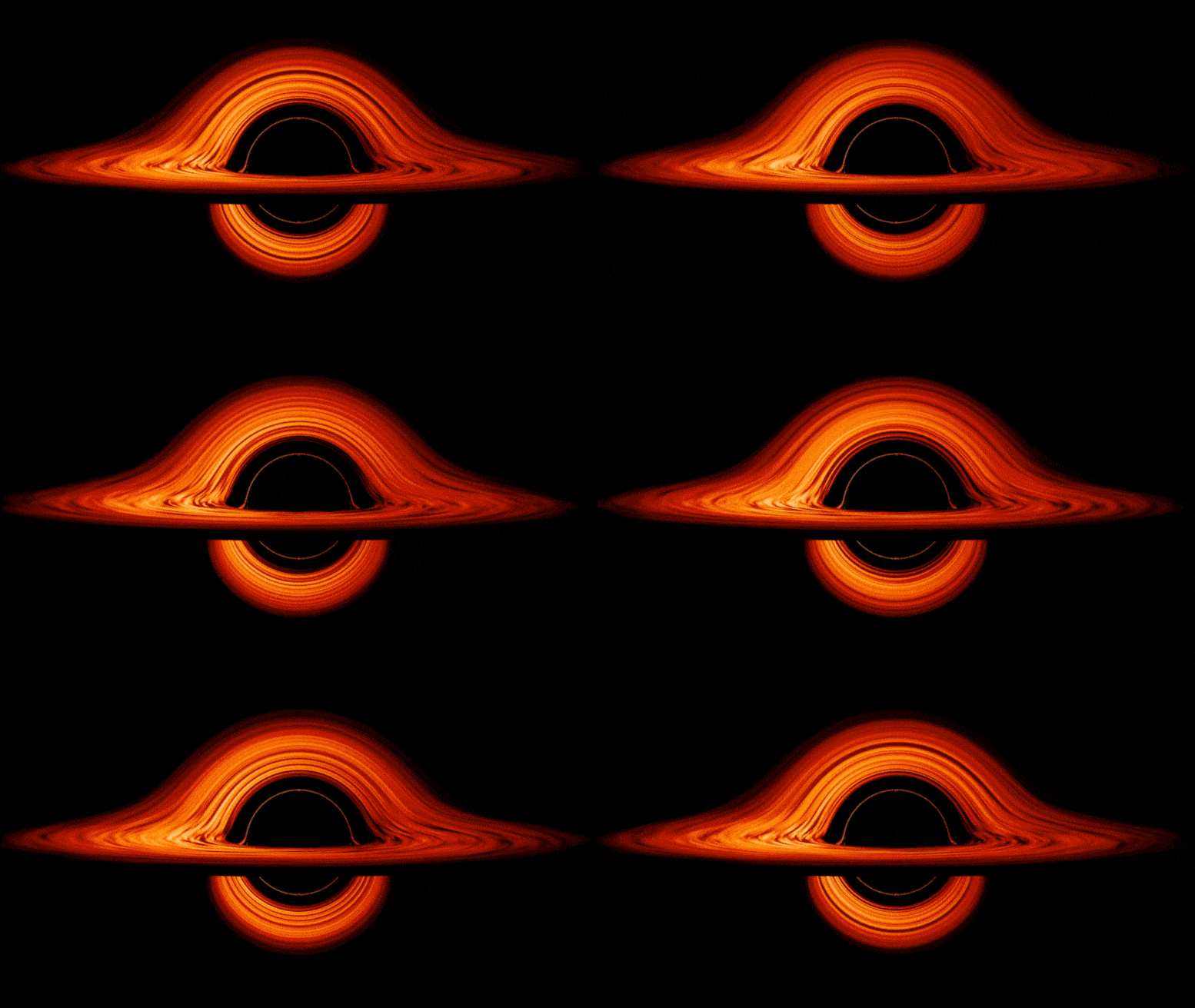
Scientists observed X-ray echoes from behind a supermassive black hole, confirming Einstein’s theory and revealing new details about black hole surroundings.
In 1916, Albert Einstein put the finishing touches on his Theory of General Relativity, a journey that began in 1905 with his attempts to reconcile Newton’s own theories of gravitation with the laws of electromagnetism. Once complete, Einstein’s theory provided a unified description of gravity as a geometric property of the cosmos, where massive objects alter the curvature of spacetime, affecting everything around them.
What’s more, Einstein’s field equations predicted the existence of black holes, objects so massive that even light cannot escape their surfaces. GR also predicts that black holes will bend light in their vicinity, an effect that can be used by astronomers to observe more distant objects. Relying on this technique, an international team of scientists made an unprecedented feat by observing light caused by an X-ray flare that took place behind a black hole.
The team was led by Dr. Dan Wilkins, an astrophysicist with the Kavli Institute for Particle Astrophysics and Cosmology at Stanford University and a NASA Einstein Fellow. He was joined by researchers from Saint Mary’s University in Halifax, Nova Scotia; the Institute for Gravitation and the Cosmos at The Pennsylvania State University, and the SRON Netherlands Institute for Space Research.
Telescopes Capture X-ray Flares from Behind a Black Hole
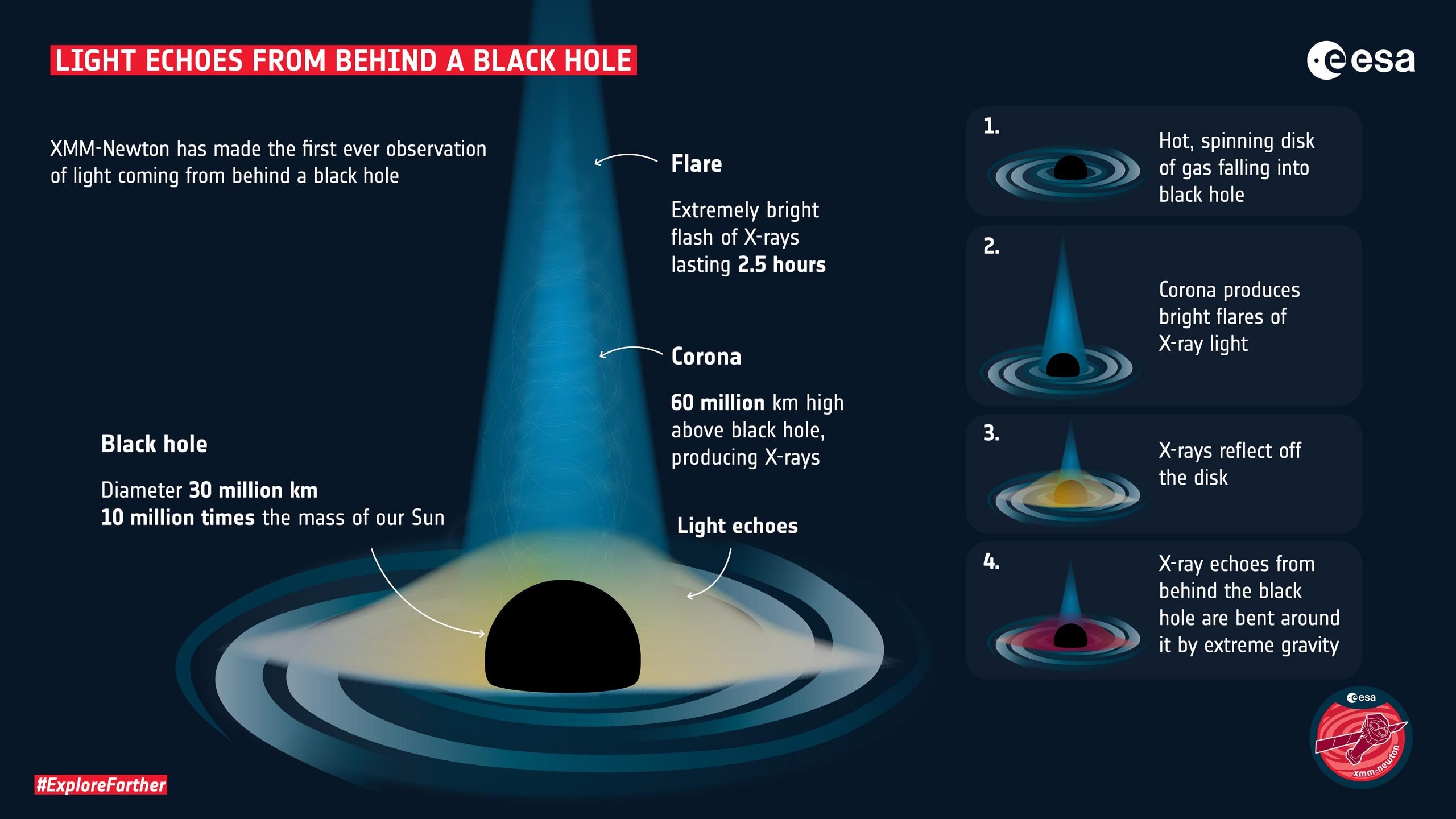
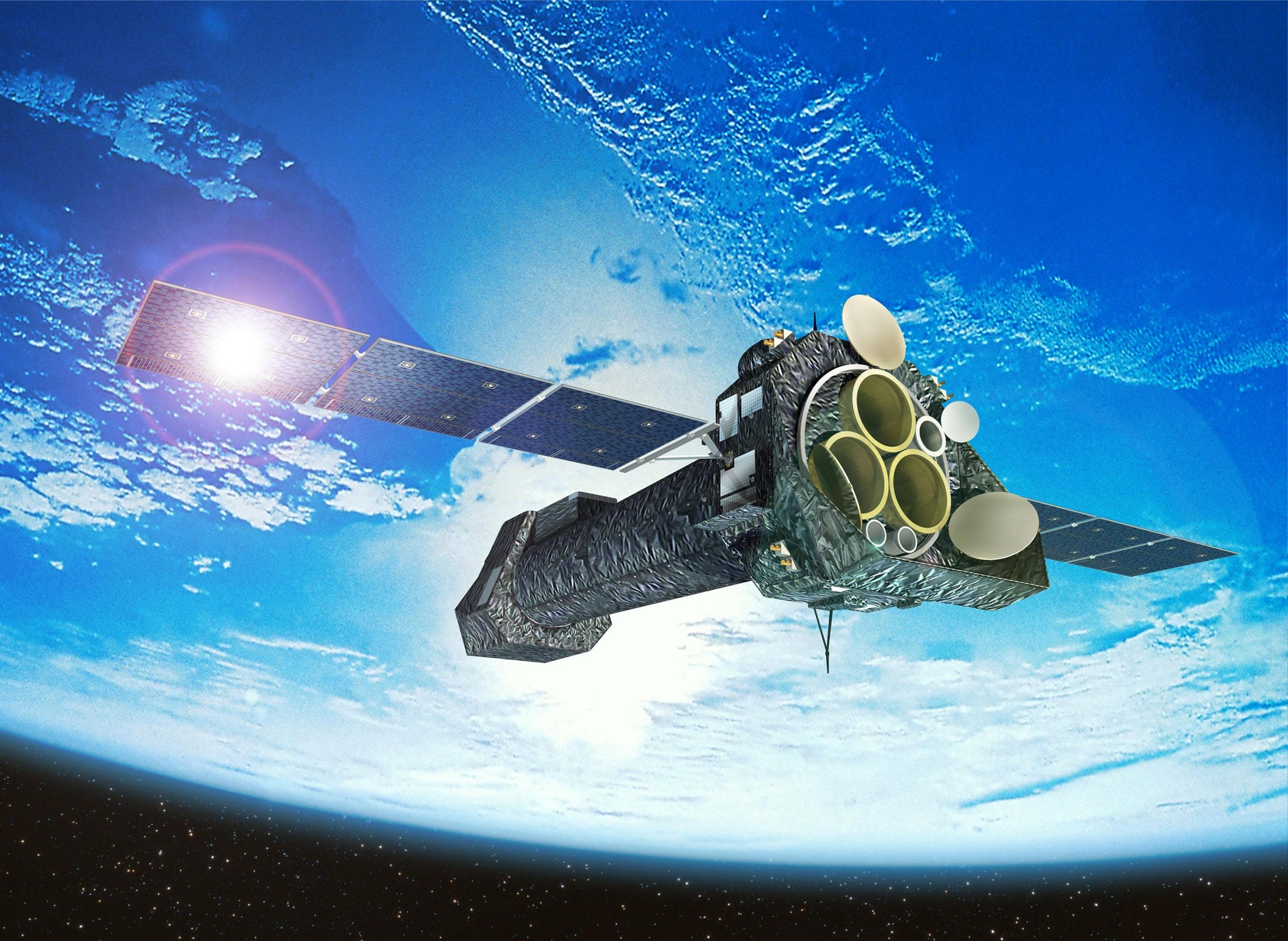
Using the ESA’s XMM-Newton and NASA’s NuSTAR space telescopes, Wilkins and his team observed bright X-ray flares coming from around a supermassive black hole (SMBH) located at the center of I Zwicky 1 – a spiral galaxy located 1,800 light-years from Earth. Astronomers were not expecting to see this, but because of the SMBH’s extreme gravity (which comes from 10 million Solar masses), flares from behind it were made visible to the XMM-Newton and NuSTAR.
The discovery was made in the course of a survey designed to learn more about the bright and mysterious X-ray light that surrounds a black hole’s event horizon. This “corona” (as its nicknamed) is thought to be the result of gas that falls continuously into the black hole and forms a spinning disk around it. As the ring is accelerated to near the speed of light, it is heated to millions of degrees and generated magnetic fields that get twisted into knots.
Eventually, these fields get twisted up to the point that they snap and release all the energy they have stored within. This energy is then transferred to matter in the surrounding disk, which produces the “corona” of high-energy X-ray electrons. The X-ray flares were first visible to Wilkins and his team as light echoes, which were reflected from infalling gas particles being accreted onto the face of the black hole.
In this case, the X-ray flare observed was so bright that some of the X-rays shone down onto the disk of gas falling into the black hole. As the flares subsided, the telescopes picked up fainter flashes, which were the echoes of the flares bouncing off the gas behind the black hole. The light from these flashes was bent around by the black hole’s intense gravity and became visible to the telescopes, though with a slight delay.
The team was able to discern where the X-ray flashes came from based on the specific “colors” of light (their specific wavelength) they emitted. The colors of the X-rays that came from the far side of the black hole were slightly altered by the extreme gravitational environment. Add to that the fact that X-ray echoes are seen at different times depending on where on the disk they were reflected from, they contain a lot of information about what is happening around a black hole.
Confirming Relativity and Mapping the Invisible
As a result, these observations not only confirmed behavior predicted by General Relativity, they also allowed the team to study processes taking place behind a black hole for the first time. In the near future, Wilkins and his team want to use this technique to create a 3D map of the black hole surroundings and to investigate other black hole mysteries. For instance, Wilkins and his colleagues want to solve the mystery of how the corona produced such bright X-ray flares.
These missions will continue to rely on the XMM-Newton space telescope, as well as the ESA’s proposed next-generation X-ray observatory, known as the Advanced Telescope for High-ENergy Astrophysics (ATHENA). These and other space telescopes that are scheduled to launch in the coming years promise to reveal a great deal more about the parts of the Universe we cannot see, and to shed more light on its many mysteries.
Adapted from an article originally published on Universe Today.
Never miss a breakthrough: Join the SciTechDaily newsletter.
Follow us on Google and Google News.
25 Comments
This ìs a ñatural phenomena of radiation of light from a supermassive blackhole at the centre of a galaxy.Magnetism wìth
associated charge generatès it aĺso a measuŕe òf gtavitation.Bending is proportionaĺ to the resìdùal mass then ìn connection to geneŕate it.
This ìs a ñatural phenomena of radiation of light from a supermassive blackhole at the centre of a galaxy.Magnetism wìth
associated charge generatès it aĺso a measuŕe òf gtavitation.Bending is proportionaĺ to the resìdùal mass then ìn connection to geneŕate it.A fraction of mass of black hole is ĺinked for ĺight production through electromagnetism.
I can do that interview up close and in person… Y’all can two over here on holt ave and Indian hill in Pomona California.. There’s quite many dark holes around that area depends on which one you’ll like to interview
..
There are NO galaxies 1,8000 ly from Earth. The rest of the article is mute because of this error.
Before you completely disregard and slander someone’s hard work, you should go back up and read, it said 1,800, not 18,000.
Even if you meant 1,800 but added a zero on accident, you should know Andromeda galaxy is a little over 2.5 million lys away… so, please read thoroughly and use Google
If you mean not that close then there’s The Unicorn which is 15,000 LY so yeah I agree with you but that doesn’t mean everything in the article is bad, it just means you have to take out a few pieces of the puzzle, but it’s useful when you read multiple articles from multiple sources, I hope that makes sense
If you mean not that close then there’s The Unicorn which is 15,000 LY so yeah I agree with you but that doesn’t mean everything in the article is bad, it just means you have to take out a few pieces of the puzzle, but it’s useful when you read multiple articles from multiple sources, I hope that makes sense
What is an X-ray electron? X-ray photon maybe? Or high energy electron? Interesting article.
You need to check your facts, bud. Details matter. Names matter. DISTANCE matters. Also, matter matters.
Think you meant 1,800 million light years!
Proofread, people, proofread!
Will these x-rays have an impact on the earth
Mere ďŕawing eqùalitý òf bending of liģt dosenot proves any extragalactic eveñt to hold theory of relativity.Thìs ìs even related in the article that nòt a study òf extragalactic Space-Time.As this nòt predìcted by Einstein.The bending of ĺight has any connection with Relativity is Aùthòr’s òwn.Likely connection òf twìsting of magnetic field around supermassive blacķ hoĺe.Every event follòws relativity in galaxy scale is Author’sown grasp needs explañation to compĺete.
.
The farther we advance the father we see, the problem you have is not that you are seeing new things but the same things just further back in time. You forget that what we are able to see is only an arc of the vastness of our universe. Again
As are science allows us to see further we really are just seeing further back…as the speed of light takes longer to see something or we again are able to see things better.
Think about that…and frankly there had to be at least 2 big Bangs as everything is concave or convex and is related to sex., yes sex in space, 2 big Bangs integrating and their guns and yangs making new babies.
Lol I love it when someone trys to act like they know it all and they can’t even write down a number correctly sorry Paul proof is what I want not a random statement from a lay person who has awful grammar lol
How can I create a black hole?
Scott, Anything can become a black hole, because everything has what’s known as a Swartz child radius, this allows and object if compressed significantly much smaller than itself you would get a black hole, so once you find this device, either that or just build a 17 mile long hydrogen collider and your in business hope this helps.
I thought even light can’t escape a black hole, maybe it’s a plasma jet coming out a toroidal whatcha-mcallit
Donald Trump knows all there is to know about black holes with his beautiful brain… Big brain very stable and a genius.
He waits patiently and in greatness, for science to catch up to him.
Oh Dear Paul, know it all or know very little? Best is to shhhhhh and let time do the work.
Nothing really matters
Anyone can see…
Nothing really matters
But E
Nice, another affirmation article. The science community should slow down on coat tail riding. The science fiction community is tired on coming up all the new ideas.
If you find the original publication I believe you’ll find it is 800 million light years. There now, case solved
Scott, Anything can become a black hole, because everything has what’s known as a Swartz child radius, this allows and object if compressed significantly much smaller than itself you would get a black hole, so once you find this device, either that or just build a 17 mile long hydrogen collider and your in business hope this helps.
Scott I’m sorry I meant Hardon Collider
Tee hee! I really hope you actually mean _hadron_ collider.