
Close Menu
    Facebook X (Twitter) Instagram
    SciTechDaily
    • Biology
    • Chemistry
    • Earth
    • Health
    • Physics
    • Science
    • Space
    • Technology
    Facebook X (Twitter) Pinterest YouTube RSS
    SciTechDaily
    Home»Space»Acceleration of Quasar Outflows at Scale of Tens of Parsecs Discovered for the First Time
    Space

    Acceleration of Quasar Outflows at Scale of Tens of Parsecs Discovered for the First Time

    By University of Science and Technology of ChinaFebruary 28, 2022No Comments3 Mins Read
    Facebook Twitter Pinterest Telegram LinkedIn WhatsApp Email Reddit
    Share
    Facebook Twitter LinkedIn Pinterest Telegram Email Reddit
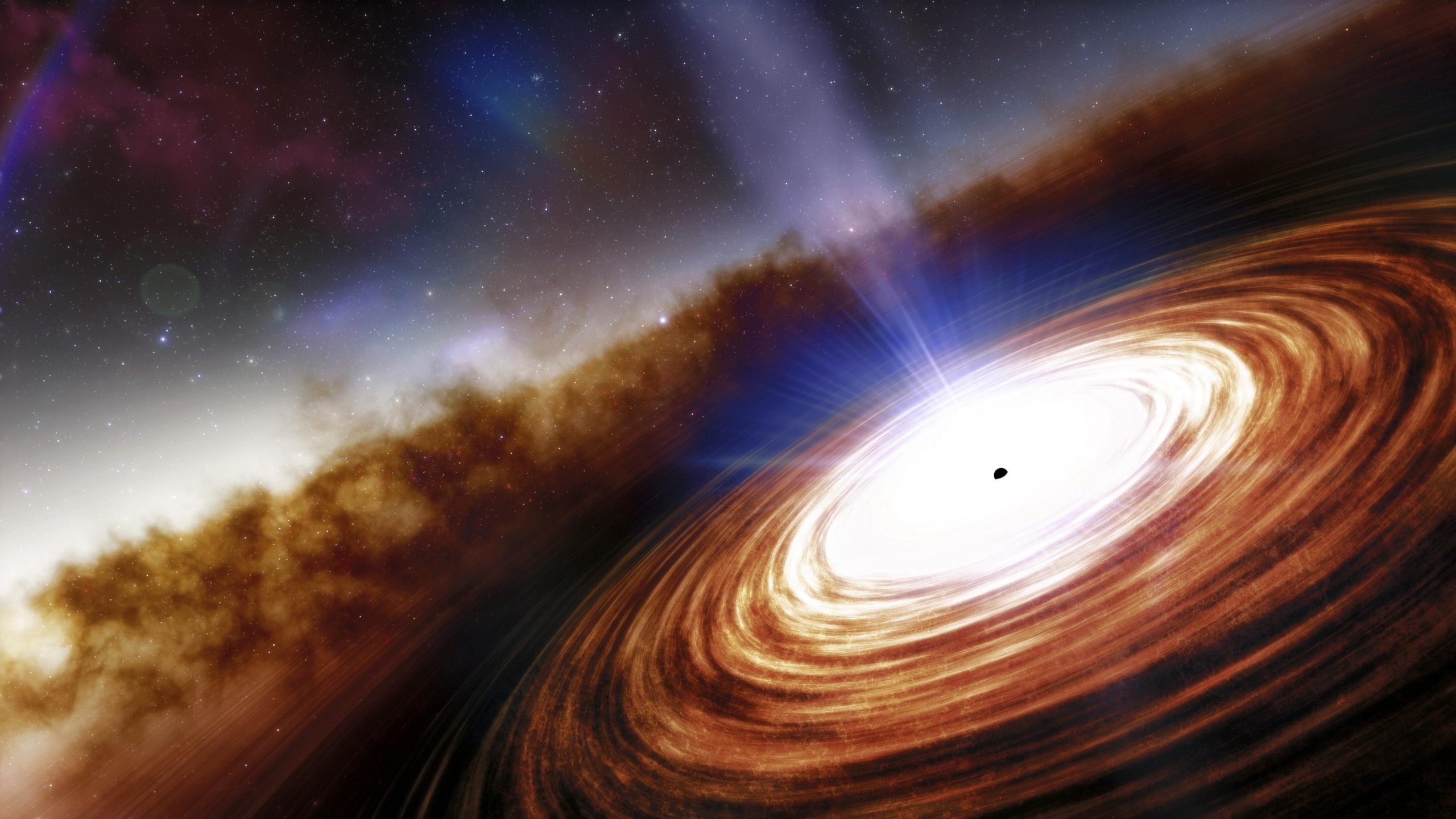
    Quasar J0313-1806
    Quasar illustration. Credit: NOIRLab/NSF/AURA/J. da Silva

    Researchers have identified quasar outflow acceleration and linked it to interstellar dust, revealing new insights into galaxy evolution.

    Dr. HE Zhicheng and his coworkers from the University of Science and Technology of China (USTC) of the Chinese Academy of Sciences created a new way to measure the physical properties of galactic ionized gas, and discovered the acceleration of quasar outflows at the scale of tens of parsecs for the first time. Their paper was published on Science Advances.

    Quasar Outflows and AGN Feedback Mechanism

    According to modern theories on galactic formation and evolution, the mechanism of Active Galactic Nuclei (AGN) feedback suggests that the gigantic black hole at a galactic center modulates its evolution by blowing ionized gas, namely the quasar outflow, preventing a potential oversized growth of black hole. The outflow, which transports matter and energy to host galaxies, serves as one of the predominant ways of AGN feedback.

    However, little was known about the outflow of active galaxies, for a key factor, the scale of outflows was mainly deduced from spectroscopic blueshifted adsorption lines (BAL). The obtained results were not reliable enough due to their heavy reliance on models.

    Dr. HE developed a new approach based on his previous studies. He proposed that BAL variation could be a powerful tool in probing outflows. In this work, he advanced this method by considering both the amplitude and the phase of the function which describes the response of ionized gas under radiation. They obtained the kinetic information regarding quasar outflows, and discovered the acceleration at a scale of tens of parsecs for the first time, which far exceeded that predicted by the traditional accretion disk wind model.

    Dust in Quasar Outflow Acceleration

    Interstellar dust could be a major reason for the acceleration, as proposed by Dr. HE and other fellow scholars, since the cross section between dust and accretion disk ultraviolet radiation far exceeds that of Thomson scattering of free electrons. Their calculations proved this hypothesis, and the speculated scale of outflow origin matched that of the dust ring, firmly supporting their theory.

    The findings indicated that dust did play an important role in the linkage between accretion disk radiation and interstellar media, and the significant effect of outflows on host galaxies was proven as well. The findings were also consistent with the evidence of outflows’ suppression on star formations, which was discovered recently by Dr. HE and his collaborators.

    Reference: “Evidence for quasar fast outflows being accelerated at the scale of tens of parsecs” by Zhicheng He, Guilin Liu, Tinggui Wang, Guobin Mou, Richard Green, Weihao Bian, Huiyuan Wang, Luis C. Ho, Mouyuan Sun, Lu Shen, Nahum Arav, Chen Chen, Qingwen Wu, Hengxiao Guo, Zesen Lin, Junyao Li and Weimin Yi, 11 February 2022, Science Advances.
    DOI: 10.1126/sciadv.abk3291

    Never miss a breakthrough: Join the SciTechDaily newsletter.
    Follow us on Google and Google News.

    Astronomy Astrophysics Popular Quasars University of Science and Technology of China
    Share. Facebook Twitter Pinterest LinkedIn Email Reddit

    Related Articles

    From Quasars to Black Holes: Spectral Energy Puts Established Theories in Question

    NASA’s Webb Telescope Will Look Back in Time, Use Quasars to Unlock the Secrets of the Early Universe

    Black Hole Pairs Found in Distant Merging Galaxies Provide Crucial Insight Into the Early Universe

    Seeing Quadruple: Artificial Intelligence Leads to Discovery That Can Help Solve Cosmological Puzzles

    Massive X-ray Jet – Extending for 160,000 Light-Years – Spied From Supermassive Black Hole in Early Universe

    Astronomers Have Discovered the Most Distant Source of Radio Emission Ever Known – 13 Billion Light-Years Away

    Astronomers Discover Earliest Supermassive Black Hole and Quasar in the Universe – 1000x More Luminous Than the Milky Way

    Most Distant Quasar Discovered Sheds Light on How Supermassive Black Holes Grow

    Research Shows NASA’s James Webb Space Telescope Will Reveal Hidden Galaxies

    Leave A Reply Cancel Reply

    • Facebook
    • Twitter
    • Pinterest
    • YouTube

    Don't Miss a Discovery

    Subscribe for the Latest in Science & Tech!

    Trending News

    Popular Vitamin B3 Supplements May Help Cancer Cells Survive, Scientists Warn

    Scientists Discover Strange Property of Rice and Turn It Into a Smart Material

    NASA Artemis II Skips Burn As Astronaut Captures Stunning View of Earth

    NASA’s Artemis II: Humans Just Left Earth Orbit for the First Time Since 1972

    What Causes Chronic Pain? Scientists Identify Key Culprit in the Brain

    Semaglutide Shows Surprising Mental Health Benefits in Massive 100,000-Person Study

    This Liquid Snapped Instead of Flowing and Scientists Were Shocked

    Breakthrough Alzheimer’s Drug Rewires the Brain Instead of Just Clearing Plaques

    Follow SciTechDaily
    • Facebook
    • Twitter
    • YouTube
    • Pinterest
    • Newsletter
    • RSS
    SciTech News
    • Biology News
    • Chemistry News
    • Earth News
    • Health News
    • Physics News
    • Science News
    • Space News
    • Technology News
    Recent Posts
    • Scientists Uncover the Secret “Glue” That Helps Soil Hold Water
    • Climate Change Is Altering a Key Greenhouse Gas in a Way Scientists Didn’t Expect
    • Why Antarctic Sea Ice Suddenly Collapsed After Decades of Growth
    • Astronomers Discover the Most Pristine Star Ever Found
    • New Study Suggests Gravitational Waves May Have Created Dark Matter
    Copyright © 1998 - 2026 SciTechDaily. All Rights Reserved.
    • Science News
    • About
    • Contact
    • Editorial Board
    • Privacy Policy
    • Terms of Use

    Type above and press Enter to search. Press Esc to cancel.