
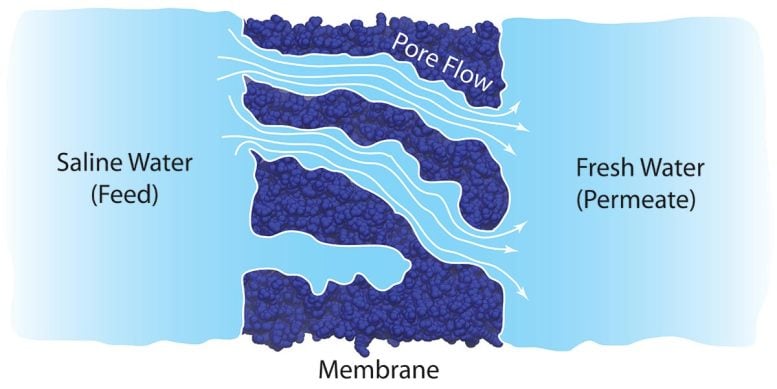
Researchers have found that the accepted theory of reverse osmosis, based on concentration gradients, is incorrect. Instead, pressure changes within the membrane drive the process, potentially leading to more effective uses in desalination, wastewater treatment, and energy production.
The process of reverse osmosis has proven to be the state-of-the-art method for removing salt from seawater and increasing access to clean water. Other applications include wastewater treatment and energy production.
Now a team of researchers reveal in a new study that the standard explanation for how reverse osmosis works — one that has been accepted for more than five decades — is fundamentally wrong. In the process, the researchers offer an alternate theory. Besides correcting the record, these insights could lead to more effective uses of reverse osmosis. The results of the study, led by the lab of Prof. Menachem Elimelech, are published in Science Advances.
Conventional Solution-Diffusion Model Under Scrutiny
Reverse osmosis — a technology first put to use in the 1960s — removes salt and impurities from water by passing the water through a semipermeable membrane, which allows the water to go through while blocking the contaminants. To explain exactly how it works, researchers have used the theory of solution-diffusion. This theory assumes that the water molecules dissolve and diffuse through the membrane by way of their concentration gradient — that is, the molecules move from areas of high concentration to wherever there are fewer molecules. Although this theory has been widely accepted for more than 50 years and is even taught in textbooks, Elimelech said he has long had questions about it.
“Some of the assumptions do not make any sense,” said Elimelech, the Sterling Professor of Chemical and Environmental Engineering. For instance, he said, the theory is based in part on the idea that pressure across the membrane is constant. “Whenever you have water flow through any porous material, there is always a pressure drop.”
To get a better sense of the physics involved, the research team — which included scientists from the University of Wisconsin-Madison and Texas Tech University — did a combination of experiments and computer simulations. Specifically, they used simulations of the molecules’ movements, which revealed that water transport is driven by changes in pressure within the membranes. They further show that water molecules travel as clusters through a network of pores in the membrane. This contrasts with the conventional theory based on the solution-diffusion model, which assumes that the water molecules separate from each other in the membranes.
Supplementing the computer simulations, the scientists performed experiments that allowed them to observe water passing through membranes. The results showed that the way that water permeates the membrane depends on the membrane pore size, the size of the water molecules, and viscosity of the water. This was also inconsistent with the solution-diffusion model.
Pressure Drives Reverse Osmosis
Overall, the simulations and experiments demonstrated that, rather than being driven by the concentration of molecules, reverse osmosis is driven by pressure changes within the membrane.
Because previous measurements related to reverse osmosis were based on a faulty understanding of it on a molecular level, Elimelech said, many attempts to advance the field have met a dead end. Having a more accurate theory to explain reverse osmosis, he said, could open the way toward developing more effective materials and techniques to improve the process.
Reference: “Water transport in reverse osmosis membranes is governed by pore flow, not a solution-diffusion mechanism” by Li Wang, Jinlong He, Mohammad Heiranian, Hanqing Fan, Lianfa Song, Ying Li and Menachem Elimelech, 14 April 2023, Science Advances.
DOI: 10.1126/sciadv.adf8488
Other authors of the study include Li Wang, Mohammad Heiranian, Hanqing Fan (all from Yale); Jinlong He and Ying Li from University of Wisconsin-Madison; and Lianfa Song from Texas Tech University.
This work was supported by the National Alliance for Water Innovation (NAWI), funded by the U.S. Department of Energy, Office of Energy Efficiency and Renewable Energy (EERE), Advanced Manufacturing Office, under Funding Opportunity Announcement Number DE-FOA-0001905 through a subcontract to Yale University and University of Wisconsin-Madison.
Never miss a breakthrough: Join the SciTechDaily newsletter.
Follow us on Google and Google News.