
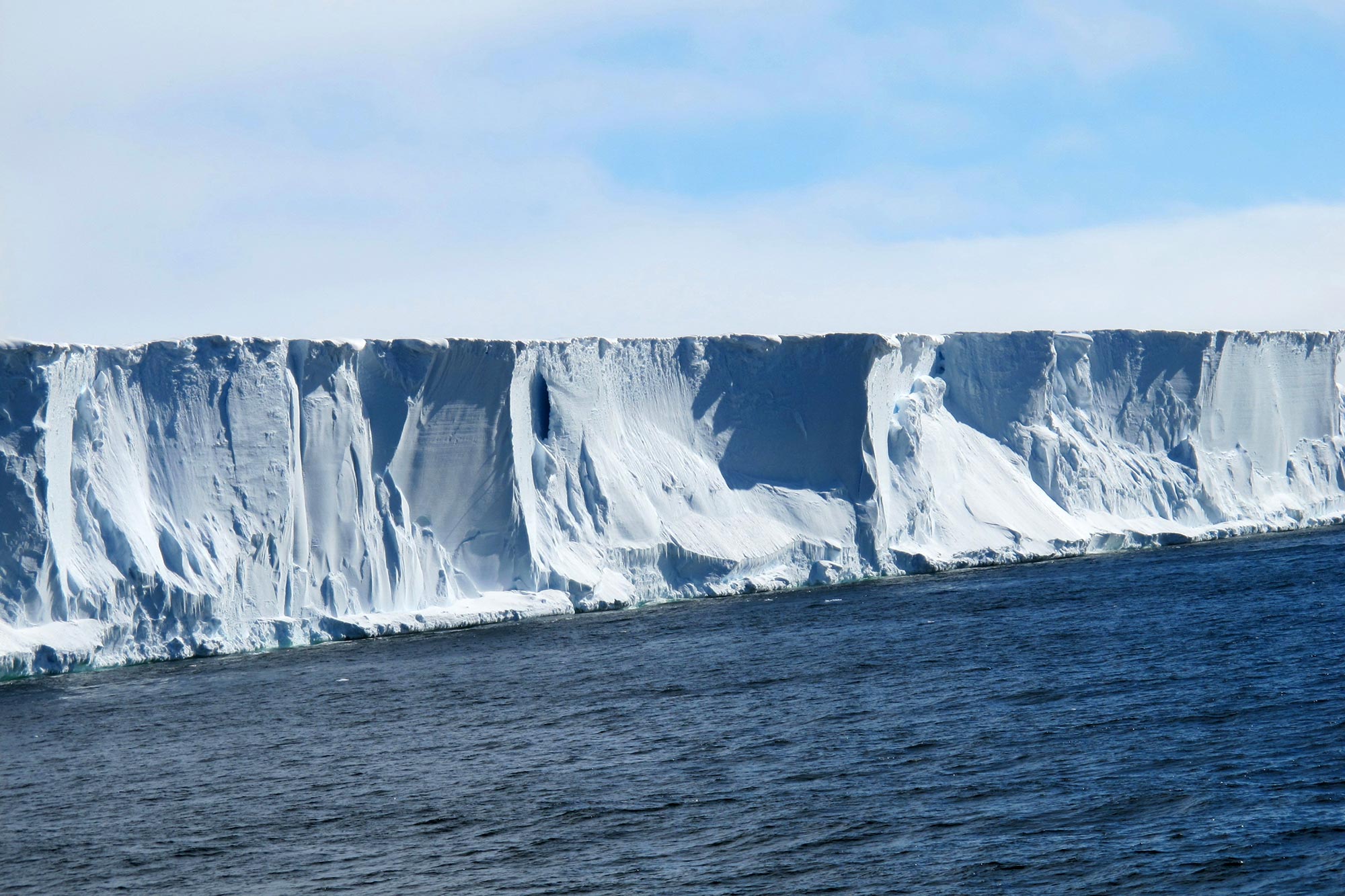
Warming ocean waters are melting Antarctica’s Ross Ice Shelf at accelerating rates, highlighting a climate-driven trend with implications for global sea levels and climate modeling.
New research unveils, for the first time, how warming ocean waters have intensified melting on a major Antarctic ice shelf over the past 40 years.
Scientists from the University of East Anglia (UEA) say the study – the result of their autonomous Seaglider getting accidentally stuck underneath the Ross Ice Shelf – suggests this will likely only increase further as climate change drives continued ocean warming.
The glider, named Marlin, was deployed in December 2022 into the Ross Sea from the edge of the sea ice. Carrying a range of sensors to collect data on ocean processes that are important for climate, it was programmed to travel northward into open water.
However, Marlin was caught in a southward-flowing current and pulled into the ice shelf cavity where it remained, with its sensors on, for four days before re-emerging. During this time the ‘lost’ glider completed 79 dives, taking measurements of the water within the cavity to a depth of 200 meters, right up to the base of the overlying ice shelf.
Warm Water Intrusion and Ice Shelf Melting
Researchers from UEA’s School of Environmental Sciences recorded a 50-meter-thick ‘intrusion’ of – relatively – warm water that had entered the cavity from the nearby open water. Water temperatures ranged from -1.9°C to a warmer -1.7°C under the ice.
Subsequent re-analysis of all available measurements shows that heat transported into the cavity has increased over the last 45 years, most likely due to the warming of the Ross Sea because of climate change. The findings are published in the journal Science Advances.

“While the temperature increase – four-thousandths of a degree a year – might not seem all that much, it could lead to around 20 to 80 cm of additional ice loss per year over the 45 years we look at,” explained lead author Dr Peter Sheehan.
“We found the waters of the intrusion were warm enough to melt the underside of the ice shelf, unlike the freezing-point waters they likely displaced. What’s new here is that we can track the warm water pretty much from the open water of the Ross Sea at the ice front, back into the cavity. We have not seen one of these intrusions happening directly before.”
Dr Sheehan added: “A trip into the cavity underneath the Ross Ice Shelf was not planned, and it’s not normally possible to measure this region of an ice shelf: you can’t send instruments this close to the underside of an ice shelf deliberately, it’s too risky.”
The ice shelves that surround Antarctica are exposed to the warmth of the ocean across the expanse of their undersides that float out over the continent’s shelf seas, and the ocean-driven melting that occurs at the ice base is the largest cause of Antarctic ice-mass loss.
While the melting of floating ice does not itself substantially raise sea level, ice shelves slow the seaward flow of land ice and so stabilize the Antarctic ice sheet; their thinning and disintegration would hasten the delivery of land ice to the ocean and accelerate global sea-level rise.
Impact of Ekman Heat Transport
One of the processes that can drive warm surface water under the Ross Ice Shelf is wind. Certain wind patterns lead to southward flow in the surface ocean and into the ice shelf cavity.
These wind-driven ocean-surface flows are called Ekman currents, and as with any ocean current, these have an associated heat transport. Because this is an ocean-surface process, this heat is instantly available to melt the overlying ice: it doesn’t have to wait to be mixed upward to the ice base.
Ekman heat transport is particularly relevant for climate scientists because oceans absorb and redistribute much of the Earth’s heat. Changes in this system can have profound effects on weather, sea levels, and global temperature trends.

Dr Sheehan and co-author Prof Karen Heywood used long-term measurements of wind and ocean temperature – blended with a model to fill in spatial and temporal gaps in the record – to calculate the strength of southward Ekman heat transport over the last 45 years. They found that the heat transported into the cavity by Ekman currents has increased.
Year-to-year variability is driven by the wind. However, the trend towards greater heat transport into the cavity is likely linked to the warming of the Ross Sea – because the water has warmed, winds today will transport more heat energy into the cavity than winds of comparable strength in the past.
Prof Heywood said: “It appears reasonable to expect that the magnitude of the Ekman heat flux, and of the melting that it drives, will increase yet further as climate change drives continued ocean warming. This trend is a concern in itself.
“The influence of surface-water intrusions, alongside the trends and variability in the Ekman dynamics that can drive these, must be incorporated into climate models, not least given continued uncertainty in the response of Antarctic land-based ice to climate change.”
This is the first time that this process has been looked at using a long-term, multi-decadal data set. Previous understanding of surface-water intrusions has come mainly from comparisons of hydrography in open water, for example from ships, observations from tagged seals, and ice moorings deployed within a cavity.
Reference: “Ross Ice Shelf frontal zone subjected to increasing melting by ocean surface waters” by Peter M. F. Sheehan and Karen J. Heywood, 8 November 2024, Science Advances.
DOI: 10.1126/sciadv.ado6429
The study was funded by the UK Natural Environment Research Council, the US National Science Foundation, and the European Research Council Horizon 2020 program.
Never miss a breakthrough: Join the SciTechDaily newsletter.
Follow us on Google and Google News.
7 Comments
“…, most likely due to the warming of the Ross Sea because of climate change.”
Competent and experienced scientists develop several ideas on how or why something happens, as advised by T. C. Chamberlain (1890) in his seminal paper, The Method of Multiple Working Hypotheses.
https://www.science.org/doi/10.1126/science.148.3671.754
Where are the alternatives to “climate change” in this report? Why is only one explanation being promoted? In particular, why is submarine vulcanism not mentioned when the Antarctic warming is different from what is happening elsewhere in the oceans, and the ‘warm’ water is found below the surface despite being more bouyant than colder water?
“…, ice shelves slow the seaward flow of land ice and so stabilize the Antarctic ice sheet; …”
One sees this claim frequently. However, the evidence for it is weak. If the ice shelf is grounded (a case of an unstoppable force encountering an immovable object) then there is probably an observable effect; although, if the ice is thick enough it can plastically shear over the obstacle as it often does on land with uneven bedrock topography.
I have watched a time-lapse animation on the internet, which is touted as demonstrating an acceleration after the calving of an iceberg, several times and I cannot perceive the claimed increase in speed. One would expect that if the shelf ice were buttressing the glacier that there would be compression ridges upstream from the ice shelf. Instead, what one observes is tension cracks that allow the calving! Why would one expect floating ice to offer more resistance to movement than the bedrock friction on an irregular land surface? “You got some ‘splainin’ to do, Lucy!”
“…, ice shelves slow the seaward flow of land ice and so stabilize the Antarctic ice sheet; …”
One might suppose that large masses of ice shelf, such as the Ross Ice Shelf, have a certain inertia; and even plastic shearing of ice over bedrock takes a bit of effort as it would require deformation of the ice crystals . I would expect that the Ross Ice Shelf has swales that are the result of a compression-extension deformation and that such a deformation would also engender tension fractures of appropriate orientation, as well as other tension fractures caused by different rates of lateral shearing.
However, that article does have a circular argument in it, much as I support the use of “likely” as indicating one of several possibilities. Although “likely” is better replaced by a more neutral word such as “possibly”.
As for geothermal heat-flow below the Ross Ice Shelf, the RIS is rather extensive and quite where the research was carried out is not indicated other by the ice cliffs in the background, which suggests that that photos were taken some distance away from such volcanic centres, past and present, dotted around the McMurdo Sound region.
From Britannica, “Newton’s first law: the law of inertia Newton’s first law states that if a body is at rest or MOVING AT A CONSTANT SPEED IN A STRAIGHT LINE, it will remain at rest or KEEP MOVING IN A STRAIGHT LINE AT CONSTANT SPEED unless it is acted upon by a force.” That is, the floating shelf ice still has the momentum of the glacier it is a part of, and any new ice that forms on the leading edge will inherit the momentum of the glacial ice. However, the floating section has much less basal friction than the ice on land. Therefore, the inertia of the shelf ice only impedes acceleration, NOT forward movement. Surging in glaciers is well known, but there isn’t agreement on what causes it, even when the glacier is entirely on land.
In a complex environment of obstacles, one can expect compression ridges on the upstream side of the obstacle, and tension cracks on the downstream side. However, the extremely large icebergs that break off and drift away from the main ice sheet don’t lend support to the claim that the icebergs had been acting to impede the forward motion of the shelf ice. Otherwise, they would remain in place.
If any up-slope geothermal hot spots are melting ice, the warm water will flow downhill, not necessarily staying where it melted.
Recalling that F=mv, such things as the Ross Ice Shelf have considerable mass and are rather old, so perhaps one would have to add up all the present mv bits of all the glaciers feeding the Ross Ice Shelf to incorporate them into arguments about the RIS buttressing, or not, glaciers. It’s sort of like rivers flowing downhill into the sea; the v bit of the mv gets dispersed across a large area, dumping its detritus onto the sea floor. Then again, the RIS is three dimensional which means that a fair swag of the floating bits are underwater, and water, whilst a movable object, may impede what is trying to push through it. Ships have that problem.
” Otherwise, they would remain in place”. That assumes a simple picture of a complex situation.
” and any new ice that forms on the leading edge will inherit the momentum of the glacial ice”. I was unaware that the new ice of the RIS formed at its leading edge; one could interpret that the leading edge is the seaward side.
“the inertia of the shelf ice only impedes acceleration”. Which surely is what the greenie argument is all about.The inertia impedes the acceleration of the assorted glaciers rushing seaward to drown us all by wiping out Real Estate built on sand-dunes by the sea.
And yes, the arguments cited in the article do sound somewhat circular.
Newton’s equation is actually Force = Mass x Acceleration, not velocity. The product of m and v is the momentum, and the first derivation of the velocity — the change in velocity over time — is the acceleration.
If the shelf ice is floating and the underside is melting, then the mass is decreasing with time. However, that doesn’t affect the velocity. It only reduces the inertia, meaning that the thinner the ice, the less effective it is at resisting a force resulting from acceleration.
The friction with water varies with the speed of the object moving through it, probably with the cube of the speed, as with air. At the speed with which a glacier moves, it is negligible. That is one of the reasons I take exception to the claim that floating shelf ice is buttressing the forward movement of the grounded ice.
During the Summer, much of the ‘pack ice’ melts, and then re-forms in the Winter. Despite humans not being able to perceive glacier movement over short time intervals, it is moving and remains a part of the ‘v’ in Newton’s equations. In the Winter, the ‘m’ variable increases, meaning the effectiveness in resisting acceleration forces increases.
Something that has not been considered is that most glaciers routinely surge. That means, additional force applied by the up-slope glacier will actually increase the speed to the grounded and floating ice. When the force from the surge decreases (the glacier slows down) the leading edge, principally the floating section, will have a higher velocity than before the surge. Thus, there will be tension between the faster floating section and the slower grounded section. One can expect tension cracks to form at the boundary between the faster floating ice and the currently slower grounded ice. Although, tides play a role in flexing and breaking the ice near the grounding line.
Yes, it is a complex situation, and I’m suggesting that the climatologists have simplified it to the point that they are arguing to support something that isn’t happening.
Incorrect, is my guess. The Russians, and Japanese, drilling in the centre of Antarctica decades back, found large liquid freshwater lakes below the icecap there. The heat doing that is from the rocks, both molten and solid, deep below. No warm ocean current could possibly have reached there from the liquid open oceans. This is being pushed to back the more-than-slightly-absurd notion that the farts of our cars, trucks and cows are driving the very real climate changes we are presently seeing.
The earth-moon barycentre moves from the top to the bottom of the mantle, each lunar month, and has since the moon arrived. maybe 2 billion years back. Hence our large magnetic field, the mantle, the crust and the core. The moon’s orbit shifts latitude fairly irregularly, hence the temperature changes on the earth’s surface, in this glacial epoch. Our galaxy takes about 300 million years to do one rotation around the small galaxy of which it is satellite, so shielding this planet from the magnetic field of the rest of the universe. The last one was the Permian. We are in a short interglacial within this present major glacial epoch.
Peter Spencer Ravenscroft, geologist and social anthropologist, Africa, Oceania and Australia, last 53 years. Details if wanted, always public domain and always free.