
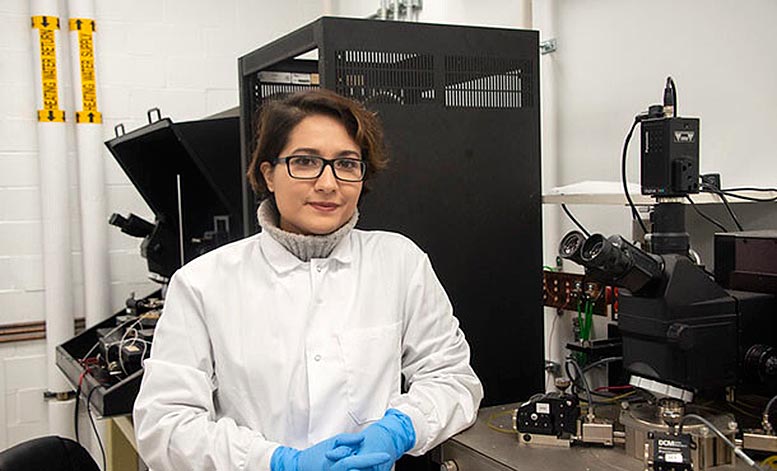
Penn State electrical engineering professor Aida Ebrahimi receives NIH Trailblazer Award for developing a daily testing device.
Current COVID-19 tests require laboratory processing, resulting in potentially sick people going to a lab or waiting days for a diagnosis. Now, with a three-year, $590,800 National Institutes of Health, National Institute of Biomedical Imaging and Bioengineering Trailblazer Award for New and Early-Stage Investigators, Penn State researchers plan to develop an affordable and accurate at-home, saliva-based COVID-19 test, rivaling the simplicity and convenience of pregnancy tests and glucose monitors, but with higher sensitivity.
The researchers, led by Aida Ebrahimi, assistant professor of electrical engineering and biomedical engineering, plan to design and develop a device that can provide test results within 30 minutes with an accuracy of more than 90%. The device could potentially be sensitive enough to detect the virus before a person begins to show symptoms or in asymptomatic people, according to Ebrahimi.
To accomplish this, the Ebrahimi Bioanalytical and Biosensor Lab will first use inactive SARS-CoV-2 viral particles to explore their unique electrical properties. All materials react to an electrical field, with varying responses depending on the materials’ properties. The researchers plan to determine these detailed parameters for the inactive viral particles to design the proposed electrochemical device.
“Based on the electrical properties of the virus, we are proposing a dual amplification approach to achieve the sensitivity we need to detect a low count of viral particles in saliva samples,” Ebrahimi said. “We are also proposing a new method to develop the sensor that will give us that sensitivity without expensive nanofabrication tools.”
The sensing device will use two concurrent signal amplification techniques to detect viral particles, which Ebrahimi explained will enhance the sensitivity of the device beyond conventional methods. The first will apply a small voltage through a set of electrodes to trap particles, and then another, to induce an electrochemical process called redox cycling, which can amplify the signals produced by the trapped particles to a detectable level.
“The dual amplification is key — we want to have enough sensitivity to count low numbers of the virus before a person even shows symptoms,” she said. “Eventually, the goal is that people can test their saliva at home, before coming into contact with other people.”
Next, the researchers will use photolithography, a cost-effective process that uses light to etch tiny patterns on a photosensitive surface. The patterns are designed to capture and sort the target viral particles from the saliva sample and route them to the sensor area.
Ebrahimi and her team will use computational modeling to guide the device design and develop the prototype, which they will test and validate using inactive virus particles. In the final phase of the project, the researchers will partner with Suresh Kuchipudi, clinical professor and head of the microbiology section in the Department of Veterinary and Biomedical Sciences, to safely test the diagnostic device with intact virus samples in Kuchipudi’s lab.
“The proposed concept of the device is not limited to SARS-CoV-2,” Ebrahimi said, noting the high risk, high reward potential of the project. “If proof-of-principle of this diagnostic device and the validation are successful, it can be applied to rapid quantification of biomarkers of other diseases, even beyond infectious diseases, such as Alzheimer’s disease. This project is just the first step toward bigger goals.”
Never miss a breakthrough: Join the SciTechDaily newsletter.
Follow us on Google and Google News.