
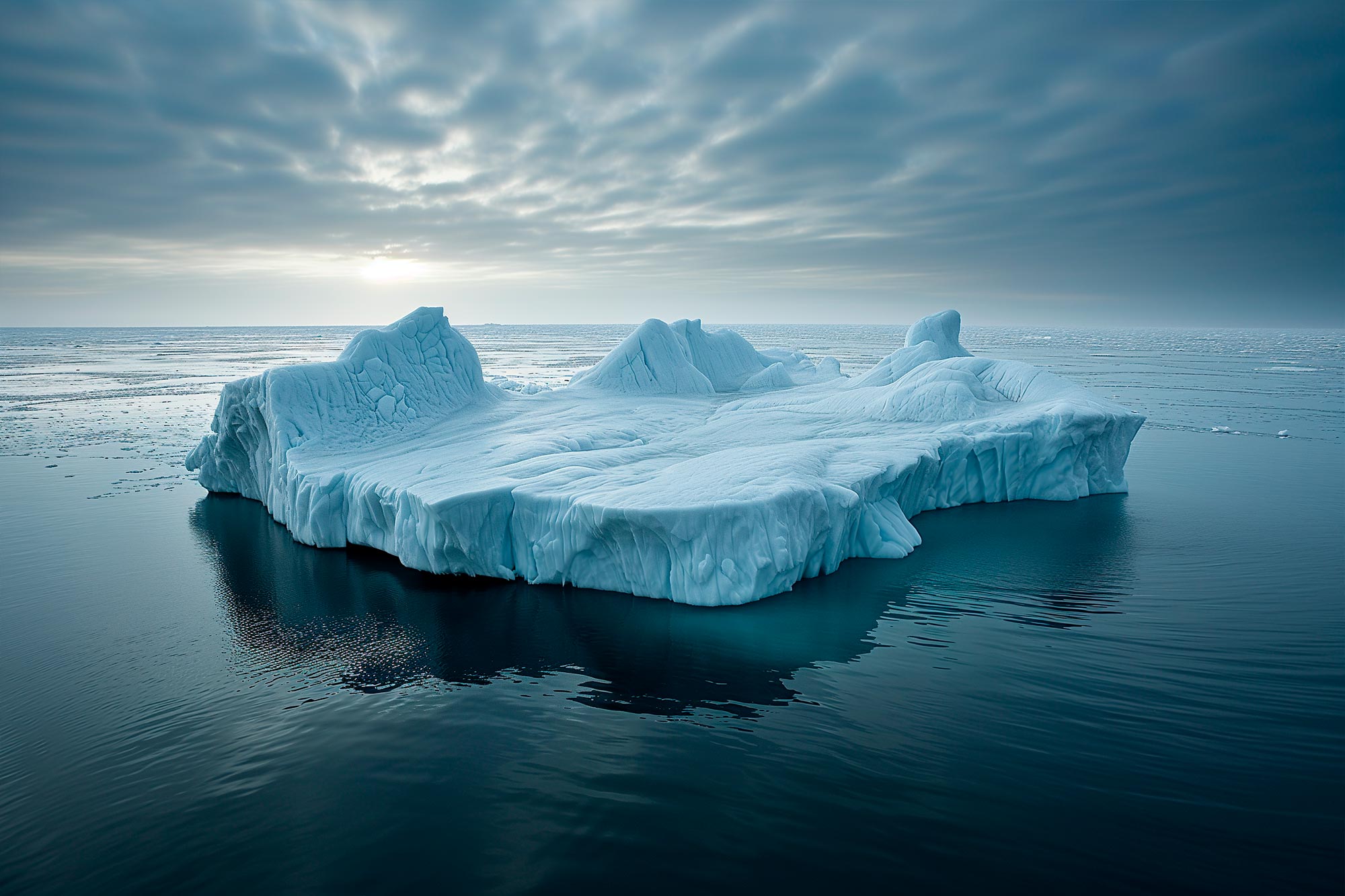
A study led by Dartmouth has compiled 16 models to refine projections of ice loss up to the year 2300.
A study led by Dartmouth, involving over 50 climate scientists from around the globe, offers the first clear projection of how carbon emissions could contribute to the loss of Antarctica’s ice sheet over the next 300 years.
The future of Antarctica’s glaciers after 2100 becomes uncertain when looking at existing ice-sheet models individually, the researchers report in the journal Earth’s Future. They combined data from 16 ice-sheet models and found that, collectively, the projections agree that ice loss from Antarctica will increase, but gradually, through the 21st century, even under current carbon emissions.
Uncertainty After 2100 and Potential Rapid Ice Loss
But that consistency falls off a cliff after 2100, the researchers found. The models predict that under current emissions, ice in most of Antarctica’s western basins begins to retreat rapidly. By 2200, the melting glaciers could increase global sea levels by as much as 5.5 feet. Some of the team’s numerical experiments projected a near-total collapse of the Antarctic ice sheet by 2300.
“When you talk to policymakers and stakeholders about sea-level rise, they mostly focus on what will happen up to 2100. There are very few studies beyond that,” says Hélène Seroussi, the study’s first author and an associate professor in Dartmouth’s Thayer School of Engineering.
“Our study provides the longer-term projections that have been lacking,” she says. “The results show that beyond 2100, the long-term impact for the regions most susceptible to sea-level rise become amplified.”
High- vs. Low-Emission Scenarios
The researchers modeled how Antarctica’s ice sheet would fare under both high- and low-emission scenarios through 2300, says Mathieu Morlighem, a Dartmouth professor of earth sciences and a co-author on the study. Dartmouth Engineering alumnus Jake Twarog ’24 also is a co-author of the study and contributed as an undergraduate.
“While current carbon emissions have only a modest impact on model projections for this century, the difference between how high- and low-emission scenarios contribute to sea-level rise grows sharply after 2100,” Morlighem says. “These results confirm that it is critical to cut carbon emissions now to protect future generations.”
The timing of when Antarctica’s glaciers would start retreating varied with the ice-flow model the researchers used, Seroussi says. But the speed with which large retreats occurred once a rapid loss of ice began was consistent among the models.
“All the models agree that once these large changes are initiated, nothing can stop them or slow them down. Several basins in West Antarctica could experience a complete collapse before 2200,” Seroussi says. “The exact timing of such collapses remains unknown and depends on future greenhouse gas emissions, so we need to respond quickly enough to reduce emissions before the major basins in Antarctica are lost.”
Future Collaboration and Research Directions
The study could lead to further collaborative models that scientists can use to understand and resolve disparities in projections for regions with significant modeling uncertainties, or for the Greenland ice sheet, Seroussi says. Research and computing resources can then be focused on investigating outcomes that those multiple models predict as most likely.
“We’re learning from the community of scientists what is going to happen,” Seroussi says. “This collaboration means we have a better, more robust assessment of the uncertainty, and we can see where our models agree and where they disagree so that we know where to focus our future research.”
Reference: “Evolution of the Antarctic Ice Sheet Over the Next Three Centuries From an ISMIP6 Model Ensemble” by Hélène Seroussi, Tyler Pelle, William H. Lipscomb, Ayako Abe-Ouchi, Torsten Albrecht, Jorge Alvarez-Solas, Xylar Asay-Davis, Jean-Baptiste Barre, Constantijn J. Berends, Jorge Bernales, Javier Blasco, Justine Caillet, David M. Chandler, Violaine Coulon, Richard Cullather, Christophe Dumas, Benjamin K. Galton-Fenzi, Julius Garbe, Fabien Gillet-Chaulet, Rupert Gladstone, Heiko Goelzer, Nicholas Golledge, Ralf Greve, G. Hilmar Gudmundsson, Holly Kyeore Han, Trevor R. Hillebrand, Matthew J. Hoffman, Philippe Huybrechts, Nicolas C. Jourdain, Ann Kristin Klose, Petra M. Langebroek, Gunter R. Leguy, Daniel P. Lowry, Pierre Mathiot, Marisa Montoya, Mathieu Morlighem, Sophie Nowicki, Frank Pattyn, Antony J. Payne, Aurélien Quiquet, Ronja Reese, Alexander Robinson, Leopekka Saraste, Erika G. Simon, Sainan Sun, Jake P. Twarog, Luke D. Trusel, Benoit Urruty, Jonas Van Breedam, Roderik S. W. van de Wal, Yu Wang, Chen Zhao and Thomas Zwinger, 04 September 2024, Earth’s Future.
DOI: 10.1029/2024EF004561
Never miss a breakthrough: Join the SciTechDaily newsletter.
Follow us on Google and Google News.
7 Comments
I remember 20 years ago when “climate scientists” were saying it would take 300 to 1,000 years for glacial ice melt to reach what it’s at now. And back then, I thought they were probably wrong and that it would only take about 25 years. So here we are, 20 years later. But now they’re setting the bar at 75 years for all bets to be off, and I think they’re wrong again. I’m predicting all bets will be off by 2030…
Do you have a 2004 citation for the 300-1,000-year estimate? On what did you base your opinion of them being wrong? Do you work in the field?
Models are only as good as the assumptions — usually unstated, let alone examined — that go into them.
Where are the probability estimates along with the error bars, and the discussion of what went into the estimation of the probability estimates?
These are safe predictions because all of those making them will be dead, or at least retired and forgotten, by the time they can be checked for accuracy. Speaking of accuracy, do any of them claim to be within even 10% of reality, or are these fact-free speculations based on unverified models? Why is there no discussion of propagation of error when the problematic output of temperature models (generally acknowledged to run warm even by the modelers) are combined with ice-melting and sea level models of unknown reliability?
16 models? I’m reminded of the old joke about how the man who only owns one watch always knows what time it is; however, the man who owns two is never sure.
Another prediction model based on flawed data.
They say that the Antarctic ice mass is melting due to climate change.
Unfortunately they obviously looked at one area of Antarctica which did melt and assumed that was because of global warming!
The truth is that the ice melted in that region because of volcanic activity on the sea bed which warmed the ocean sufficiently to result in this area..So geological tectonic plate movement was to blame.
The other thing that obviously was not considered is that the overall ice mass of Antarctica is relatively stable and actually grew slightly last year!
If you want actual real data backed analysis and not projections based on computer modelling, just go to the Heartland Institute who provide real world measurements and data which proves these climate alarmists and models are very dubious indeed regarding their conclusions
Yes, the alarmist climatologists turn a blind eye to the known high geothermal gradients in the bedrock below West Antarctic, and they know little about the volcanic activity under the water nearby. It has been documented here on SciTechDaily that the retreat of the shelf ice that is an extension of the continental glaciers is happening because the base of the shelf ice is being melted by water currents undercutting the ice, and is not melting significantly at the surface where ‘global warming’ effects would be expected. The fundamental question that no one has answered is, “Why is West Antarctic melting and East Antarctica is mostly growing, when both sides of the continent are exposed to the atmospheric winds?”
Nuclear winter is far more concerning to me than a fake problem used by liberal elites to further decimate the middle class and line their own pockets. Whatever remains of the human race after a couple generations of cell phone zombies who raise chihuahuas instead of children can deal with a couple extra feet of water.