

EPFL researchers recently developed an algorithm that maps out the media landscape and reveals biases and hidden influences in the news industry.
News consumers may not be aware that the way their local media outlet selects and presents news stories can be affected by the media group that owns it. At a time of rampant disinformation, it is just this sort of outside influence on the media that people should know about.
Researchers at EPFL’s Distributed Information Systems Laboratory (LSIR) have come up with a way to make the news industry more transparent. Their initiative, Media Observatory, maps out the Swiss and international media landscape through the topics that local media outlets choose to cover. It then uses those choices to identify possible outside influences on the outlets. “The main difficulty in this approach is the absence of an objective baseline: the simple act of selecting stories is inherently biased. So we decided to compare thousands of news sources and then map them out based on their similarities,” says Jérémie Rappaz, an LSIR researcher and one of the main authors of the study.
The researchers’ approach not only groups news outlets geographically and by the topic selection, but it also, crucially, reveals the impact of the media groups that own them. Once mapped out, any sudden change in the established editorial line of a given media outlet is immediately apparent. “Most of these changes result from a change in ownership, since media outlets tend to focus on topics favored by the group they belong to,” says Rappaz. Yet news consumers don’t necessarily know which group their local media outlet belongs to, if any. The EPFL researchers are seeking to fill this gap by identifying links between media outlets through the content they publish and by highlighting the extent of media concentration.
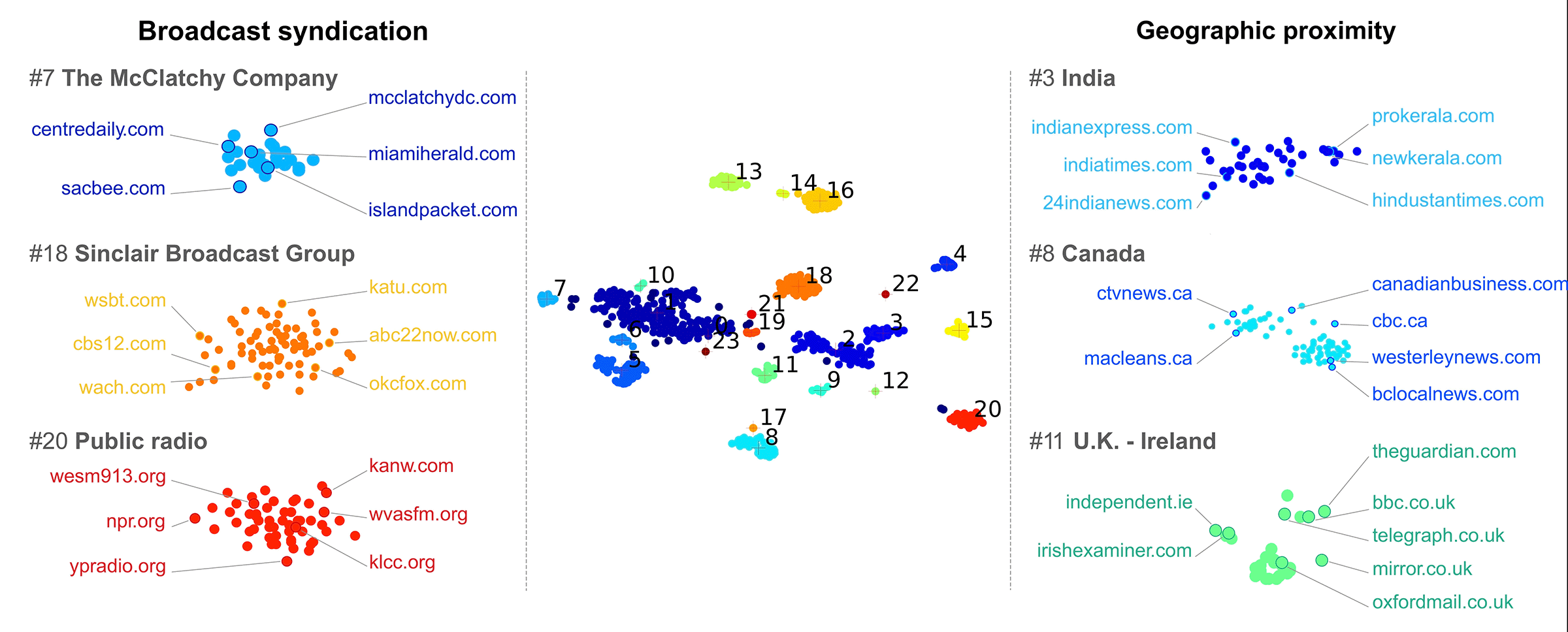
“Media groups in Switzerland and abroad are increasingly pooling their resources in order to cut the cost of producing stories. Unfortunately, media concentration of this type narrows the range of views that consumers are exposed to. This is worrying, especially when the views they get are biased,” says Rappaz. A striking example of this situation was aired by John Oliver in a recent episode of Last Week Tonight in the United States. It shows journalists on local TV channels owned by the Sinclair Group all reading an identical script commenting – ironically – on the lack of diversity in the news.
Personalization tools
The Media Observatory has the backing of the EPFL-based Initiative for Media Innovation (IMI) and has entered into a partnership with the Swiss daily newspaper Le Temps. This support will enable the LSIR team to bring its mapping project to the public next year through an online platform. The website will model news production in Switzerland and around the world while at the same time raising the public’s awareness of the dangers of disinformation. “We are pleased to be a part of the LSIR project,” says Gaël Hurlimann, co-editor-in-chief and head of the digital at Le Temps. “We really want to understand, and help the public understand, what media concentration means for all of us. It’s important to be transparent about the factors influencing news production: that’s the only way we can build trust between ourselves – the media – and our consumers. And who knows, maybe the study’s findings will convince us to make some changes in how we work.”
The web-based platform will use transparent, open-source technology. It will be built on personalization algorithms, similar to the ones used by websites like Netflix and Amazon Prime, which suggest videos based on people’s viewing history. “We applied this concept to media coverage data and were very surprised by what we could do with it,” says Rappaz. The researchers fed the algorithm around 500 million articles published by 8,000 different sources over the past three years. The algorithm assessed how individual news stories were handled by different media outlets, grouping the outlets on the basis of their similarities and revealing links between them and influences on them.
The LSIR team hopes that its research and web platform will encourage people to take a more critical approach to the news they consume, and help journalists investigate how stories are covered.
Reference: “A Dynamic Embedding Model of the Media Landscape.” by Jérémie Rappaz, Dylan Bourgeois and Karl Aberer, 13 May 2019, The Web Conference 2019.
DOI: 10.1145/3308558.3313526
Never miss a breakthrough: Join the SciTechDaily newsletter.
Follow us on Google and Google News.