
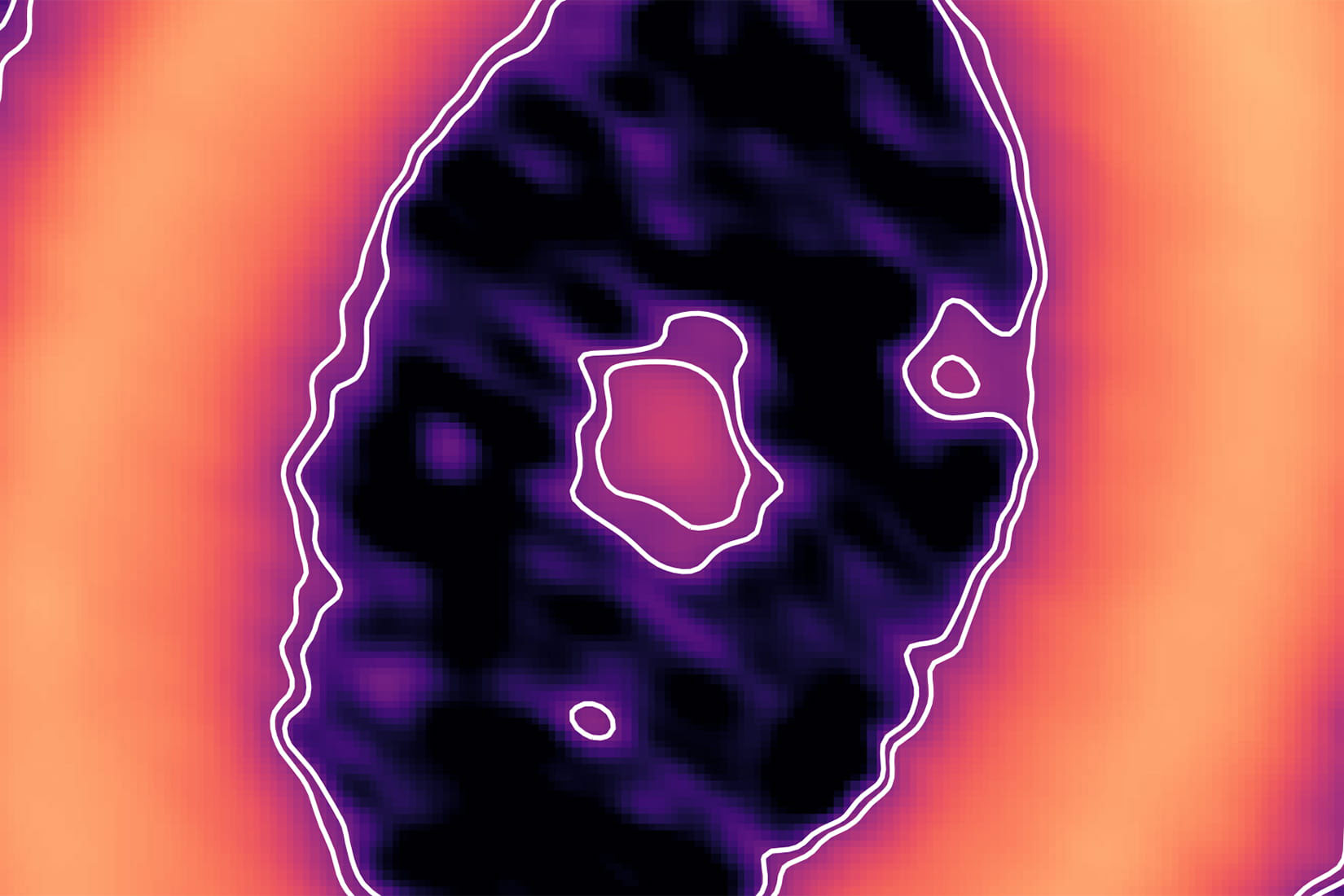
Using Earth’s most powerful array of radio telescopes, astronomers have made the first observations of a circumplanetary disk of gas and dust like the one that is believed to have birthed the moons of Jupiter.
The find, reported online today in Astrophysical Journal Letters, adds to the intriguing story of planet PDS 70 c, a still-forming gas giant about 370 light years from Earth that was first revealed last month in visible light images.
Using the massive 66-antenna Atacama Large Millimeter/submillimeter Array (ALMA) in Chile, Rice University astronomer Andrea Isella and colleagues collected millimeter wave radio signals that revealed the presence of dust grains throughout the star system where PDS 70 c and its sister planet, PDS 70 b, are still forming.
“Planets form from disks of gas and dust around newly forming stars, and if a planet is large enough, it can form its own disk as it gathers material in its orbit around the star,” Isella said. “Jupiter and its moons are a little planetary system within our solar system, for example, and it’s believed Jupiter’s moons formed from a circumplanetary disk when Jupiter was very young.”
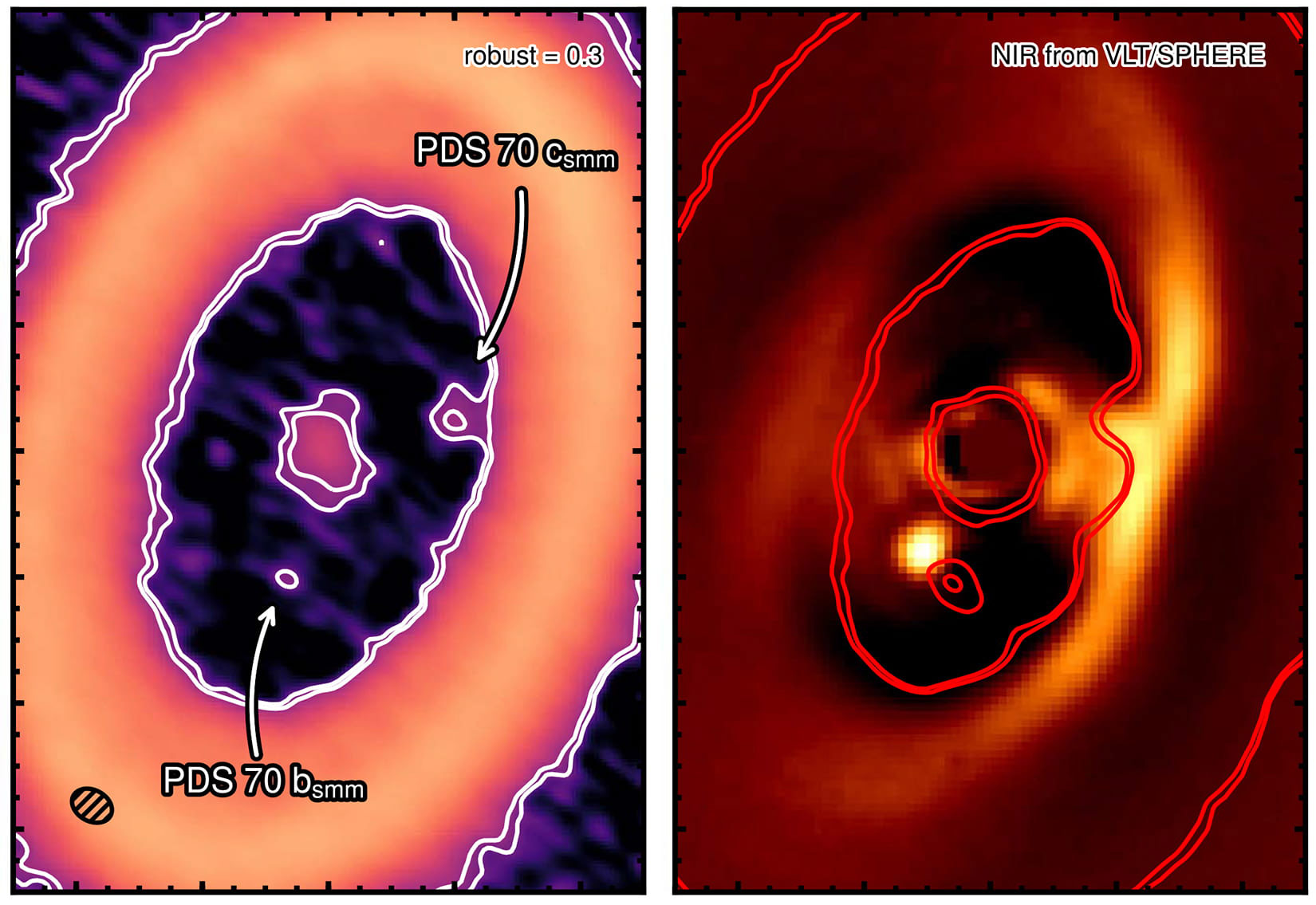
But most models of planet formation show that circumplanetary disks disappear within about 10 million years, which means circumplanetary disks haven’t existed in our solar system for more than 4 billion years. To look for them elsewhere and gather observational evidence to test theories of planet formation, Isella and colleagues search for very young star systems where they can directly observe disks and the planets still forming inside them. In the new study, Isella and colleagues analyzed observations made by ALMA in 2017.
“There are a handful of candidate planets that have been detected in disks, but this is a very new field, and they are all still debated,” Isella said. “(PDS 70 b and PDS 70 c) are among the most robust because there have been independent observations with different instruments and techniques.”
PDS 70 is a dwarf star about three-quarters the mass of the sun. Both of its planets are 5-10 times larger than Jupiter, and the innermost, PDS 70 b, orbits about 1.8 billion miles from the star, roughly the distance from the sun to Uranus. PDS 70 c is a billion miles further out, in an orbit about the size of Neptune’s.
PDS 70 b was first revealed in 2018 in infrared light images from a planet-hunting instrument called SPHERE at the European Southern Observatory’s Very Large Telescope (VLT). In June, astronomers used another VLT instrument called MUSE to observe a visible wavelength of light known as H-alpha, which is emitted when hydrogen falls onto a star or planet and becomes ionized.
“H-alpha gives us more confidence that these are planets because it suggests they are still drawing in gas and dust and growing,” Isella said.
The millimeter wavelength observations from ALMA provide even more evidence.
“It’s complimentary to the optical data and provides completely independent confirmation that there is something there,” he said.
Isella said direct observation of planets with circumplanetary disks could allow astronomers to test theories of planet formation.
“There’s much that we don’t understand about how planets form, and we now finally have the instruments to make direct observations and begin answering questions about how our solar system formed and how other planets might form.”
Isella is an assistant professor of physics and astronomy and of Earth, environmental and planetary sciences at Rice and a co-investigator on the Rice-based, NASA-funded CLEVER Planets project.
Study co-authors include Myriam Benisty of both the Universidad de Chile and the Université Grenoble Alpes, Richard Teague of the University of Michigan, Jaehan Bae of the Carnegie Institution for Science, Miriam Keppler of the Max Planck Institute for Astronomy, Stefano Facchini of the European Southern Observatory and Laura Pérez of the Universidad de Chile.
The research was supported by the National Science Foundation, the French National Research Agency, NASA, the Chilean National Commission for Scientific and Technological Research, the Chilean National Fund for Scientific and Technological Development, European Union Horizon 2020, and the European Southern Observatory.
Reference: “Detection of Continuum Submillimeter Emission Associated with Candidate Protoplanets” by Andrea Isella, Myriam Benisty, Richard Teague, Jaehan Bae, Miriam Keppler, Stefano Facchini and Laura Pérez, 11 July 2019, The Astrophysical Journal Letters.
DOI: 10.3847/2041-8213/ab2a12
Never miss a breakthrough: Join the SciTechDaily newsletter.
Follow us on Google and Google News.
1 Comment
Just a thought. Speed of light calculation “V” Distance. Could the images “pictured” be a mirrored example of our (very) own system in vitro? My hypothesis is this, it is our own universe we are observing, relitave to the speed of light. Not the formation of another Jupiter but what we are seeing IS the formation of Jupiter.