
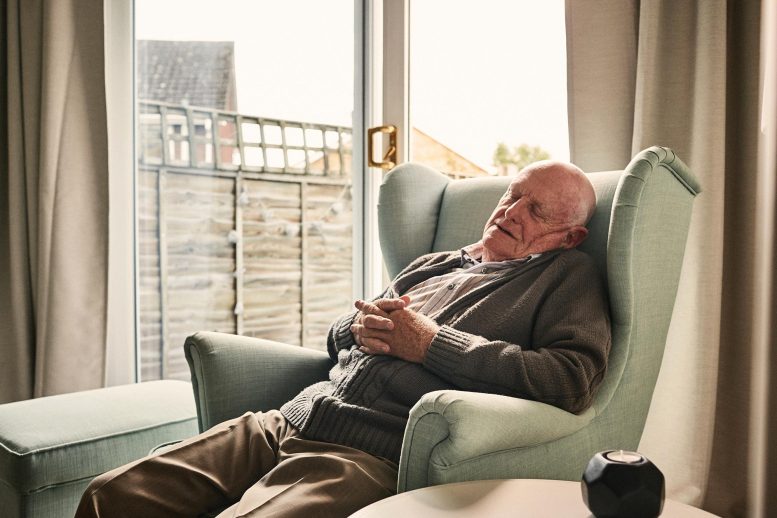
Longer and more frequent napping was correlated with worse cognition.
Could there be a connection between cognitive decline and excessive daytime napping? New research from the Rush Alzheimer’s Disease Center suggests a potential link, according to an article published recently in Alzheimer’s and Dementia: The Journal of the Alzheimer’s Association.
According to the researchers, the connection appears to occur in both directions; longer and more frequent napping was correlated with worse cognition after one year, and worse cognition was correlated with longer and more frequent naps after one year.
Alzheimer’s: A Multi-System Disorder
Aron Buchman, MD, a neurologist at Rush University Medical Center and co-author of the article, said the study lends evidence to the changing views of Alzheimer’s disease as a purely cognitive disorder.
“We now know that the pathology related to cognitive decline can cause other changes in function,” he said. “It’s really a multi-system disorder, also including difficulty sleeping, changes in movement, changes in body composition, depression symptoms, behavioral changes, etc.”
Researchers followed more than 1,400 patients for up to 14 years as part of the Rush Memory and Aging Project and the Religious Order Study. Participants wore a wrist-worn sensor that recorded activity continuously for up to 10 days, and came in once a year for examinations and cognitive testing. Any prolonged period of no activity during the daytime from 9 a.m. to 7 p.m. was considered a nap.
Napping Patterns and Risk of Alzheimer’s
When the study started, more than 75% of participants showed no signs of any cognitive impairment, 19.5% had mild cognitive impairment, and slightly more than 4% had Alzheimer’s disease dementia. Daily napping increased by about 11 minutes per year among those who didn’t develop cognitive impairment during follow-up. Naps doubled after a diagnosis of mild cognitive impairment, and nearly tripled after a diagnosis of Alzheimer’s disease dementia.
Researchers also compared participants who had normal cognition at the start of the study but developed Alzheimer’s disease dementia to their counterparts whose thinking remained stable during the study. They found that older people who napped more than an hour a day had a 40% higher risk of developing Alzheimer’s.
Buchman stressed that the study does not imply that napping causes Alzheimer’s dementia, or vice versa.
“This is an observational study, so we can’t say that ‘a causes b’,” he said. “But we can say that they unfold at the same time, and it’s possible that the same pathologies may contribute to both.”
Insights into Alzheimer’s Pathology and Potential Treatments
Alzheimer’s disease is caused by the accumulation of two proteins, amyloid beta and tau, within the brain. While the decline in cognitive function is the most well-known symptom of Alzheimer’s disease, this protein accumulation can occur in various locations of the brain, brainstem, and spinal cord, causing a variety of symptoms. The study indicates that increases in the frequency and duration of daytime napping may be one of those symptoms.
“Once you’ve identified the pathology and location, you can work on potential treatments,” Buchman said. “There are proteins or genes that might prevent the accumulation of tau and beta, or there’s potentially ways to mitigate or slow their accumulation.”
The study was supported by the National Institutes of Health and the BrightFocus Foundation Alzheimer’s Research Program. Buchman said that one of the study’s primary strengths was its participant cohorts from the Memory and Aging Project and the Religious Order Study. Both studies are decades-long efforts that recruit participants to undergo annual testing, sample collection, and organ donation after their death.
“The people in our studies are very special people,” he said. “Without people making this kind of contribution, we wouldn’t be able to do the research that we do. They are so excited to be able to participate, they animate the staff with their participation. We’re very lucky to have them.”
For more on this research:
- “Vicious Cycle” Discovered Between Excessive Daytime Napping and Alzheimer’s Dementia
- Extended Napping in Seniors May Signal Alzheimer’s Dementia
Reference: “Daytime napping and Alzheimer’s dementia: A potential bidirectional relationship” by Peng Li, Lei Gao, Lei Yu, Xi Zheng, Ma Cherrysse Ulsa, Hui-Wen Yang, Arlen Gaba, Kristine Yaffe, David A. Bennett, Aron S. Buchman, Kun Hu and Yue Leng, 17 March 2022, Alzheimer’s & Dementia: The Journal of the Alzheimer’s Association.
DOI: 10.1002/alz.12636
Never miss a breakthrough: Join the SciTechDaily newsletter.
Follow us on Google and Google News.
14 Comments
I am not a doctor but what nonsense is this?
Going to the bathroom in the middle of the night interrupts the sleep cycle greatly decreasing the amount of rem sleep. Day after day, year after year the amount of rem sleep is decreased to about 1/3 and over time that causes a deterioration of cognitive function.
Depression invites desire to sleep so finding out one has dementia ect might bring on a loss ofhope/depression/discouragement thus accompanying a desire to sleep
I can see truth in this article. My mom has mild dementia now and sleeps 15-18 hours a day, battles the depression and her body has changed dramatically in the last 2 years.
What a pile of crap.
If they were using this 4500 years ago how did they concentrate bushels of Artichokes and how did they know what was in the Artichokes that was beneficial ?
Eating Artichokes, Ginger, Turmeric and Beet roots will probably do the trick.
I’m 83 and I have been eating healthy for the last 25 years. Everyone thinks I’m in my 60’s !
This is where I am now. I know that I’ve had orthopedic pain for the past decade that is manageable during day, but worsens after lying down 15-30 min. Also CFS from Interferon therapy 20 years ago. So intermittant naps are my lifestyle. And now at 62 y/o, I’m experiencing episodes of extreme fatigue & intermittent cognitive fog intermittently. Now what?
I’m on call at night and have a couple of minor health problems that interrupt my sleep. I need AM & PM catnaps to get enough shuteye to keep me out of the nuthouse. So this is going to liquefy my brain?
No siesta?
My father took regular daily naps on his off days from work + when he retired. So sharp, all the way until his 90s. 93 to be exact. He passed from COVID.
Reading this article made me sleepy. I already forgot what it was about.
Is this really supposed to be taken seriously? I’m an American in my early 50s, my wife is a Spaniard & I’ve been residing in Spain half my life, so I know both countries well. Generally speaking, most Americans don’t take naps (long or short) regularly, however most Spaniards DO. If this so-called “research” were correct, the U.S. would have relatively few cases of Alzheimer’s & Spain would be completely overrun (neither is true).
On the other hand, my 87 year old Spanish Mother-in-law, who was an exception to the rule here in Spain, didn’t nap most of her adult life. Turns out she was diagnosed with Alzheimer’s over 10 years ago & has declined rapidly the past several years to stage 3, (can’t walk, etc. & doesn’t recognize her family or anyone now) and she STILL doesn’t nap or sleep excessively. So how do you explain her case?
The objective facts I’ve stated are diametrically opposed to the “findings” of your study & prove there’s no correlation. (Also, couldn’t the increased sleeping be a symptom rather than the cause? And perhaps the study participants just napped more because, as they got older, they didn’t sleep as well during the night & needed a daytime pick-me-up!)
So either this unsubstantiated info is bona fide clickbait… or the “experts”, “scientists” & “researchers” involved are simply grasping at straws in a desperate attempt to justify their paychecks/tenure… or sadly, maybe it’s a combination of both.
Whatever the case, I’ll say this: C’mon Guys, you can do better. For everybody’s sake, please do better.
Im 65 years old, doesn’t need a nap during the day. I can work in my yard 4-10 hrs. 12 years ago I had stroke & now paralyzed but living independently.i feel pretty healthy less the effects of stroke.
It is good to work in the yard. After 50 year old, I started walking in the local park under the sun to get healthy D3. I take supplement of Magnesium, Vita K2 mk7 and Vita B12. I gave up those veggie oil. Just use ghee or lark. I try to keep low carb diet. But sometime friend party is killing me. Try to do some light work in back yard sir. It is good to stay under the sunlight. Veggie oil is harsh on cardio vessels. I hope you the best, stay healthy, stay low carb.