

Groundwater loss is sinking U.S. cities, threatening infrastructure in densely built areas.
A recent study examining the 28 most populous cities in the United States has found that every one of them is sinking to some extent. This includes not only coastal cities, where rising sea levels are already a concern, but also many cities located inland.
Using high-resolution data, the study reveals that land within these cities is not sinking uniformly. In some areas, the ground is subsiding at different rates, while in others, some spots are even rising. These uneven changes in elevation can place stress on buildings and infrastructure.
The most common cause of this land movement is the ongoing extraction of groundwater, according to the study’s authors. However, other factors are also contributing in certain locations.
The research was recently published in the journal Nature Cities.
“As cities continue to grow, we will see more cities expand into subsiding regions,” said lead author Leonard Ohenhen, a postdoctoral researcher at the Columbia Climate School’s Lamont-Doherty Earth Observatory. “Over time, this subsidence can produce stresses on infrastructure that will go past their safety limit.”
Globally, rapidly sinking cities like Jakarta, Venice, and New Orleans have drawn widespread attention. In the United States, many studies have also shown subsidence along the East Coast and in other regions. However, most of that research has been based on relatively sparse data covering broad areas.
This new study focused on U.S. cities with populations over 600,000, using satellite data to measure vertical land motion down to the millimeter, in grids just 28 meters (about 90 feet) across. The researchers found that in 25 of the 28 cities, at least two-thirds of the land area is subsiding. In total, around 34 million people live in these affected zones.
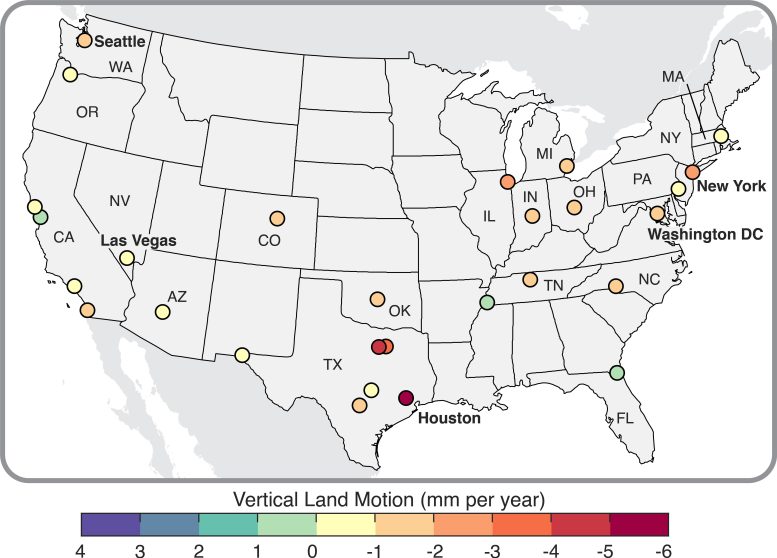
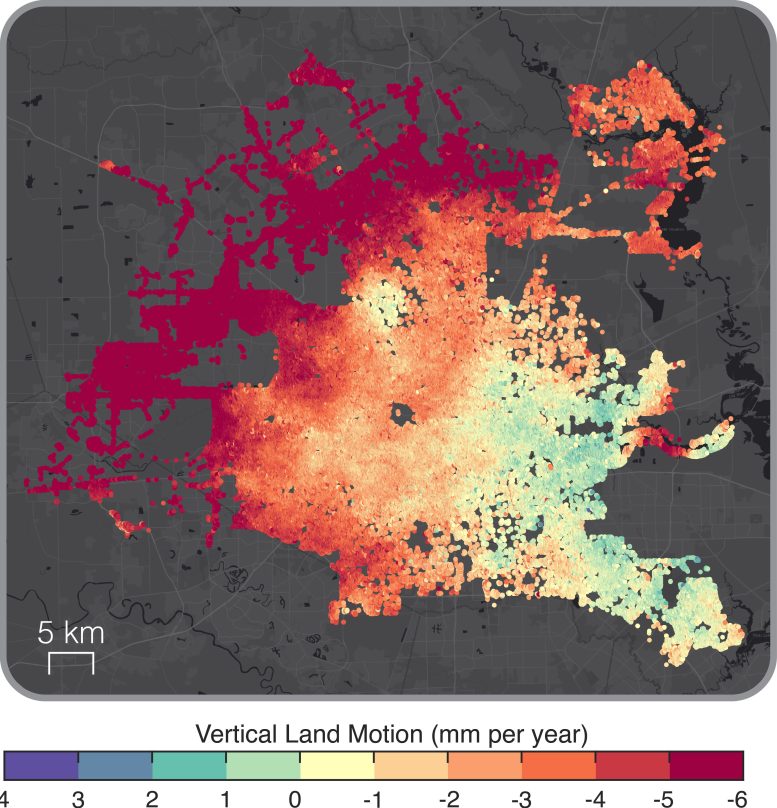
Houston is experiencing the most rapid subsidence, with over 40 percent of the city sinking more than 5 millimeters (about one-fifth of an inch) per year. About 12 percent of the city is subsiding at twice that rate. In some places, land is dropping as much as 5 centimeters (2 inches) annually. Fort Worth and Dallas are also seeing significant sinking. Other fast-subsiding areas include parts of New York near LaGuardia Airport, as well as sections of Las Vegas, Washington, D.C., and San Francisco.
Groundwater withdrawal drives most land subsidence
In addition to measuring surface-elevation changes, the researchers analyzed county-level groundwater withdrawals for the affected areas. Correlating this with land movements, they determined that groundwater removal for human use was the cause for 80% of overall sinkage.
Generally, this happens as water is withdrawn from aquifers made up of fine-grained sediments; unless the aquifer is replenished, the pore spaces formerly occupied by water can eventually collapse, leading to compaction below, and sinkage at the surface. In Texas, the problem is exacerbated by pumping of oil and gas, the paper says.
The researchers say that continued population growth and water usage, combined with climate-induced droughts in some areas, will likely worsen subsidence in the future.
Some cities also sinking from natural forces
In some areas, natural forces are at work. In particular, the weight of the towering ice sheet that occupied much of interior North America until about 20,000 years ago made the land along its edges bulge upward, somewhat like when one squeezes air from one part of a balloon to another.
Even today, with the ice long gone, some of these bulges are still subsiding at rates of 1 to 3 millimeters each year. Affected cities include New York, Indianapolis, Nashville, Philadelphia, Denver, Chicago, and Portland.
Even the sheer weight of buildings may be taking a toll. One 2023 study found that New York’s more than 1 million buildings are pressing down on the Earth so hard that they may be contributing to the city’s ongoing subsidence. A more recent separate study found that some buildings in the Miami area are sinking in part due to disruptions in the subsurface caused by construction of newer buildings nearby.
Eight cities face the most human exposure
The new study found that eight cities (New York, Chicago, Los Angeles, Phoenix, Houston, Philadelphia, San Antonio, and Dallas) account for more than 60% of the people living on sinking land. Notably, these eight cities have seen more than 90 significant floods since 2000, probably driven in part by lowering topography.
Another key finding: some cities are seeing differential motion, with adjoining localities sinking at different rates, or even sinking while other areas rise; the upward motion possibly caused by quick recharge of aquifers near rivers or other water sources. (Uplift in certain areas is actually more than compensating for overall sinkage in three cities: Jacksonville, Fla.; Memphis, Tenn., and San Jose, Calif.)
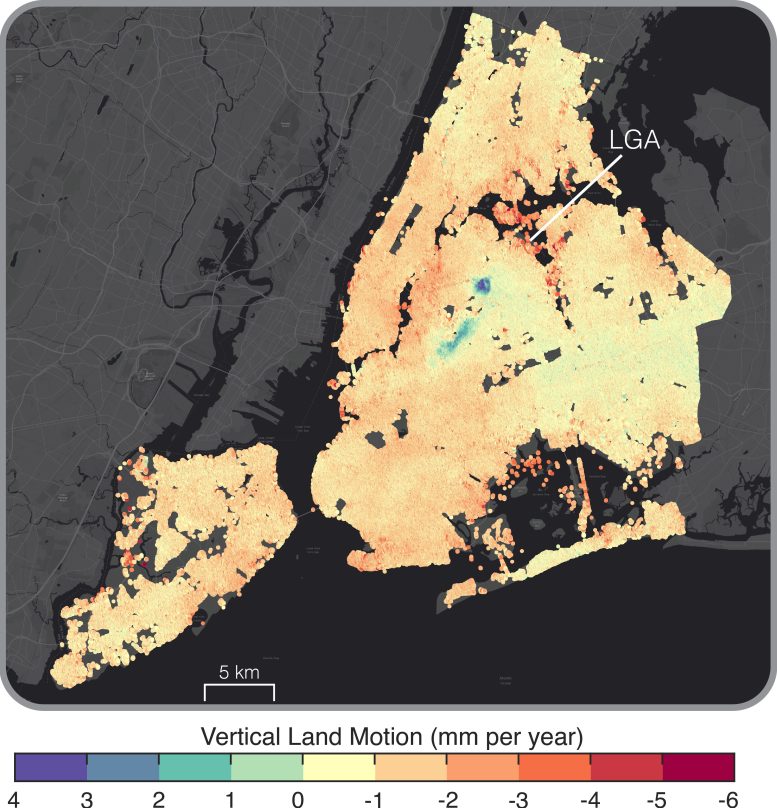
Differential motion is a problem because, as the authors point out, if a whole urban area is moving up or down evenly at the same rate, that minimizes the danger of stresses to building foundations and other infrastructure. But if structures are subjected to an array of uneven vertical movements, they can experience dangerous tilting.
“Unlike flood-related subsidence hazards, where risks manifest only when high rates of subsidence lower the land elevation below a critical threshold, subsidence-induced infrastructure damage can occur even with minor changes in land motion,” the authors write.
High-risk zones small but densely built
The study found that only about 1% of the total land area in the 28 cities lies within zones where differential motion could affect buildings, roads, rail lines, and other structures. However, these areas tend to be in the densest urban cores, and currently contain some 29,000 buildings. The most hazardous cities in this regard are San Antonio, where the researchers say 1 in 45 buildings are subject to high risk; Austin (1 in 71); Fort Worth (1 in 143), and Memphis (1 in 167).
The upshot for individual structures in these areas is unclear; it probably would require an even finer-grained study, said Ohenhen. An earlier study of 225 U.S. building collapses between 1989 and 2000 found that only 2% were directly attributable to subsidence. However, the factors behind 30% were designated unknown, suggesting that subsidence could have played a larger role, says the new study.
Call to action: planning and adaptation
The paper concludes that cities should use this new information to focus on solutions. They say that in many places, flooding can be mitigated with land raising, enhanced drainage systems, and green infrastructure such as artificial wetlands to absorb floodwaters. Cities susceptible to tilting hazards can focus on retrofitting existing structures, integrating land motions into building codes, and limiting new building in the areas of most threat.
“As opposed to just saying it’s a problem, we can respond, address, mitigate, adapt,” said Ohenhen. “We have to move to solutions.”
Reference: “Land subsidence risk to infrastructure in US metropolises” by Leonard O. Ohenhen, Guang Zhai, Jonathan Lucy, Susanna Werth, Grace Carlson, Mohammad Khorrami, Florence Onyike, Nitheshnirmal Sadhasivam, Ashutosh Tiwari, Khosro Ghobadi-Far, Sonam F. Sherpa, Jui-Chi Lee, Sonia Zehsaz and Manoochehr Shirzaei, 8 May 2025, Nature Cities.
DOI: 10.1038/s44284-025-00240-y
Never miss a breakthrough: Join the SciTechDaily newsletter.
Follow us on Google and Google News.
5 Comments
“Houston is experiencing the most rapid subsidence, with over 40 percent of the city sinking more than 5 millimeters (about one-fifth of an inch) per year. About 12 percent of the city is subsiding at twice that rate.”
To put that in perspective, much of the San Andreas Fault in California is experiencing continuous horizontal or lateral movement (creep) of approximately 25 millimeters per year. During the 1906 San Francisco Earthquake, the maximum offset across the fault was almost 6,400 millimeters over several seconds. The Earth is not as rigid and unmoving as most people assume.
People are heavy also. We also give off a good deal of heat.
I was once curious about the human contribution of heat and CO2 from respiration. I did the calculations and discovered that both were actually negligible compared to the potential radiative effects and industrial emissions of CO2.
There is also some controversy about the impact of buildings on surface loading. It is claimed that because buildings are largely empty shells, they actually weigh less than the solid rock excavated to create their basements. I haven’t run this to ground, if you will pardon the pun. However, if you know of a source that you can point me to that addresses the issue, I would appreciate you sharing it.
HELLO SCIENTIFIC FRIENDS *
I would like to mention another issue in this regard because I sent an email to international scientific associations. Apartment living is not a good way to live , Houses must be on the ground floor, only 2 steps above ground level . Dear experts, please remind the world of everything .
********** good luck **********
London, Bangkok, Saigon and etcetera. Suck out the groundwater, load the substrate and lo! A sinking city. It ain’t rocket science.