
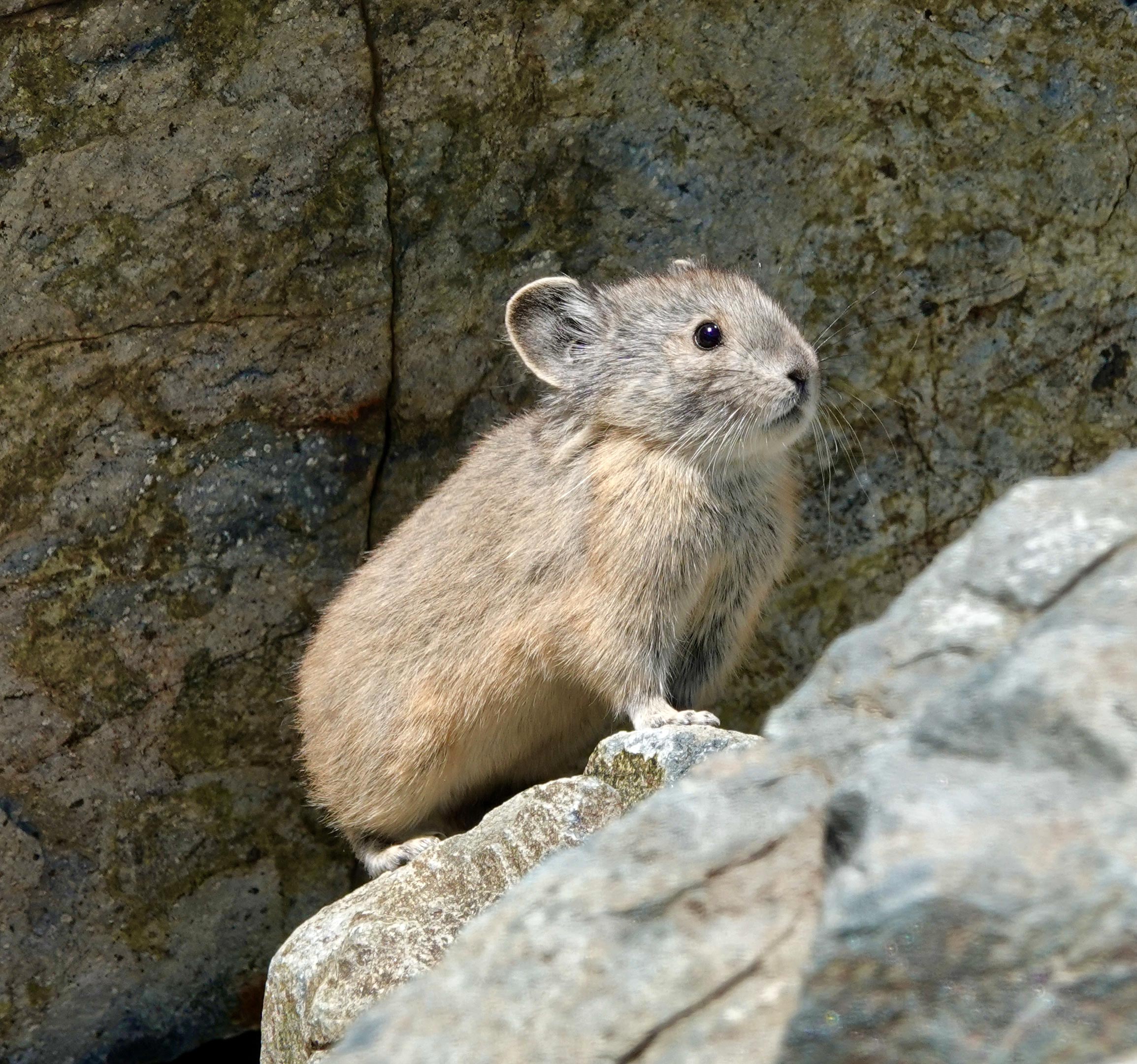
The American pika is a charismatic, diminutive relative of rabbits that some researchers say is at high risk of extinction due to climate change. Pikas typically live in cool habitats, often in mountains, under rocks and boulders. Because pikas are sensitive to high temperatures, some researchers predict that, as the Earth’s temperature rises, pikas will have to move ever higher elevations until they eventually run out of habitat and die out. Some scientists have claimed this cute little herbivore is the proverbial canary in the coal mine for climate change.
A new extensive review by Arizona State University emeritus professor Andrew Smith, published in the October issue of the Journal of Mammalogy, finds that the American pika is far more resilient in the face of warm temperatures than previously believed. While emphasizing that climate change is a serious threat to the survival of many species on Earth, Smith believes that the American pika currently is adapting remarkably well.
Smith has studied the American pika for more than 50 years and presents evidence from a thorough literature review showing that American pika populations are healthy across the full range of the species, which extends from British Columbia and Alberta, Canada, to northern New Mexico in the U.S.
Occupancy in potential pika habitat in the major western North American mountains was found to be uniformly high. Among sites that have been surveyed recently, there was no discernible climate signal that discriminated between the many occupied and relatively few unoccupied sites.
“This is a sign of a robust species,” Smith said.
Smith said most of the studies that have raised alarms about the fate of the pika are based on a relatively small number of restricted sites at the margins of the pika’s geographic range, primarily in the Great Basin. However, a recent comprehensive study of pikas evaluating 3,250 sites in the Great Basin found pikas living in over 73% of the suitable habitat investigated. Most importantly, the sites currently occupied by pikas and the sites where they are no longer found were characterized by similar climatic features.
“These results show that pikas are able to tolerate a broader set of habitat conditions than previously understood,” Smith adds.
Smith’s most interesting finding is that pikas are apparently much more resilient than previously believed, allowing them to survive even at hot, low-elevation sites. Bodie California State Historic Park, the Mono Craters, Craters of the Moon National Monument and Preserve, Lava Beds National Monument, and the Columbia River Gorge (all hot, low-elevation sites) retain active pika populations, demonstrating the adaptive capacity and resilience of pikas. Pikas cope with warm temperatures by retreating into their cool, underground talus habitat during the hot daylight hours and augment their restricted daytime foraging with nocturnal activity.
This doesn’t mean that some pika populations have not been pushed to their limit, leading to their disappearance from some habitats. Smith’s review points out that most documented cases of local loss of pika populations have occurred on small, isolated habitat patches.
“Due to the relatively poor ability of pikas to disperse between areas, those habitats are not likely to be recolonized, particularly in light of our warming climate,” Smith said. “In spite of the general health of pikas across their range, these losses represent a one-way street, leading to a gradual loss of some pika populations. Fortunately for pikas, their preferred talus habitat in the major mountain cordilleras is larger and more contiguous, so the overall risk to this species is low.”
Smith’s work emphasizes the importance of incorporating all aspects of a species’ behavior and ecology when considering its conservation status, and that all available data must be considered before suggesting a species is going extinct. For the American pika, the data conclusively show that rather than facing extinction, American pikas are changing their behaviors in ways that help them better withstand climate change, at least for now.
Reference: “Conservation status of American pikas (Ochotona princeps)” by Andrew T Smith, 3 October 2020, Journal of Mammalogy.
DOI: 10.1093/jmammal/gyaa110
Never miss a breakthrough: Join the SciTechDaily newsletter.
Follow us on Google and Google News.