
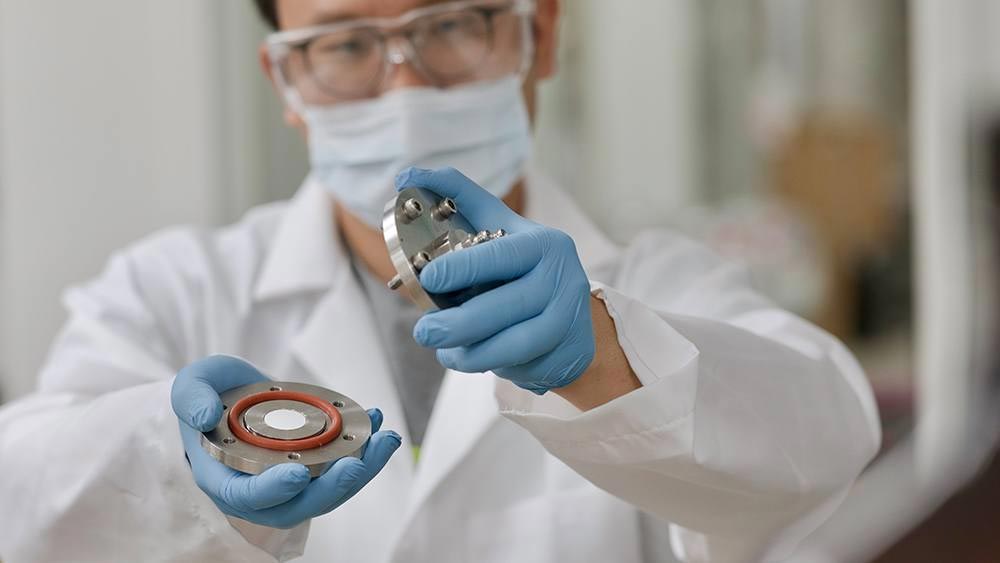
Texas A&M researchers have enhanced the dehumidification efficiency of a polymer that could help develop more energy-efficient systems with a smaller carbon footprint.
On sultry summer afternoons, heating, ventilation, and air conditioning (HVAC) systems provide much-needed relief from the harsh heat and humidity. These systems, which often come with dehumidifiers, are currently not energy efficient, guzzling around 76% of the electricity in commercial and residential buildings.
In a new study, Texas A&M University researchers have described an organic material, called polyimides, that uses less energy to dry air. Furthermore, the researchers said polyimide-based dehumidifiers can bring down the price of HVAC systems, which currently cost thousands of dollars.
“In this study, we took an existing and rather robust polymer and then improved its dehumidification efficiency,” said Hae-Kwon Jeong, McFerrin Professor in the Artie McFerrin Department of Chemical Engineering. “These polymer-based membranes, we think, will help develop the next generation of HVAC and dehumidifier technologies that are not just more efficient than current systems but also have a smaller carbon footprint.”
The results of the study are described in the Journal of Membrane Science.
Green Advantage: From Zeolites to Polymers
Dehumidifiers remove moisture from the air to a comfortable level of dryness, thereby improving air quality and eliminating dust mites, among other useful functions. The most commonly available dehumidifiers use refrigerants. These chemicals dehumidify by cooling the air and reducing its ability to carry water. However, despite their popularity, refrigerants are a source of greenhouse gases, a major culprit for global warming.
As an alternative material for dehumidification, naturally occurring materials known as zeolites have been widely considered for their drying action. Unlike refrigerants, zeolites are desiccants that can absorb moisture within their water-attractive or hydrophilic pores. Although these inorganic materials are green and have excellent dehumidification properties, zeolite-based dehumidifiers pose challenges of their own.
“Scaling up is a big problem with zeolite membranes,” Jeong said. “First, zeolites are expensive to synthesize. Another issue comes from the mechanical properties of zeolites. They are weak and need really good supporting structures, which are quite expensive, driving up the overall cost.”
Jeong and his team turned to a cost-effective organic material called polyimides that are well-known for their high rigidity and tolerance for heat and chemicals. At the molecular level, the basic unit of these high-performance polymers are repeating, ring-shaped imide groups connected together in long chains. Jeong said the attractive forces between the imides gives the polymer its characteristic strength and thus an advantage over mechanically weak zeolites. But the dehumidification properties of the polyimide material needed enhancement.
Molecular Engineering of Hydrophilic Pathways
The researchers first created a film by carefully applying polyimide molecules on a few nanometers-wide alumina platforms. Next, they put this film in a highly concentrated sodium hydroxide solution, triggering a chemical process called hydrolysis. The reaction caused the imide molecular groups to break and become hydrophilic. When viewed under a high-powered microscope, the researchers uncovered that the hydrolysis reactions lead to the formation of water-attractive percolation channels or highways within the polyimide material.
When Jeong’s team tested their enhanced material for dehumidification, they found that their polyimide membrane was very permeable to water molecules. In other words, the membrane was capable of extracting excess moisture from the air by trapping them in the percolation channels. The researchers noted that these membranes could be operated continuously without the need for regeneration since the trapped water molecules leave from the other side by a vacuum pump that is installed within a standard dehumidifier.
Balancing Strength and Dehumidification Efficiency
Jeong said his team carefully designed their experiments to partial hydrolysis wherein a controlled number of imide groups become hydrophilic.
“The strength of polyimides comes from their intermolecular forces between their chains,” Jeong said. “If too many imides are hydrolyzed, then we are left with weak material. On the other hand, if the hydrolysis is too low, the material won’t be effective at dehumidification.”
Although polyimide membranes have shown great promise in their potential use in dehumidification, Jeong said their performance still lags behind zeolite membranes.
“This is a new approach to improve the property of a polymer for dehumidification and a lot more optimizations need to be done in order to further enhance the performance of this membrane,” Jeong said. “But another key factor for engineering applications is it has to be cheap, especially if you want the technology to be reasonably affordable for homeowners. We are not there yet but are certainly taking strides in that direction.”
Reference: “Enhancing air-dehumidification performance of polyimide membranes by generating hydrophilic Poly(amic acid) domains using partial hydrolysis” by Sunghwan Park and Hae-Kwon Jeong, 28 December 2020, Journal of Membrane Science.
DOI: 10.1016/j.memsci.2020.119006
Sunghwan Park in the chemical engineering department also contributed to this study.
This research is funded by the National Science Foundation and the Qatar National Research Fund.
Never miss a breakthrough: Join the SciTechDaily newsletter.
Follow us on Google and Google News.