
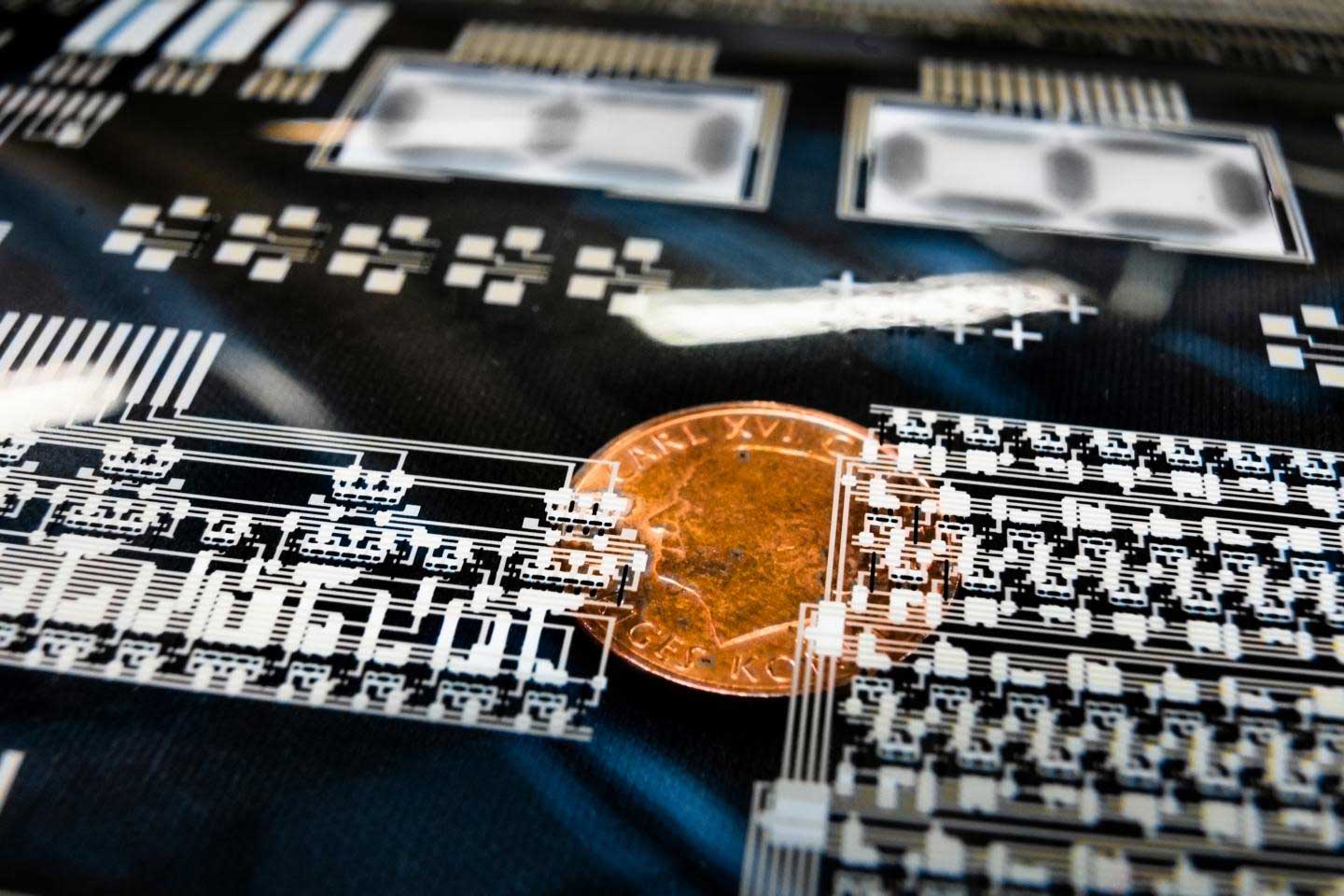
Researchers at Linköping University and RISE, Campus Norrköping, have shown for the first time that it is possible to print complete integrated circuits with more than 100 organic electrochemical transistors. The result has been published in Nature Communications.
“This is a decisive step for a technology that was born at Linköping University just over 17 years ago. The result shows that we are again leading the field, thanks to the close collaboration between basic research at the Laboratory of Organic Electronics, LOE, and applied research at RISE,” says Magnus Berggren, professor of organic electronics and director of LOE.
“The advantage we have here is that we do not need to mix different manufacturing methods: everything is done by screen printing, and in relatively few processing steps. The key is ensuring that the different layers end up in exactly the right place,” says Peter Andersson Ersman, a researcher in printed electronics at the RISE research institute.
Printing electronic circuits with a line width of approximately 100 micrometers also places high demands on the print technology, and the printed electronics research has here been aided by the graphics industry. They have developed screen printing frames with meshes that can print extremely fine lines. And many hours of research were needed to develop printing ink with the right properties.
Many different fundings
“The research has received funding from many different sources during the past 17 years,” Magnus Berggren tells us.
These include the Swedish Foundation for Strategic Research, Vinnova, and the Knut and Alice Wallenberg Foundation, while in recent years the EU has become involved, through the Eureka Eurostars Prolog project.
“The first breakthrough for printed circuits using screen printing came in the Prolog project. We published these results in 2017,” Peter Andersson Ersman says.

At least three further challenges have been dealt with since then: reducing the circuit size, increasing the quality such that the probability that all transistors in the circuit work lies as close to 100% as possible, and – not least – solving integration with the silicon-based circuits needed to process signals and to communicate with the surroundings.
“One of the major advances is that we have been able to use printed circuits to create an interface with traditional silicon-based electronic components. We have developed several types of printed circuits based on organic electrochemical transistors. One of these is a shift register, which can form an interface and deal with the contact between the silicon-based circuit and other electronic components such as sensors and displays. This means that we can now use a silicon chip with fewer contacts, which needs a smaller area and is in this way cheaper,” says Magnus Berggren.
1000 organic transistors on an A4
The development of ink to print the thin lines and improvements of the screen printing frames have contributed not only to the miniaturization process, but also to achieving higher quality.
“We can now place more than 1000 organic electrochemical transistors on an A4-sized plastic substrate, and can connect them in different ways to create different types of printed integrated circuits,” says Simone Fabiano, head of research in organic nanoelectronics in the Laboratory of Organic Electronics.
These large-scale integrated circuits (abbreviated “LSI”) can be used, for example, to power an electrochromic display, itself manufactured as printed electronics, or another part of the online electronic world that the internet of things brings.
The material used by the researchers is the polymer PEDOT:PSS, which is the most deeply studied material in the world in the field of organic electronics.
“This material was commercially available 17 years ago, and it was pure luck that we chose to work with this particular material. We now use the same material in the integrated circuit as in the display, which makes it possible to print more efficiently. We have developed a complete process for printing circuits here at the Printed Electronics Arena in Norrköping,” says Magnus Berggren.
###
Reference: “All-Printed Large-Scale Integrated Circuits Based on Organic Electrochemical Transistors” by Peter Andersson Ersman, Roman Lassnig, Jan Strandberg, Deyu Tu, Vahid Keshmiri, Robert Forchheimer, Simone Fabiano, Göran Gustafsson and Magnus Berggren, 7 November 2019, Nature Communications 2019.
DOI: 10.1038/s41467-019-13079-4
Never miss a breakthrough: Join the SciTechDaily newsletter.
Follow us on Google and Google News.