
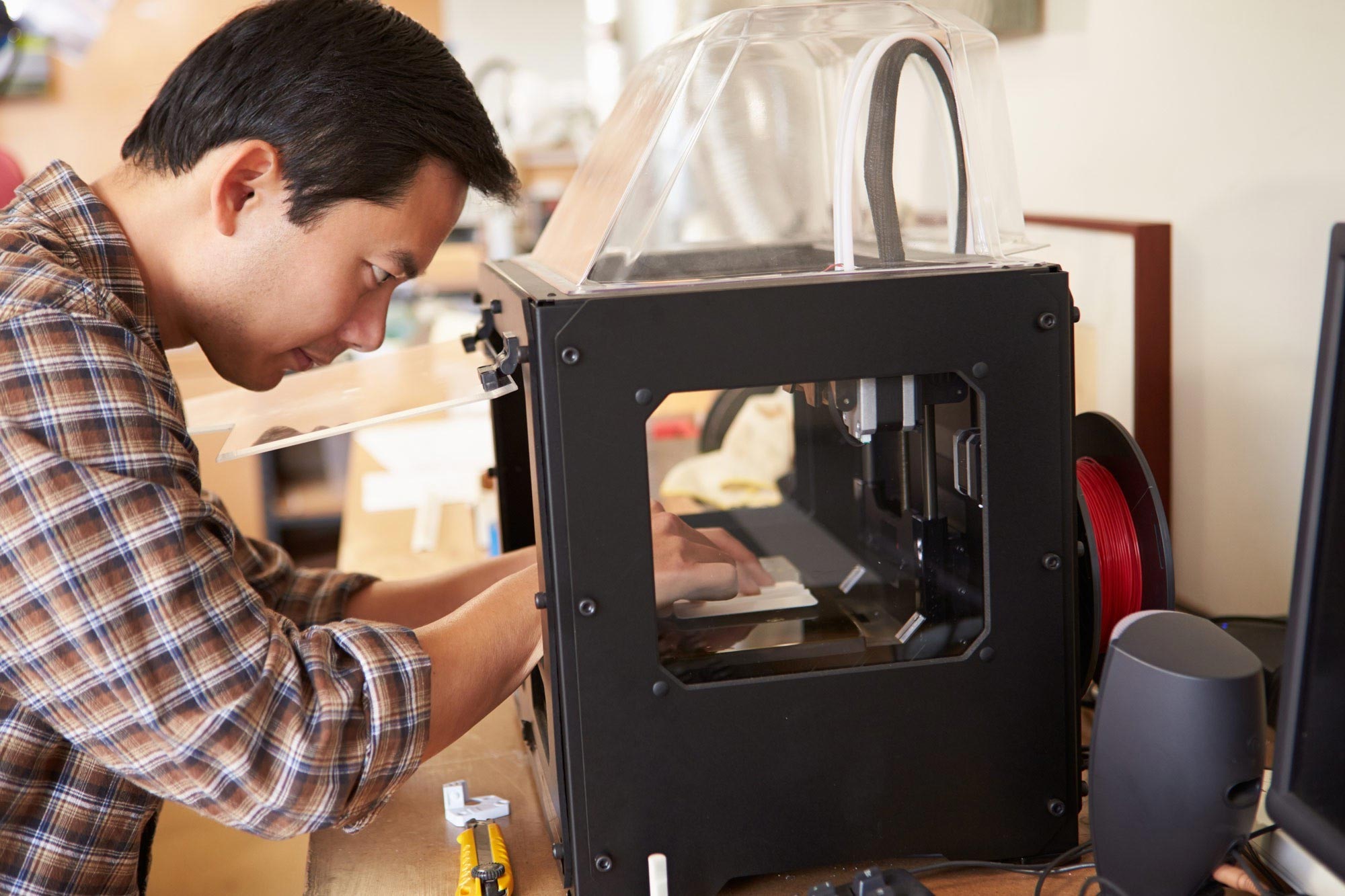
The Army has a new type of multi-polymer filament for commonly-used desktop 3-D printers. This advance may save money and facilitate fast printing of critical parts at the point of need.
The research is also the cover story of the April edition of Advanced Engineering Materials, a monthly peer-reviewed scientific journal.
Parts produced with these printers historically have had poor strength and toughness, which prevented affordable printers from being used to resupply military parts on demand, especially at deployed locations, until now. The Army’s new material overcomes those deficiencies, potentially allowing Soldiers to use low-cost printers to create parts that, once subjected to a few hours of heat, can achieve mechanical properties robust enough to withstand the rigors of field operations.
This breakthrough is an important step forward for Army expeditionary manufacturing, said Dr. Eric D. Wetzel, who leads the Emerging Composites team and serves as the research area leader for Soldier Materials at the U.S. Army Combat Capabilities Development Command’s Army Research Laboratory.
Wetzel’s research encompasses a wide range of technological solutions that could increase Soldier lethality by enhancing the way warfighters shoot, move, communicate, protect, and sustain themselves.
“The Army would like to be able to print parts in the field to simplify logistics by carrying digital part files instead of physical parts, but to date, the technologies for producing high-strength parts have not been practical in an expeditionary setting. These printers are too large, energy-hungry, delicate or messy for starters, and their feedstocks can require specialized storage requirements.”
This technology may enable the Army to use affordable, simple printers to produce high-quality parts.
According to the paper, fused filament fabrication, or FFF, is the most common additive manufacturing technology, but parts fabricated using FFF lack sufficient mechanical integrity for most engineering applications.
The research team used a novel thermal drawing process to fabricate a dual material filament comprising acrylonitrile butadiene styrene, known as ABS, with a star‐shaped polycarbonate core.
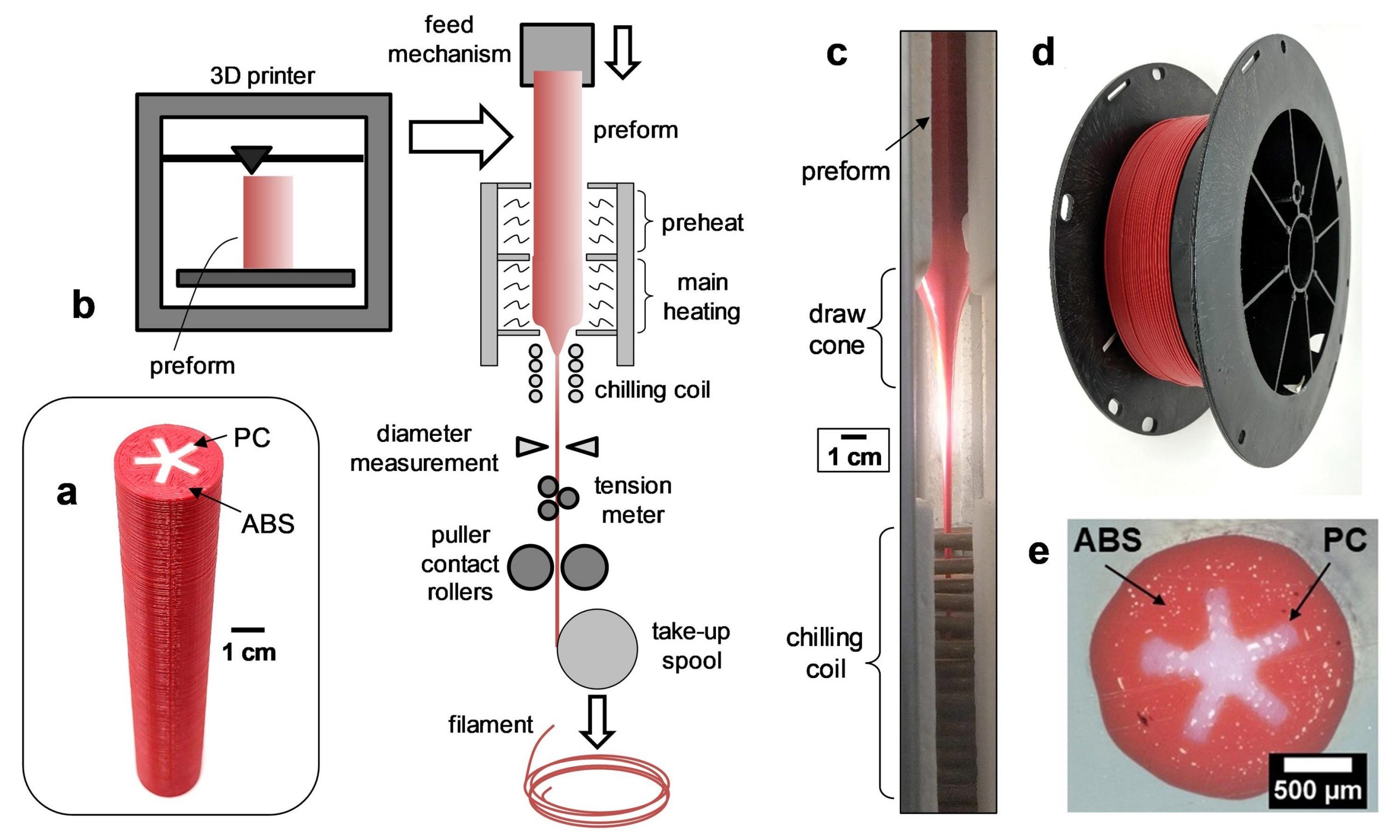
This dual material filament is then used as feedstock in a conventional FFF printer to create 3-D solid bodies with a composite ABS/polycarbonate core meso‐structure.
This novel DM filament can revolutionize additive manufacturing allowing low‐cost printers to produce parts with mechanical properties competitive with injection‐molded plastics, as referenced in the paper.
In ongoing experiments, the Army’s research team is experimenting with new material pairings, print conditions, and annealing protocols to further improve mechanical properties and reduce processing times. Their goal is to reduce current annealing times of 24-48 hours to four hours or less.
Researchers are using a pilot manufacturing line to produce larger quantities of the filament over the next few months to provide material samples to a variety of Army transition partners.
“Having the option to additively manufacture parts from a high strength polymer via the FFF process, at the field, division, and/or depot level will certainly provide warfighters with the ability to produce better temporary parts much quicker – hours versus days or weeks – and at significantly lower costs – often pennies compared to tens of dollars, said Jeff Wallace, a mechanical engineer with the Army’s C5ISR Center at APG. “Additionally, Soldiers tend to improvise as needed, often finding their own design solutions to the issues they face. As such, offering them a higher strength polymer material that can be used in the desktop printers they have access to, affords them the opportunity to innovate on-the-fly, as necessary to temporarily solve greater numbers of supply and design challenges. Their designs would then be sent to the proper Engineering Support Activity for evaluation.”
The lab has filed multiple patent applications on the technology, and a license has already been granted for one aspect of the technology: thermally drawn filaments using a specialty polymer for use in additive manufacturing. The Army is looking for additional commercial partners to accelerate the development and fielding of this technology, which could hold broad applicability to a wide range of additively manufactured thermoplastic parts.
Reference: “Tough, Additively Manufactured Structures Fabricated with Dual‐Thermoplastic Filaments” by Kevin R. Hart, Ryan M. Dunn and Eric D. Wetzel, 10 December 2020, Advanced Engineering Materials.
DOI: 10.1002/adem.201901184
Never miss a breakthrough: Join the SciTechDaily newsletter.
Follow us on Google and Google News.
5 Comments
please unsubscribe me=e take me off your list tried of your invasifnice!!!!!
stop !!!! get out of my pc!!!!
I had a lot of new ideas when reading this post, it provided me very useful information. Thanks for this valuable information for all.
Very valuable information. Thank you for sharing it with us.
I am browsing this website dailly and get nice facts from here all the time.