
Scientists received new information about the conditions on the planet closest to the Sun.
An international group of planetary scientists from the United States, Russia, and Finland for the first time analyzed the abundance of boulders on Mercury and the factors that determine it. Details of the research and conclusions were published in the journal Icarus, which is dedicated to the study of the solar system and other planetary systems.
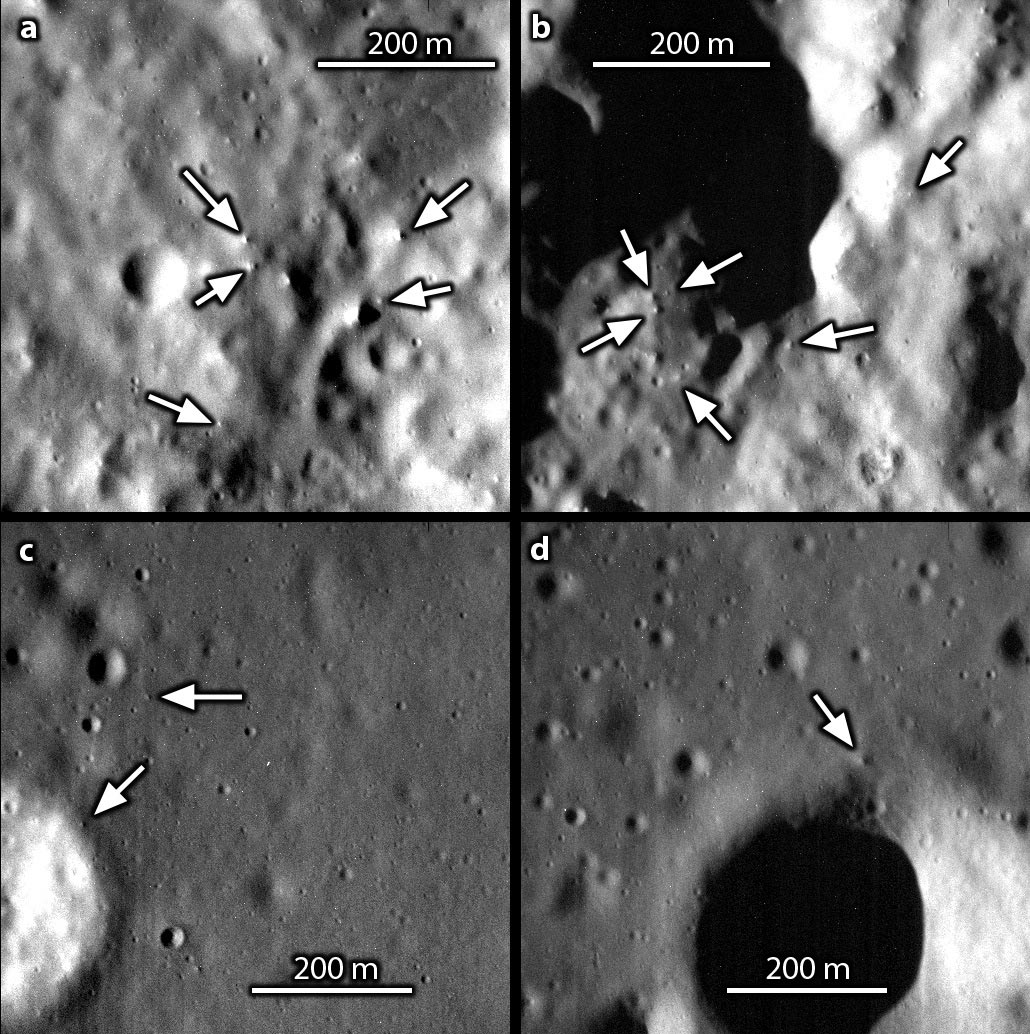
Mercury is the smallest planet in the solar system, closest to the sun. It is slightly larger than the Moon and their surfaces are similar. To study boulders on Mercury researchers have screened almost 3000 images obtained in 2015 by the Narrow Angle Camera onboard NASA’s MESSENGER space probe during its orbital mission to Mercury. They noted only 14 boulders down to 5 meters (16 feet) in size (currently smaller objects are indistinguishable).
Then scientists monitored images of the Moon’s surface. The quality of the images of the Moon (taken by NASA’s Lunar Reconnaissance Orbiter, which launched to the Moon in 2009) is much better. Therefore, to make an adequate comparison of Earth’s natural satellite with the Mercury “portraits,” it was necessary to specially “worsen” the quality of the Moon photographs to the same level.
Key Factors Influencing Boulder Rarity on Mercury
“A comparison of materials led us to the conclusion that boulders are found on Mercury about 30 times less often than on the Moon,” said Mikhail Kreslavsky, a researcher at the University of California. “This exact quantitative estimate is inherently inaccurate due to the limitation in the source data. However, the significant relative rarity of boulders on Mercury can be firmly and reliably established.”
The difference is determined by the three factors, scientists believe. The first factor is a micrometeorite flux to Mercury. Due to the planet’s proximity to the Sun, it is more than 50 times more abundant and 1.5–5.5 times faster than the flux to the Moon. Microscopic particles of interplanetary dust, hitting Mercury boulders, grind them like an abrasive material almost 15 times faster than on the Moon.
The second factor is a thicker regolith layer (loose soil) on the surface of Mercury, which is the “product” of the same intense micrometeorite bombardment. Due to the thicker regolith, space objects tens of meters in size, hitting Mercury, “traumatize” the planet much less and knock out much fewer boulders from its surface. The erasure of boulders by microparticles in combination with the effect of thicker regolith is perhaps the main condition explaining the insignificant number of boulders on Mercury, planetary scientists suggest.
The third factor is the cyclical temperature changes that occur on Mercury during a sunny day (it equals 176 Earth’s days). As the closest to the Sun, Mercury has the largest temperature fluctuations of all the planets in the solar system: from 80 to 700 K.
“A large thermal stress, which is 2.5 times that on the Moon, causes rapid wear of the material, numerous large and micro-cracks, and, ultimately, the destruction of boulders on the Mercury. On the Moon, however, boulders’ “lifetime” reaches 100 million years,” said Maria Gritsevich, senior researcher at the Ural Federal University and at the Finnish Geospatial Research Institute, docent of planetary sciences at the University of Helsinki.
Thus, with a comparatively small number of boulders on Mercury, scientists determine both, the rarer cases of their formation and the faster process of destruction.
“Our analysis is limited by the quality of most available images of the surface of Mercury and the limited number of high-resolution images,” said Maria Gritsevich.
“Research can be continued based on the next mission to Mercury. The joint mission between European Space Agency (ESA) and the Japan Aerospace Exploration Agency (JAXA), BepiColombo, launched in October 2018 is scheduled to reach Mercury in December 2025. The results of the BepiColombo mission will be very beneficial for further boulder studies. In particular, if thermal stresses contribute significantly to boulder obliteration, an anticorrelation of boulder abundance with the “hot poles” of Mercury would be expected, and this could be tested with HRIC images.”
Note
Boulders are fragments of rock that are formed as a result of meteorite impacts on the surface of the planet and are located in areas of fresh impact craters hundreds of meters in diameter and wider. Their exact age is difficult to estimate, but the fact that they are deeper than heavily degraded craters of similar size indicates their relative youth.
Reference: “Boulders on Mercury” by Mikhail A. Kreslavsky, Anastasia Yu. Zharkova, James W. Head and Maria I. Gritseviche, 20 July 2021, Icarus.
DOI: 10.1016/j.icarus.2021.114628
Never miss a breakthrough: Join the SciTechDaily newsletter.
Follow us on Google and Google News.