
Researchers discovered that early Holocene ice loss in East Antarctica was driven by oceanic feedback loops connecting distant regions.
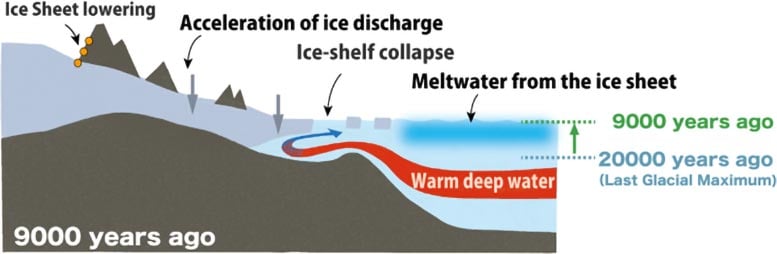
Meltwater discharge altered ocean layers, allowing warm deep water to intrude beneath ice shelves and hasten their collapse. These self-reinforcing processes mirror dynamics now observed in West Antarctica, raising concern that modern warming could trigger widespread ice retreat.
Ice Melt Feedbacks in East Antarctica
A new study in Nature Geoscience has uncovered that the East Antarctic Ice Sheet (EAIS) underwent a massive retreat around 9,000 years ago, driven by a powerful feedback loop between melting ice and shifting ocean currents. Led by Professor Yusuke Suganuma of the National Institute of Polar Research (NIPR) and the Graduate University for Advanced Studies (SOKENDAI), the team discovered that warm deep water flowed toward East Antarctica’s coasts, causing ice shelves to collapse. As the shelves broke apart, inland ice began to flow more rapidly toward the ocean.
The findings show that Antarctic melting is not confined to a single region; instead, it can spread across connected areas through ocean circulation. This “cascading positive feedback,” where meltwater in one area accelerates melting elsewhere, may hold the key to understanding the long-term instability of Antarctica’s ice.
Uncovering the Mechanism of Past Ice-Sheet Collapse
The study sought to determine how past ice-sheet collapses occurred and what triggered them.
The East Antarctic Ice Sheet, which holds over half of Earth’s freshwater, is now losing ice along parts of its coast. Understanding how these vast ice sheets reacted to earlier periods of warming helps scientists assess their future under today’s climate change.
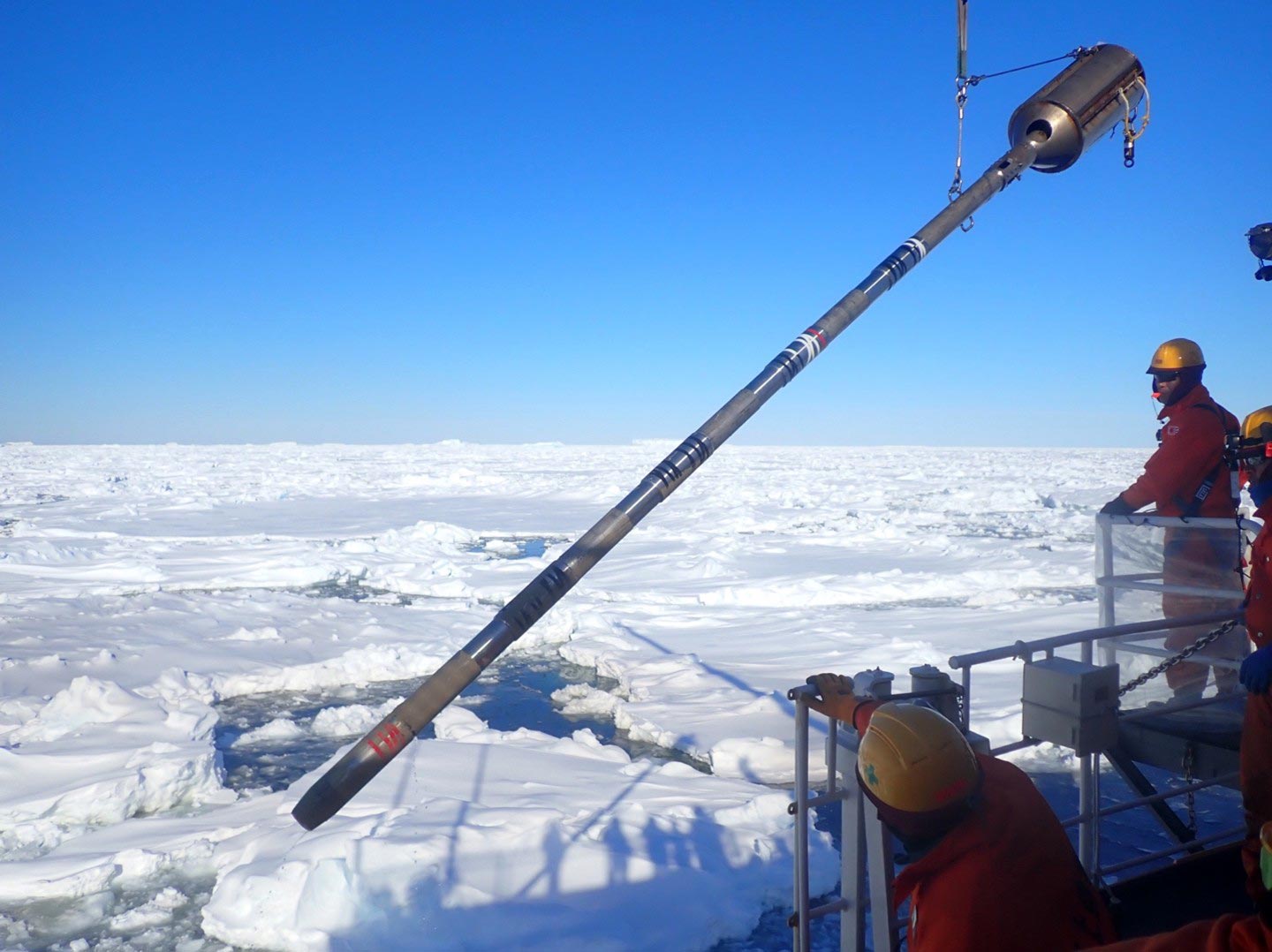
To explore this, researchers examined marine sediment cores taken from Lützow-Holm Bay, near Japan’s Syowa Station on the Sôya Coast. These samples were analyzed alongside geological surveys conducted across Dronning Maud Land. The sediments, gathered through numerous Japanese Antarctic Research Expeditions (JARE) from 1980 to 2023—including recent sampling aboard the icebreaker Shirase—provided a detailed record of past environmental conditions.
By studying beryllium isotope ratios (10Be/9Be) and using sedimentological, micropaleontological, and geochemical methods, the team reconstructed how conditions in the bay changed over time. Their data revealed that about 9,000 years ago, warm Circumpolar Deep Water (CDW) intensified in the region, leading to the collapse of floating ice shelves. Without these shelves acting as stabilizing barriers, inland ice surged more quickly into the sea.
Modeling Reveals a Self-Reinforcing Feedback Loop
To uncover what caused the surge of warm deep water, scientists turned to climate and high-resolution ocean models. The simulations showed that meltwater from other parts of Antarctica, including the Ross Ice Shelf, spread across the Southern Ocean. This freshened the surface layer and strengthened vertical stratification in the water column. Stronger stratification limited the upward mixing of cold surface water, allowing warm deep water to flow more easily toward East Antarctica’s continental shelf.
The result was a reinforcing cycle: meltwater strengthened stratification, which in turn encouraged more warm-water inflow, causing further melting. This “cascading mechanism” implies that ice loss in one part of Antarctica can set off or speed up melting in distant regions through interconnected ocean processes.
A Warning From the Past for Modern Climate Change
This research provides compelling evidence that the Antarctic Ice Sheet is vulnerable to widespread, self-reinforcing melting when the planet warms. Although the event took place in the early Holocene—a naturally warmer period following the last Ice Age—the same physical dynamics are relevant to today’s climate.
Modern observations show that parts of West Antarctica, such as the Thwaites and Pine Island glaciers, are already retreating rapidly as warm deep water erodes their bases. If similar cascading feedbacks are at work now, local melting could spread, accelerating overall ice loss and contributing significantly to rising sea levels.
Global Collaboration and Future Implications
The study brought together over 30 research institutions, including NIPR, the Geological Survey of Japan (AIST), the Japan Agency for Marine–Earth Science and Technology (JAMSTEC), the University of Tokyo, Kochi University, Hokkaido University, and international collaborators from New Zealand, Spain, and other countries. This wide-ranging effort combined geological fieldwork, marine sediment analysis, cosmogenic nuclide dating, and climate–ocean modeling to reconstruct the complex interactions between ice and ocean systems in East Antarctica.
Professor Suganuma concludes: “This study provides essential data and modelling evidence that will facilitate more accurate predictions of future Antarctic ice-sheet behavior. The cascading feedbacks identified in this study serve to underscore the notion that minor regional alterations can potentially engender global ramifications.”
Reference: “Antarctic ice-shelf collapse in Holocene driven by meltwater release feedbacks” by Yusuke Suganuma, Takuya Itaki, Yuki Haneda, Kazuya Kusahara, Takashi Obase, Takeshige Ishiwa, Takayuki Omori, Minoru Ikehara, Robert McKay, Osamu Seki, Daisuke Hirano, Masakazu Fujii, Yuji Kato, Atsuko Amano, Yuki Tokuda, Hokuto Iwatani, Yoshiaki Suzuki, Motohiro Hirabayashi, Hiroyuki Matsuzaki, Takeyasu Yamagata, Masao Iwai, Kota Katsuki, Francisco J. Jimenez-Espejo, Hiroki Matsui, Koji Seike, Moto Kawamata, Naohisa Nishida, Masato Ito, Shin Sugiyama, Jun’ichi Okuno, Takanobu Sawagaki, Ayako Abe-Ouchi, Shigeru Aoki and Hideki Miura, 7 November 2025, Nature Geoscience.
DOI: 10.1038/s41561-025-01829-7
Never miss a breakthrough: Join the SciTechDaily newsletter.
Follow us on Google and Google News.
6 Comments
The heat needed to melt the entire Antarctic ice sheet lurks just below the surface.
“As the shelves broke apart, inland ice began to flow more rapidly toward the ocean.”
One frequently encounters similar claims in the literature. A problem is that invariably it is offered with little or no support. In this instance, the claim has only a single reference that is applicable. Fundamentally, what is being dealt with is a dynamic system where the slope and thickness of the ice supply a resultant diagonal force vector composed of the weight and resisting friction that provides a slight, net movement downhill. It is classically characterized as an irresistible force encountering an immovable object. We are expected to believe that removing some of the floating ice reduces the frictional resistance enough to allow the glacier(s) to surge. Yet, once the shelf ice breaks off and is floating freely, with 90% of the ice under water, there is so little friction that winds can move icebergs around. While the shelf ice was still attached, it had the same momentum as the glacial tongue. Newtonian physics says that to accelerate a mass, force must be applied. Yet, after detaching, the shelf icebergs invariably drift away. If they were buttressing the glacier, why don’t they continue to resist the glacier and show buckling or stacking of the ice?
It is well known that some glaciers exhibit transient, aperiodic surging. How can we be certain that a surge after calving isn’t coincidental. Or, that the glacier surged, accelerating the leading edge, and then stopped, causing the leading edge to fail along tensional cracks, and then float off at the velocity it achieved just before the surging glacier locked up again?
So many questions by anyone willing to question, and so little follow-up on poorly supported claims.
Inertia?
“Inertia” is essentially the same thing as momentum. Newton’s First Law says that an object not experiencing acceleration requires a force to be applied to change the speed or direction of the object. What I proposed above is that a glacier surges because the friction along a significant portion is suddenly reduced, probably by basal meltwater. It then locks up again. Imagine what happens to a bag of groceries sitting on top of your car because you forgot to load it inside. You start off smoothly and drive slowly, and friction keeps the bag in place. Suddenly, a dog runs out in front of you and you slam on the brakes. You can guess what happens to that bag of groceries! Shelf ice often has tension cracks in it, mostly from tidal flexing. If the glacier suddenly locks up, the shelf ice is going to act like that hypothetical bag of groceries, breaking free at the incipient crack.
So what is being done to deal with this event? Cities will be inundated? OK, who are the people working to build dikes or move cities? Trying to stop this makes me think of the cartoon pictures of a mouse raising a middle finger at the stooping hawk about to devour it.
If this is underway now, perhaps we should possibly maybe form a committee to study the formation of a committee to figure out what might be done to deal with its consequences? Of heavens forbid, actually draw up plans to deal with the consequences and start to implement them? Or are we doomed to just raise our middle fingers at the rising water as it engulfs us? Well, engulfs you. I am up a thousand feet above MSL so all that will happen is that the local international airports may replace LAX.
{^_^} Maybe it is time to actually DO something?
Committees can solve any problem. They can even design an animal like a camel.
Assuming that something needs to be done, without compelling evidence, is an example of putting the camel in front of the cart.