
Discrepancy between terrestrial and marine data resolved; shows that ice sheets vulnerable to small CO2 fluctuations.
New research led by the University of Massachusetts Amherst definitively resolves a long-standing discrepancy in the geologic record that pitted studies of marine ice-sheet behavior against those that reconstructed past conditions on land. The research, published recently in the journal Geology, and funded by the National Science Foundation and the National Environment Research Council, lends additional weight to evidence that the Antarctic Ice Sheet is sensitive to small changes in CO2 levels and that, in the past, large portions of the ice sheet could have disappeared under CO2 levels similar to today.
The Discrepancy Between Marine and Land Data
There has been a decades-long debate amongst scientists who study the history of the Antarctic Ice Sheet, and it revolves around the discrepancy between marine data from the Ross Sea and data collected in the McMurdo Dry Valleys, an ice-free mountainous coastal region adjacent to the Ross Sea. In one corner stands marine records from the seafloor that have shown that the Antarctic Ice Sheet has repeatedly shrunk to a smaller-than-modern size across the last 10 million years, and that the ice-covered Ross Sea was periodically open ocean. This suggests that the Antarctic Ice Sheet is sensitive to relatively small CO2 and temperature fluctuations and receded during past warm periods.
In the other corner stands terrestrial studies of ancient and well-preserved landforms in the McMurdo Dry Valleys that reveal that cold-desert conditions on land were maintained across the same ten-million-year time period, which has led some researchers to conclude that a stable Antarctic Ice Sheet has persisted across multiple past warm periods, and therefore may be less susceptible to climate warming than the marine data suggests.
Is the West Antarctic Ice Sheet sensitive to a warming climate or not? Resolving this debate is of planetary significance, since the same portions of the Antarctic Ice Sheet that collapsed in the past could raise future sea levels by 10 feet or more if they were to collapse in our own time.
Using Climate Models to Reconcile the Data
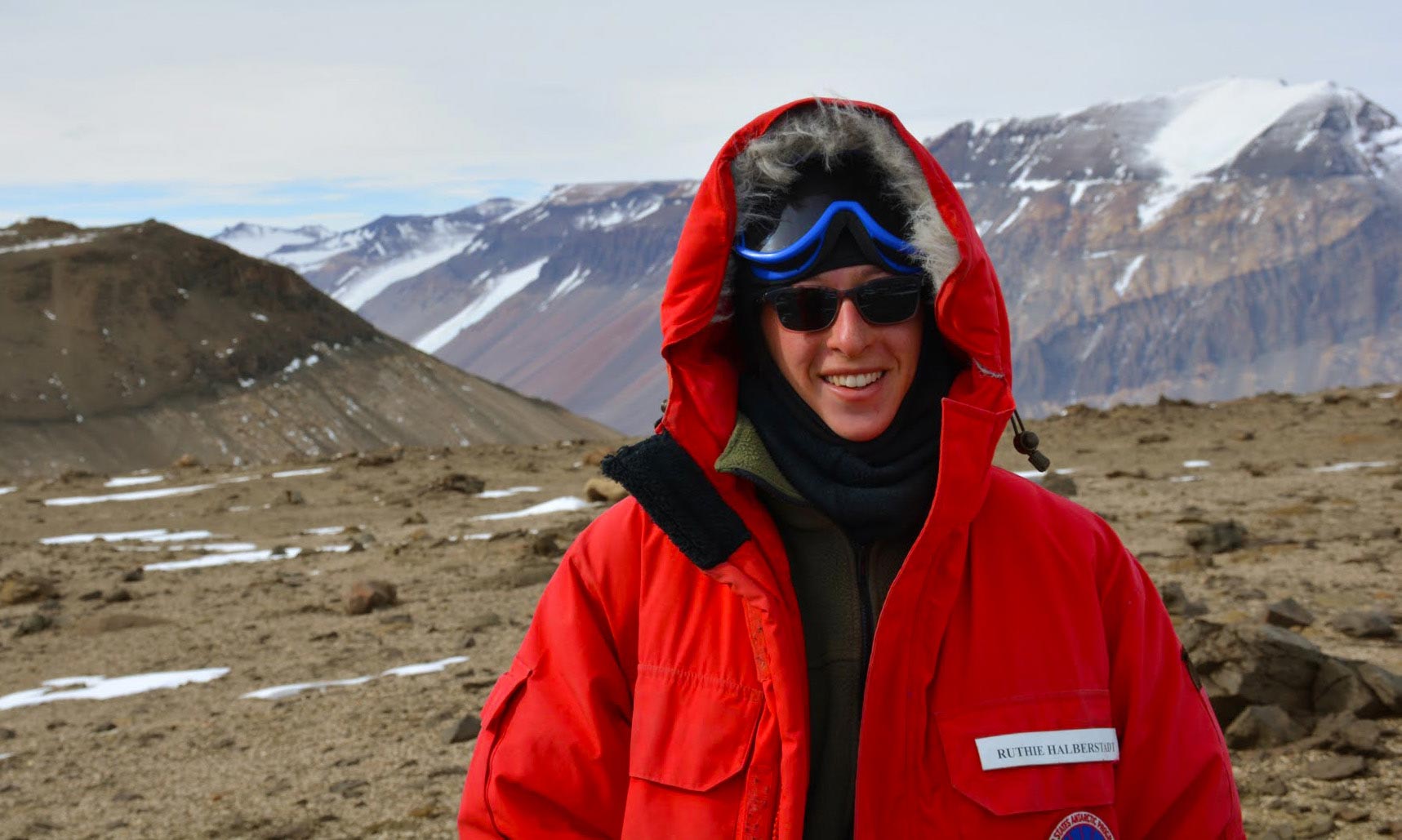
Using a series of high-resolution climate and ice-sheet models, Anna Ruth Halberstadt, who completed this research as part of her Ph.D. in geosciences at UMass Amherst, and her colleagues were able to show that it is entirely possible for below-freezing temperatures to exist in the McMurdo Dry Valleys even when the nearby Ross Sea is completely ice free. “We can now say, ‘ok, now we understand why these two sets of data appeared to be at odds,’” says Halberstadt, the paper’s lead author.
Halberstadt and her team conducted a series of experiments using state-of-the-art climate and sea-ice models to show that the McMurdo Dry Valleys could certainly have stayed frozen, even during times when the ice sheet collapsed. Halberstadt says that “this work finally brings all of the geologic information neatly into line, and suggests that large parts of the Antarctic Ice Sheet may have collapsed under climatic situations similar to today.”
Reference: “Reconciling persistent sub-zero temperatures in the McMurdo Dry Valleys, Antarctica, with Neogene dynamic marine ice-sheet fluctuations” by Anna Ruth W. Halberstadt, Douglas E. Kowalewski and Robert M. DeConto, 11 February 2022, Geology.
DOI: 10.1130/G49664.1
Never miss a breakthrough: Join the SciTechDaily newsletter.
Follow us on Google and Google News.
3 Comments
“New research led by the University of Massachusetts Amherst DEFINITIVELY resolves a long-standing discrepancy in the geologic record …”
Experienced scientists understand that the ‘science’ is NEVER settled! Physicists and astronomers are still attempting to disprove Einstein’s General Theory of Relativity more than 100 years after he proposed it.
“… since the same portions of the Antarctic Ice Sheet that collapsed in the past could raise future sea levels by 10 feet or more if they were to collapse in our own time.”
Where is the evidence that such sea level rises occurred as shown by “marine records from the seafloor that have shown that the Antarctic Ice Sheet has repeatedly shrunk to a smaller-than-modern size across the last 10 million years, …”? This would be called “corroborating field evidence.” Models have utility and their place in understanding dynamic processes. However, the output from models is NOT data, and is, at best, weak evidence!
On a more philosophical level, it seems that she has made a case for frequent melting in Antarctica of a magnitude that we now call an ‘existential threat.’ That was before humans could have had any influence. In other words, Occam’s Razor would suggest one doesn’t have to appeal to other than natural forces to consider. Even if we ARE responsible for recent warming, she has made the case that if we were to eliminate anthropogenic GHG emissions, we might still experience flooding of coastal cities in the future. Thus, we should probably follow a path of mitigation, as necessary.
Science is never settled, of course, but it is ALWAYS right, in the field of “climate change”.
Perhaps the key to understanding West Antarctic ice dynamics is under the surface of the Ross Sea (a magma plume in the crust), which is why the Dry Valley region does not show warming.
The article is a little bit ridiculous: “definitive resolution” — then a series of “mays” and “coulds” and “suggests.”
And meanwhile in the real world. Human made poisons are scheduled to cause the deaths of billions of humans when the ocean food chain collapses. Nothing being done because all of the grants are in climate change. To bad, someone could have stopped this back in the 90’s.