
Close Menu
    Facebook X (Twitter) Instagram
    SciTechDaily
    • Biology
    • Chemistry
    • Earth
    • Health
    • Physics
    • Science
    • Space
    • Technology
    Facebook X (Twitter) Pinterest YouTube RSS
    SciTechDaily
    Home»Technology»Anode-Free Zinc Battery Could Someday Provide Large Scale Storage of Renewable Energy
    Technology

    Anode-Free Zinc Battery Could Someday Provide Large Scale Storage of Renewable Energy

    By American Chemical SocietyJanuary 20, 2021No Comments3 Mins Read
    Facebook Twitter Pinterest Telegram LinkedIn WhatsApp Email Reddit
    Share
    Facebook Twitter LinkedIn Pinterest Telegram Email Reddit
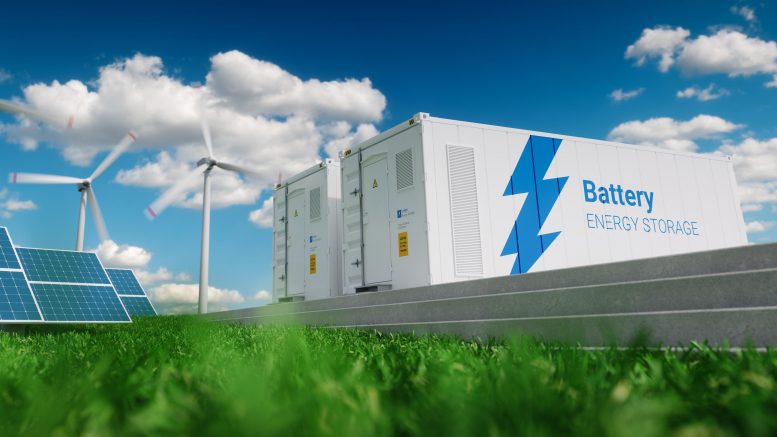
    Large Scale Energy Storage
    Researchers have created a prototype of a zinc-based battery without an anode, utilizing cost-effective and readily available materials.

    An anode-free zinc battery design improves safety, lowers cost, and offers stable energy storage, making it promising for renewable power systems.

    Renewable energy sources, such as wind and solar power, could help decrease the world’s reliance on fossil fuels. But first, power companies need a safe, cost-effective way to store the energy for later use. Massive lithium-ion batteries can do the job, but they suffer from safety issues and limited lithium availability. Now, researchers reporting in ACS’ Nano Letters have made a prototype of an anode-free, zinc-based battery that uses low-cost, naturally abundant materials.

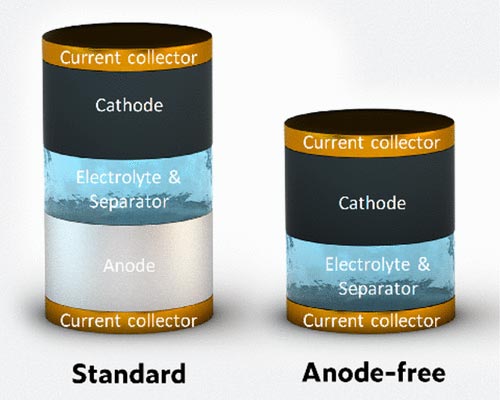
    Aqueous zinc-based batteries have been previously explored for grid-scale energy storage because of their safety and high energy density. In addition, the materials used to make them are naturally abundant. However, the rechargeable zinc batteries developed so far have required thick zinc metal anodes, which contain a large excess of zinc that increases cost. Also, the anodes are prone to forming dendrites — crystalline projections of zinc metal that deposit on the anode during charging — that can short-circuit the battery. Yunpei Zhu, Yi Cui and Husam Alshareef wondered whether a zinc anode was truly needed. Drawing inspiration from previous explorations of “anode-free” lithium and sodium-metal batteries, the researchers decided to make a battery in which a zinc-rich cathode is the sole source for zinc plating onto a copper current collector.
    Anode Free Battery
    An Anode-Free Zn–MnO2 Battery. Credit: Nano Letters

    In their battery, the researchers used a manganese dioxide cathode that they pre-intercalated with zinc ions, an aqueous zinc trifluoromethanesulfonate electrolyte solution, and a copper foil current collector. During charging, zinc metal gets plated onto the copper foil, and during discharging the metal is stripped off, releasing electrons that power the battery. To prevent dendrites from forming, the researchers coated the copper current collector with a layer of carbon nanodiscs. This layer promoted uniform zinc plating, thereby preventing dendrites, and increased the efficiency of zinc plating and stripping. The battery showed high efficiency, energy density, and stability, retaining 62.8% of its storage capacity after 80 charging and discharging cycles. The anode-free battery design opens new directions for using aqueous zinc-based batteries in energy storage systems, the researchers say.

    Reference: “An Anode-Free Zn–MnO2 Battery” by Yunpei Zhu, Yi Cui and Husam N. Alshareef, 20 January 2021, Nano Letters.
    DOI: 10.1021/acs.nanolett.0c04519

    The authors acknowledge funding from King Abdullah University of Science and Technology.

    Never miss a breakthrough: Join the SciTechDaily newsletter.
    Follow us on Google and Google News.

    American Chemical Society Battery Technology Energy Nanotechnology
    Share. Facebook Twitter Pinterest LinkedIn Email Reddit

    Related Articles

    MXene Nanomaterial Offers Flexible and Stretchable High-Capacity Energy Storage

    Battery Breakthrough to Give Flight to Electric Aircraft and Boost Long-Range Electric Cars

    Improved Advanced Energy Storage Using New Nano-Engineering Strategy

    First Quantum Phase “Supercurrent” Battery Ever Developed

    Fast-Charging Super-Capacitor Technology Unveiled for Clean Energy Storage

    Next-Generation Energy Storage Breakthrough: Fast-Charging, Long-Running, Flexible

    New Aqueous Lithium-Ion Battery – Low Cost & Improved Safety

    Swarms of Microrobots Quickly Clean Up Radioactive Waste [Video]

    Iron-Air Batteries Promise Higher Energy Density Than Lithium-Ion Batteries

    Leave A Reply Cancel Reply

    • Facebook
    • Twitter
    • Pinterest
    • YouTube

    Don't Miss a Discovery

    Subscribe for the Latest in Science & Tech!

    Trending News

    The Strange “Spacetime Crystal” That Can Suddenly Turn Into a Black Hole

    The Surprising Way Asteroids May Have Helped Life Begin on Earth

    Vast Hidden Structure Discovered Under Miles of Ice in East Antarctica

    A Surprising Discovery Suggests Autism Is Not One Condition

    New Alzheimer’s Discovery Could Change How Scientists Fight the Disease

    Yale Discovery Overturns Long-Held “Evolutionary Dead End” Theory

    UCLA Scientists Uncover a “Hidden Weakness” in Some of the World’s Deadliest Cancers

    Humpback Whale Stuns Scientists With 15,000 Kilometer Journey Across Oceans

    Follow SciTechDaily
    • Facebook
    • Twitter
    • YouTube
    • Pinterest
    • Newsletter
    • RSS
    SciTech News
    • Biology News
    • Chemistry News
    • Earth News
    • Health News
    • Physics News
    • Science News
    • Space News
    • Technology News
    Recent Posts
    • JUNO’s First Results Bring the Neutrino Mass Mystery Into Focus
    • Astronomers Confirm Dark Energy After Shock Challenge Rocked Cosmology
    • James Webb Spots Something Strange Between Day and Night on an Alien Planet
    • Food Waste Becomes a Powerful Carbon Trap in Climate Breakthrough
    • Battery-Free Artificial Photosynthesis Turns Sunlight, Water, and CO2 Into Fuel
    Copyright © 1998 - 2026 SciTechDaily. All Rights Reserved.
    • Science News
    • About
    • Contact
    • Editorial Board
    • Privacy Policy
    • Terms of Use

    Type above and press Enter to search. Press Esc to cancel.