
Close Menu
    Facebook X (Twitter) Instagram
    SciTechDaily
    • Biology
    • Chemistry
    • Earth
    • Health
    • Physics
    • Science
    • Space
    • Technology
    Facebook X (Twitter) Pinterest YouTube RSS
    SciTechDaily
    Home»Space»Antennae Galaxies Collision: ALMA Observatory Celebrates 10 Years of Science
    Space

    Antennae Galaxies Collision: ALMA Observatory Celebrates 10 Years of Science

    By ALMAOctober 25, 2021No Comments3 Mins Read
    Facebook Twitter Pinterest Telegram LinkedIn WhatsApp Email Reddit
    Share
    Facebook Twitter LinkedIn Pinterest Telegram Email Reddit
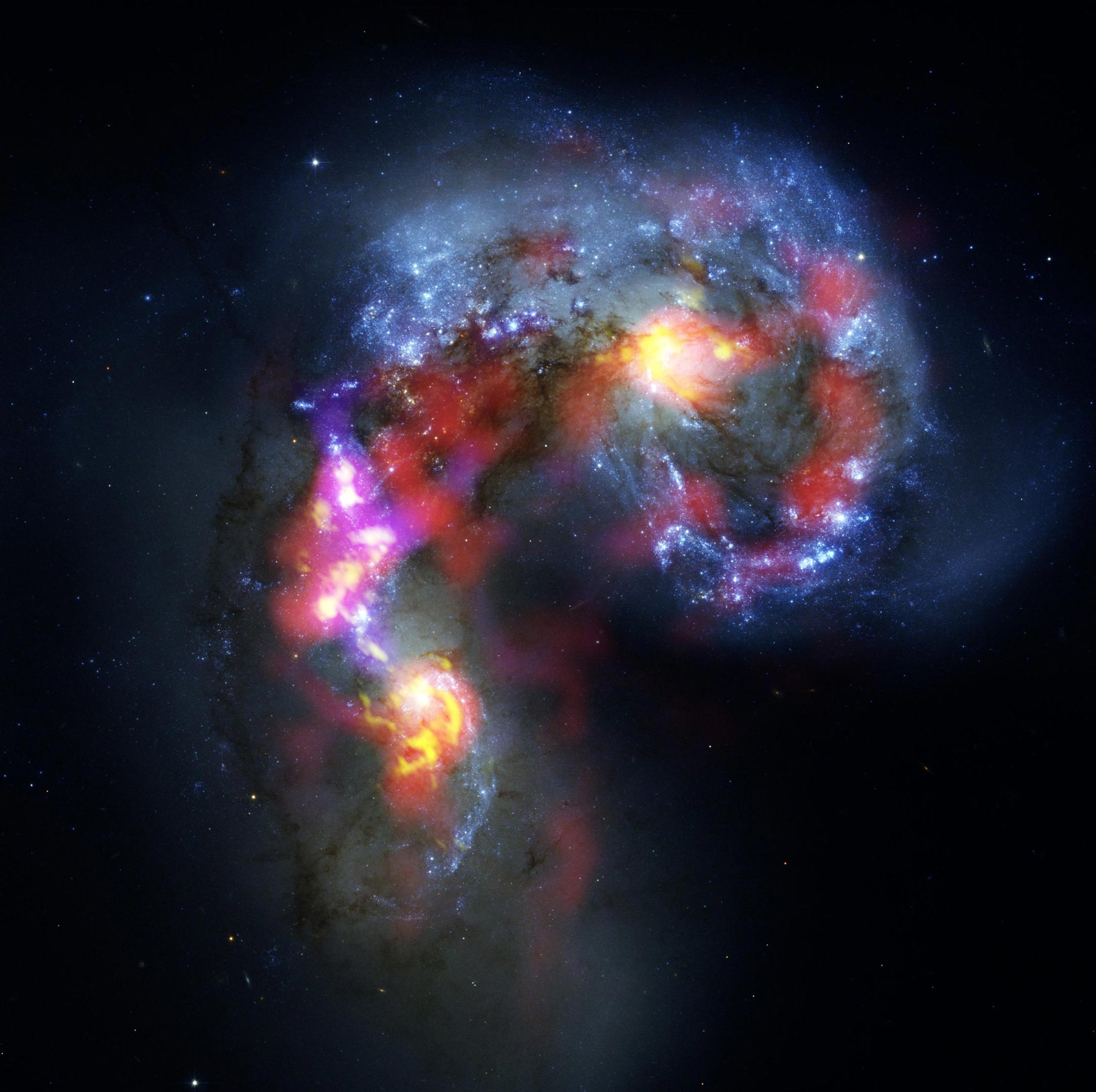
    Antennae Galaxies Collision ALMA
    At ALMA, we are celebrating doubly: on the one hand, October is the month of Science in Chile, and, on the other, we commemorate in ALMA the ten years since the first image of the observatory. Credit: ALMA

    At ALMA, we are celebrating doubly: on the one hand, October is the month of Science in Chile, and, on the other, we commemorate in ALMA the ten years since the first image of the observatory.

    Ten years ago, on October 3rd, 2011, the Atacama Large Millimeter/submillimeter Array (ALMA) officially opened its doors to the astronomical community with the launch of its first image: the Antennae Galaxies collision, demonstrating its potential and heralding the start of a successful decade of astronomy.

    The celebration started one month before the anniversary, with the collection of names suggestions by the public for the 66 ALMA antennas. There were two categories: Celestial objects and Kunza words, the language of the Atacameños, indigenous neighbors to the observatory. The public voted more than 200 concepts that met this criterion arrived through the ALMA website and its social networks. The result of the vote is available here.

    Located on the Chajnantor plateau in northern Chile, the ALMA array was operating at 5,000 meters with only twelve of its 66 antennas when it first opened for scientific observations. With more than 900 observation proposals before its official inauguration, the observatory demonstrated how excited the scientific community was to use this new facility. Since then, during the last decade, ALMA has continued to receive high demand from astronomers worldwide. The observation demand far exceeds the time available, and many exciting and innovative projects are submitted every year.

    A Telescope Beyond Compare

    ALMA’s antennas can be separated by up to 16 kilometers (10 miles). They work together as a single giant telescope that observes the Universe in light of millimeter and submillimeter wavelengths, approximately a thousand times longer than the wavelengths of visible light. These waves are emitted by some of the coldest objects in space, such as dense clouds of gas and cosmic dust from which stars and planets are formed, as well as very distant objects in the early Universe. Using interferometry, ALMA has a maximum spatial resolution better than the NASA/ESA Hubble Space Telescope at visible wavelengths. Even after ten years, ALMA remains the largest and most powerful telescope operating in the millimeter and submillimeter range.

    In its first decade, ALMA has been used by astronomers worldwide to make important discoveries. To date, ALMA has provided data for nearly 2,500 scientific articles. Highlights include:

    • Observing the protoplanetary disk surrounding the young star HL Tau revolutionizes our understanding of how planets form.
    • Images of an Einstein ring provide the most detailed picture of star formation in the distant Universe.
    • The detection of complex organic molecules in a young star system.

    Additionally, ALMA was one of eight ground-based telescopes used as part of the Event Horizon Telescope (EHT) collaboration to capture the first image of a black hole, the supermassive object at the center of the galaxy M87.

    ALMA is a partnership of ESO (representing its member states), NSF (USA), and NINS (Japan), together with NRC (Canada), MOST and ASIAA (Taiwan), and KASI (Republic of Korea), in cooperation with the Republic of Chile. The Joint ALMA Observatory is operated by ESO, AUI/NRAO and NAOJ.

    Never miss a breakthrough: Join the SciTechDaily newsletter.
    Follow us on Google and Google News.

    ALMA Astronomy Astrophysics
    Share. Facebook Twitter Pinterest LinkedIn Email Reddit

    Related Articles

    Astronomers Spot Stellar Eggs Near Center of the Milky Way Hatching Into Baby Stars

    Incredibly Powerful 900+ Mph Winds in Jupiter’s Atmosphere Measured for the First Time

    “Meteorological Beast in Our Solar System” – Powerful Stratospheric Winds Measured on Jupiter for the First Time

    Cosmic Cold Gas Pipelines Detected Feeding Early, Massive Galaxies

    Growing up Stardust: Astronomers Discover That Stars and Planets May Be Siblings

    Shocking Discovery As Astronomers Peer 12 Billion Years Into the Past – “Defies Our Understanding of Galaxy Formation”

    Observations of Molecular Gas in a Tidal Dwarf Galaxy Sheds Light on How Stars Form

    Distant Colliding Galaxy Dying Out As It Loses the Ability to Form Stars – Ejecting 10,000 Suns-Worth of Gas a Year

    Purported Phosphine – An Indicator of Life – On Venus More Likely to Be Ordinary Sulfur Dioxide

    Leave A Reply Cancel Reply

    • Facebook
    • Twitter
    • Pinterest
    • YouTube

    Don't Miss a Discovery

    Subscribe for the Latest in Science & Tech!

    Trending News

    Mezcal “Worm” in a Bottle Mystery: DNA Testing Reveals a Surprise

    New Research Reveals That Your Morning Coffee Activates an Ancient Longevity Switch

    This Is What Makes You Irresistible to Mosquitoes

    Shockingly Powerful Giant Octopuses Ruled the Seas 100 Million Years Ago

    Scientists Stunned by New Organic Molecules Found on Mars

    Rewriting Dinosaur Evolution: Scientists Unearth Remarkable 150-Million-Year-Old Stegosaur Skull

    Omega-3 Supplements Linked to Cognitive Decline in Surprising New Study

    First-of-Its-Kind Discovery: Homer’s Iliad Found Embedded in a 1,600-Year-Old Egyptian Mummy

    Follow SciTechDaily
    • Facebook
    • Twitter
    • YouTube
    • Pinterest
    • Newsletter
    • RSS
    SciTech News
    • Biology News
    • Chemistry News
    • Earth News
    • Health News
    • Physics News
    • Science News
    • Space News
    • Technology News
    Recent Posts
    • New Research Challenges Long-Held Beliefs About How the Brain Makes Decisions
    • Breakthrough Technology Reveals New Treatment Targets for Cancer
    • Scientists Discover New Way To Make Drug-Resistant Cancer Treatable Again
    • This Simple Exercise Trick Builds Muscle With Less Effort, Study Finds
    • Middle Age Is Becoming a Breaking Point in America, Study Reveals
    Copyright © 1998 - 2026 SciTechDaily. All Rights Reserved.
    • Science News
    • About
    • Contact
    • Editorial Board
    • Privacy Policy
    • Terms of Use

    Type above and press Enter to search. Press Esc to cancel.