
Close Menu
    Facebook X (Twitter) Instagram
    SciTechDaily
    • Biology
    • Chemistry
    • Earth
    • Health
    • Physics
    • Science
    • Space
    • Technology
    Facebook X (Twitter) Pinterest YouTube RSS
    SciTechDaily
    Home»Space»Are Distant Snowy Moons Potentially Habitable?
    Space

    Are Distant Snowy Moons Potentially Habitable?

    By University of WarwickDecember 19, 2017No Comments3 Mins Read
    Facebook Twitter Pinterest Telegram LinkedIn WhatsApp Email Reddit
    Share
    Facebook Twitter LinkedIn Pinterest Telegram Email Reddit
    Are Snowy Moons Potentially Habitable
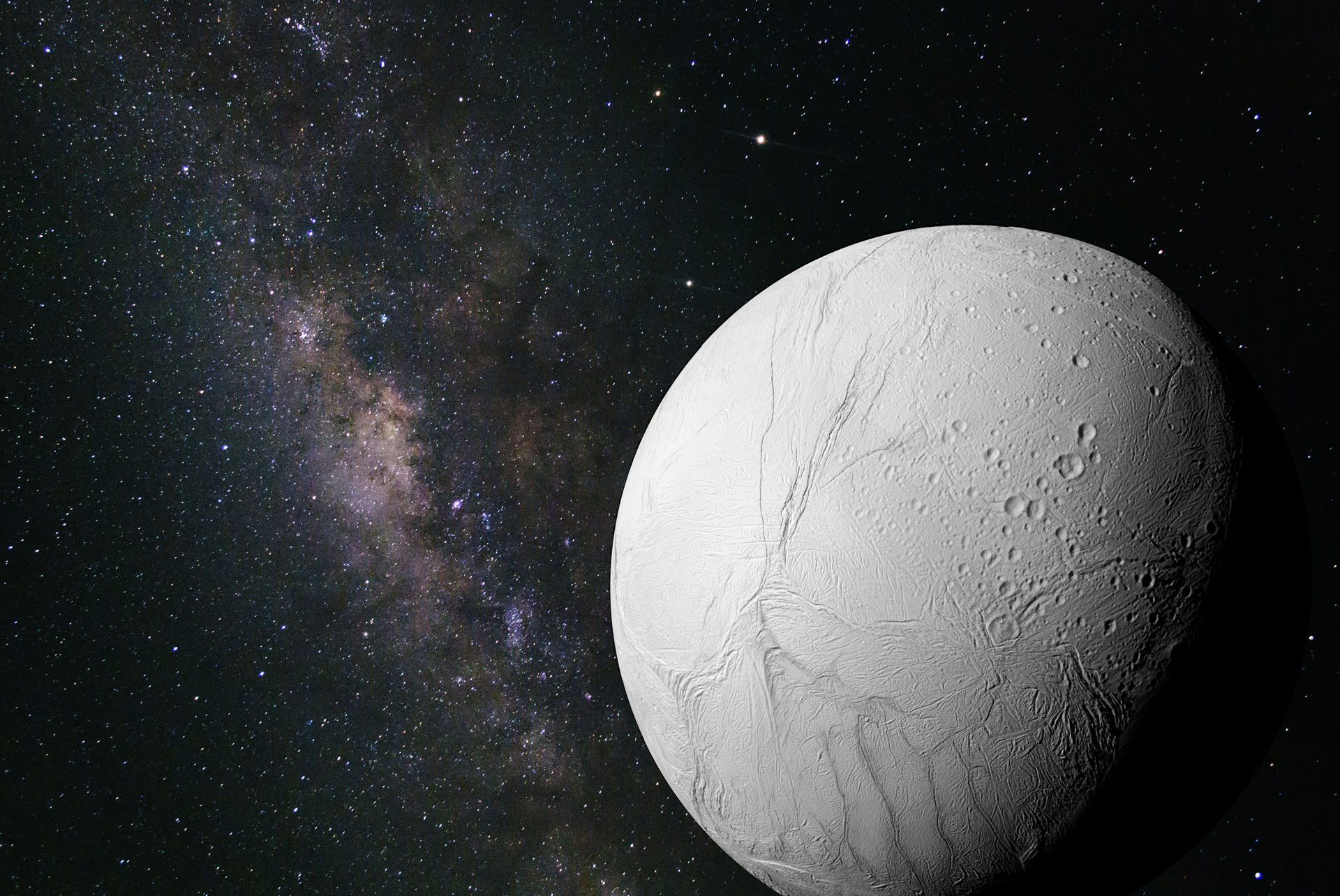
    NASA image of Saturn’s moon, Enceladus.

    Santa’s winter workshop might be in space, as University of Warwick researchers are exploring whether snowy moons over a billion kilometers away from Earth are potentially habitable.

    According to Dr. David Brown, and colleagues at Warwick’s Center for Exoplanets and Habitability, life could be supported on moons of ice and snow with vast oceans under their frozen surfaces, orbiting Jupiter and Saturn.

    One example is Enceladus – the sixth largest moon of Saturn, a frosty environment of perpetual winter, its surface covered in fresh ice and snow, with a noon temperature of −198 °C (−324 °F).

    Although conditions seem inhospitable, researchers suggest that life could thrive there thanks to large amounts of water (which may already be home to microbial life) underneath the icy surface, which can protect beings from harmful ultraviolet radiation and cosmic rays.

    Regular mixing of the water from changes in temperature and pressure, and the potential for hydrothermal vents like the ones we see in Earth’s oceans, would also encourage life to be sustained.

    The snowy moons orbiting Jupiter and Saturn open up the possibility that more of the solar system is habitable than we thought – giving us more opportunities to search for alien life, and even to discover new terrestrial homes amongst the stars.

    Dr. David Brown commented: “Living in a never-ending landscape of snow and ice all year might not seem particularly inviting, even for Santa! But these moons represent some of the best chances for life beyond Earth in the solar system, and are environments that we’re very interested in exploring.”

    “Looking at places like Enceladus gives us a great chance to explore the potential of these winter wonderlands for supporting life.” “We’re also trying to find more examples of icy moons out there in the wider Galaxy, and it would be really exciting if we do.”

    In 2005, the Cassini spacecraft flew close to Enceladus and revealed details about its surface and environment in great detail – including water-rich plumes venting from the south polar region of the moon.

    The JUpiter ICy moons Explorer (JUICE) mission will be launched in 2022 by the European Space Agency – this will similarly reveal details of Jupiter’s icy moons.

    The Center for Exoplanets and Habitability at the University of Warwick is a cross-disciplinary research center designed to investigate questions concerning life on this planet and beyond. It includes researchers from both science and arts subjects.

    Never miss a breakthrough: Join the SciTechDaily newsletter.
    Follow us on Google and Google News.

    Astronomy Enceladus Planetary Science University of Warwick
    Share. Facebook Twitter Pinterest LinkedIn Email Reddit

    Related Articles

    AI Uncovers Hidden Signals, Discovering Dozens of New Alien Planets

    NASA Prepares for Historic Flyby of Icy Saturn Moon Enceladus

    NASA’s Cassini Reveals New Views of Saturn’s Moon Enceladus

    Cassini Spacecraft to Begin Flyby of Saturn’s Moon Enceladus

    Cassini Reveals Global Ocean in Saturn’s Moon Enceladus

    Activity on Enceladus Could Be ‘Curtain Eruptions’

    Astronomers Track Icy Tendrils Reaching into Saturn’s E Ring

    Saturn’s Moon Enceladus Exhibits Signs of Hydrothermal Activity

    NASA Detects Ocean Inside Saturn’s Moon Enceladus

    Leave A Reply Cancel Reply

    • Facebook
    • Twitter
    • Pinterest
    • YouTube

    Don't Miss a Discovery

    Subscribe for the Latest in Science & Tech!

    Trending News

    Magnetic Fields May Solve a Longstanding Binary Star Mystery

    The Probiotic Breakthrough for Natural Anxiety Relief and Better Mental Health

    Animal vs. Plant Protein: Scientists Found a Surprising Nutritional Difference

    According to Scientists, This Simple Dietary Change Is Linked to Lower Depression Scores

    Researchers Discover a Hidden Vitamin D Problem That Persists Year-Round

    Interstellar Comet 3I/ATLAS Reveals Strange Chemistry Beyond Our Solar System

    A Newly Found Cellular Shift May Explain Why Aging Leads to Disease

    Scientists Discover Gut Signal That Turns Off Sugar Cravings

    Follow SciTechDaily
    • Facebook
    • Twitter
    • YouTube
    • Pinterest
    • Newsletter
    • RSS
    SciTech News
    • Biology News
    • Chemistry News
    • Earth News
    • Health News
    • Physics News
    • Science News
    • Space News
    • Technology News
    Recent Posts
    • Breakthrough for 800 Million Patients? Kidney Disease Drug Shows Powerful New Benefits
    • A Surprising Discovery Suggests Autism Is Not One Condition
    • New Alzheimer’s Discovery Could Change How Scientists Fight the Disease
    • This Quantum Detector Boosts Terahertz Sensitivity by 20 Times
    • A Universe Without Dark Energy? Mathematicians Challenge Standard Cosmology
    Copyright © 1998 - 2026 SciTechDaily. All Rights Reserved.
    • Science News
    • About
    • Contact
    • Editorial Board
    • Privacy Policy
    • Terms of Use

    Type above and press Enter to search. Press Esc to cancel.