
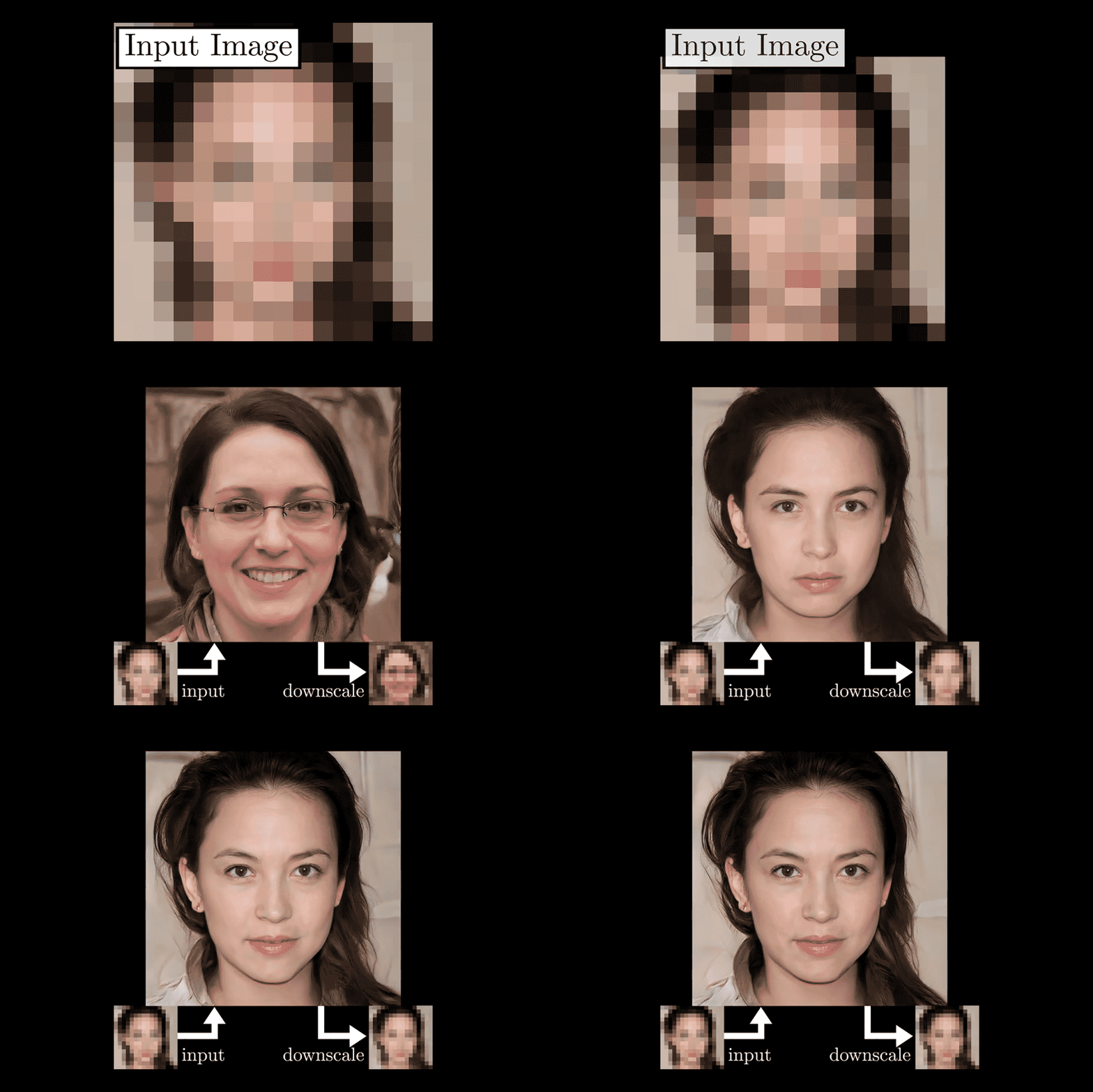
This AI turns even the blurriest photo into realistic computer-generated faces in HD.
Duke University researchers have developed an AI tool that can turn blurry, unrecognizable pictures of people’s faces into eerily convincing computer-generated portraits, in finer detail than ever before.
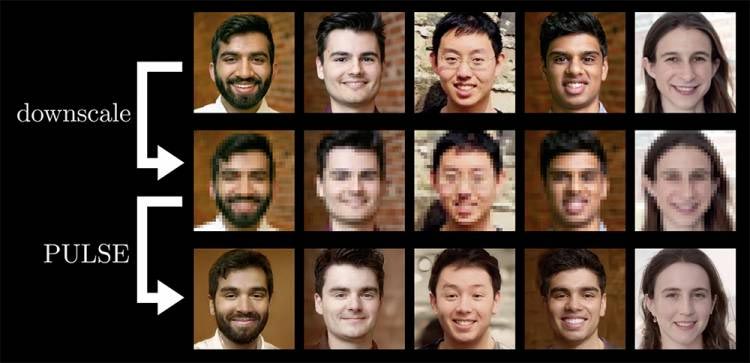
Previous methods can scale an image of a face up to eight times its original resolution. But the Duke team has come up with a way to take a handful of pixels and create realistic-looking faces with up to 64 times the resolution, ‘imagining’ features such as fine lines, eyelashes, and stubble that weren’t there in the first place.
“Never have super-resolution images been created at this resolution before with this much detail,” said Duke computer scientist Cynthia Rudin, who led the team.
The system cannot be used to identify people, the researchers say: It won’t turn an out-of-focus, unrecognizable photo from a security camera into a crystal clear image of a real person. Rather, it is capable of generating new faces that don’t exist, but look plausibly real.
While the researchers focused on faces as a proof of concept, the same technique could in theory take low-res shots of almost anything and create sharp, realistic-looking pictures, with applications ranging from medicine and microscopy to astronomy and satellite imagery, said co-author Sachit Menon ’20, who just graduated from Duke with a double-major in mathematics and computer science.
The researchers will present their method, called PULSE, at the 2020 Conference on Computer Vision and Pattern Recognition (CVPR), held virtually from June 14 to June 19.

Traditional approaches take a low-resolution image and ‘guess’ what extra pixels are needed by trying to get them to match, on average, with corresponding pixels in high-resolution images the computer has seen before. As a result of this averaging, textured areas in hair and skin that might not line up perfectly from one pixel to the next end up looking fuzzy and indistinct.
The Duke team came up with a different approach. Instead of taking a low-resolution image and slowly adding new detail, the system scours AI-generated examples of high-resolution faces, searching for ones that look as much as possible like the input image when shrunk down to the same size.
The team used a tool in machine learning called a “generative adversarial network,” or GAN, which are two neural networks trained on the same data set of photos. One network comes up with AI-created human faces that mimic the ones it was trained on, while the other takes this output and decides if it is convincing enough to be mistaken for the real thing. The first network gets better and better with experience, until the second network can’t tell the difference.
PULSE can create realistic-looking images from noisy, poor-quality input that other methods can’t, Rudin said. From a single blurred image of a face it can spit out any number of uncannily lifelike possibilities, each of which looks subtly like a different person.
Even given pixelated photos where the eyes and mouth are barely recognizable, “our algorithm still manages to do something with it, which is something that traditional approaches can’t do,” said co-author Alex Damian ’20, a Duke math major.
The system can convert a 16×16-pixel image of a face to 1024 x 1024 pixels in a few seconds, adding more than a million pixels, akin to HD resolution. Details such as pores, wrinkles, and wisps of hair that are imperceptible in the low-res photos become crisp and clear in the computer-generated versions.
The researchers asked 40 people to rate 1,440 images generated via PULSE and five other scaling methods on a scale of one to five, and PULSE did the best, scoring almost as high as high-quality photos of actual people.
See the results and upload images for yourself here.
Reference: “PULSE: Self-Supervised Photo Upsampling via Latent Space Exploration of Generative Models” by Sachit Menon, Alexandru Damian, Shijia Hu, Nikhil Ravi, Cynthia Rudin, 14-19 June 2020, IEEE/ CVF International Conference on Computer Vision and Pattern Recognition (CVPR).
arXiv: 2003.03808
This research was supported by the Lord Foundation of North Carolina and the Duke Department of Computer Science.
Never miss a breakthrough: Join the SciTechDaily newsletter.
Follow us on Google and Google News.
3 Comments
Oh. This has vaguely horrifying implications for privacy and government surveillance huh
Right!
Nice – Now we can finally get to see all of those blurry UFO pics and prove there are aliens among us. 🙂