
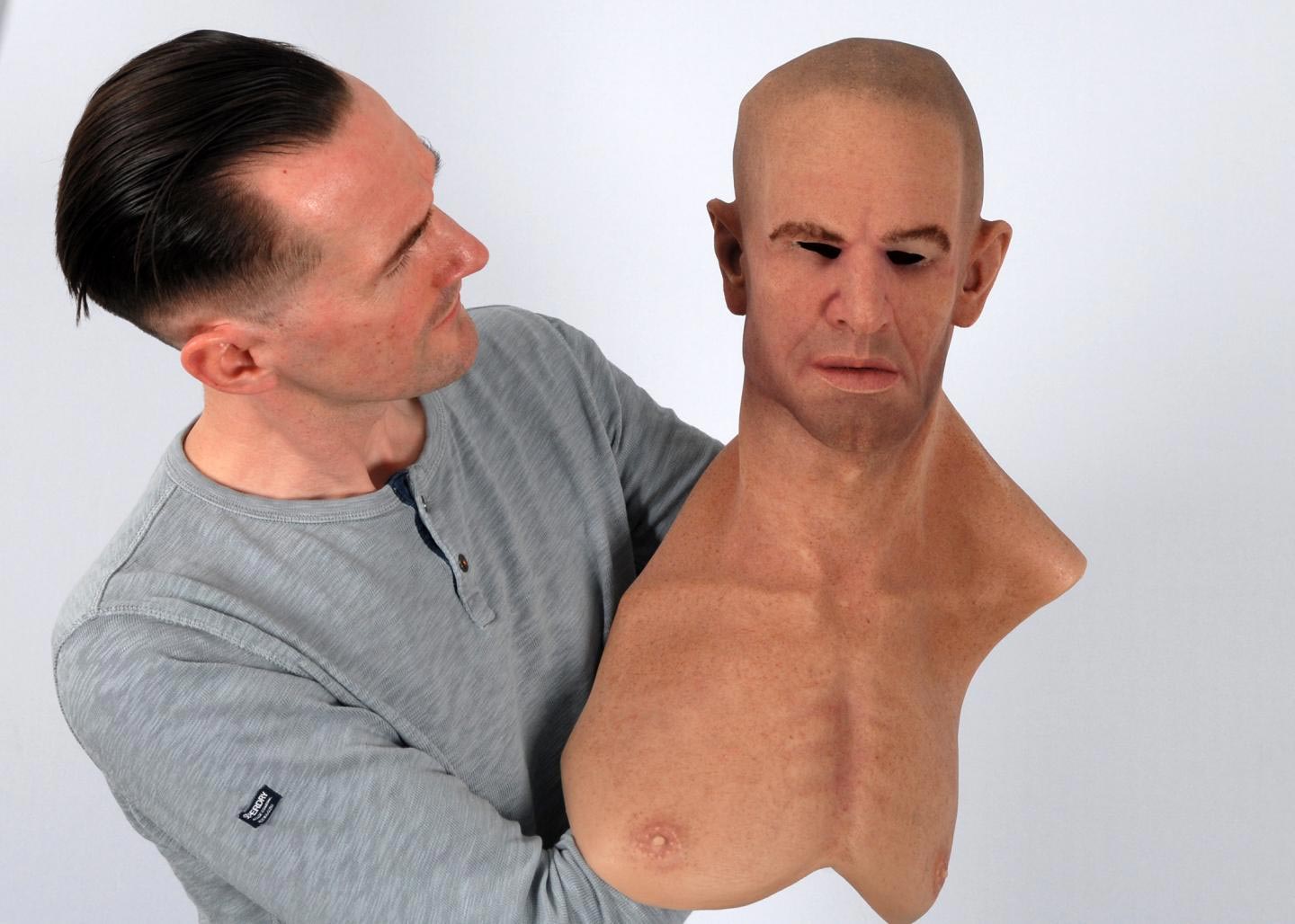
Images of synthetic hyper-realistic masks could be mistaken for those of real faces, according to a study published in the open access journal Cognitive Research: Principles and Implications. The study also found that a viewer’s ability to accurately discriminate a mask from a real face may also be affected if the mask is designed to mimic a different race to the observer.
Hyper-realistic masks are made from flexible materials such as silicone and are designed to imitate real human faces. Evidence from previous research and criminal investigations have shown that these masks can pass for genuine faces in real-life situations, but this may be influenced by factors such as body language or the amount of attention paid by the viewer.
To investigate the potential for synthetic masks to pass for real faces in photographs, researchers at the Universities of York and Kyoto asked 120 participants, 60 from each institution, to view pairs of on-screen images; one face and one mask. Participants were asked to indicate which of the two they thought to be the mask and easily-detectable low-realism masks were used as controls.
Dr. Jet Sanders, lead author with the London School of Economics and Political Science said: “When participants were given a time limit of 500 milliseconds per pairing, the identification of the mask from each pair was slower for high-realism masks than for low-realism masks (300 ms). For low-realism masks accuracy was 98%, compared with 66% accuracy for high-realism masks, even with a 50% chance of success. This suggests that some participants may have perceived some masks to have more realistic human features than the real face.”
In studies such as these, limiting viewing duration is standard practice when a task may otherwise be too simple. To assess whether this may have been a limiting factor, the authors repeated the experiment with a new cohort and no time limit. For high-realism masks, responses were slower (1100 ms) and one in five participants incorrectly judged the real face to be the mask (20%). Data were collected from participants from both the UK and Japan to establish any differences according to race. When asked to choose between photographs depicting faces of a different race to the trial participant, response times were approximately 400 ms slower and selections were 5% less accurate.
Author Dr. Rob Jenkins said: “We made it clear to viewers that their task was to identify the mask in each pair of images. Example masks were shown before the test began. In a real-life situation, the error rate would likely be much higher than in our study as hyper-realistic masks are extremely rare and many people may not know they exist.”
Dr. Sanders said: “Failure to detect synthetic faces may also have important implications for security and crime prevention as hyper-realistic masks may allow the key characteristics of a persons’ appearance to be incorrectly identified. These masks currently cost around £1000 each and we expect them to become more widely used as advances in manufacturing make them more affordable.”
The authors suggest that further research should assess difficulties in identification between real faces and partial masks used to distort particular features and whether this may also be influenced by race.
Read Hyper-Realistic Masks Can Be More Believable Than Real Human Faces for more on this study.
Reference: “More human than human: a Turing test for photographed faces” by Jet Gabrielle Sanders, Yoshiyuki Ueda, Sakiko Yoshikawa and Rob Jenkins, 21 November 2019, Cognitive Research: Principles and Implications.
DOI: 10.1186/s41235-019-0197-9
Never miss a breakthrough: Join the SciTechDaily newsletter.
Follow us on Google and Google News.