

Surgical masks offer strong self-protection against aerosols, outperforming cloth masks and rivaling respirators like KN95, making them ideal for public and healthcare use.
New research presented at this year’s European Congress of Clinical Microbiology & Infectious Diseases (ECCMID), held online this year (9-12 July), shows that wearing a surgical face mask can provide similar protection against aerosols as wearing a respirator. Face shields, however, provide little or no protection.
The efficacy of personal protective equipment (PPE), including face masks, has been the focus of scientific and public interest since the emergence of SARS-CoV-2, a virus which is mainly transmitted through droplets and aerosols in poorly ventilated settings. It is crucial to provide healthcare workers with high-quality face masks or respirators to protect both themselves and their patients. However, at the start of the pandemic, some experts, particularly in Europe, said that while surgical face masks protect others, they provide no significant protection for the wearer. Moreover, many newly produced masks seem to be of poor quality.
The study, by Dr. Christian Sterr and colleagues at Philipps University Marburg, Marburg, Germany, compared 32 types of mask intended for use in hospitals, including cloth and surgical (medical) masks, respirators, and face shields. The surgical masks included some with EN 14683 certification (the EU quality standard) and others that were non-certified. Both FFP2 and KN95 respirators were tested. KN95 respirators, which meet Chinese standards, were subject to EU RAPEX safety warnings from April 2020.
Filtering Efficiency: Cloth vs. Surgical vs. Respirators
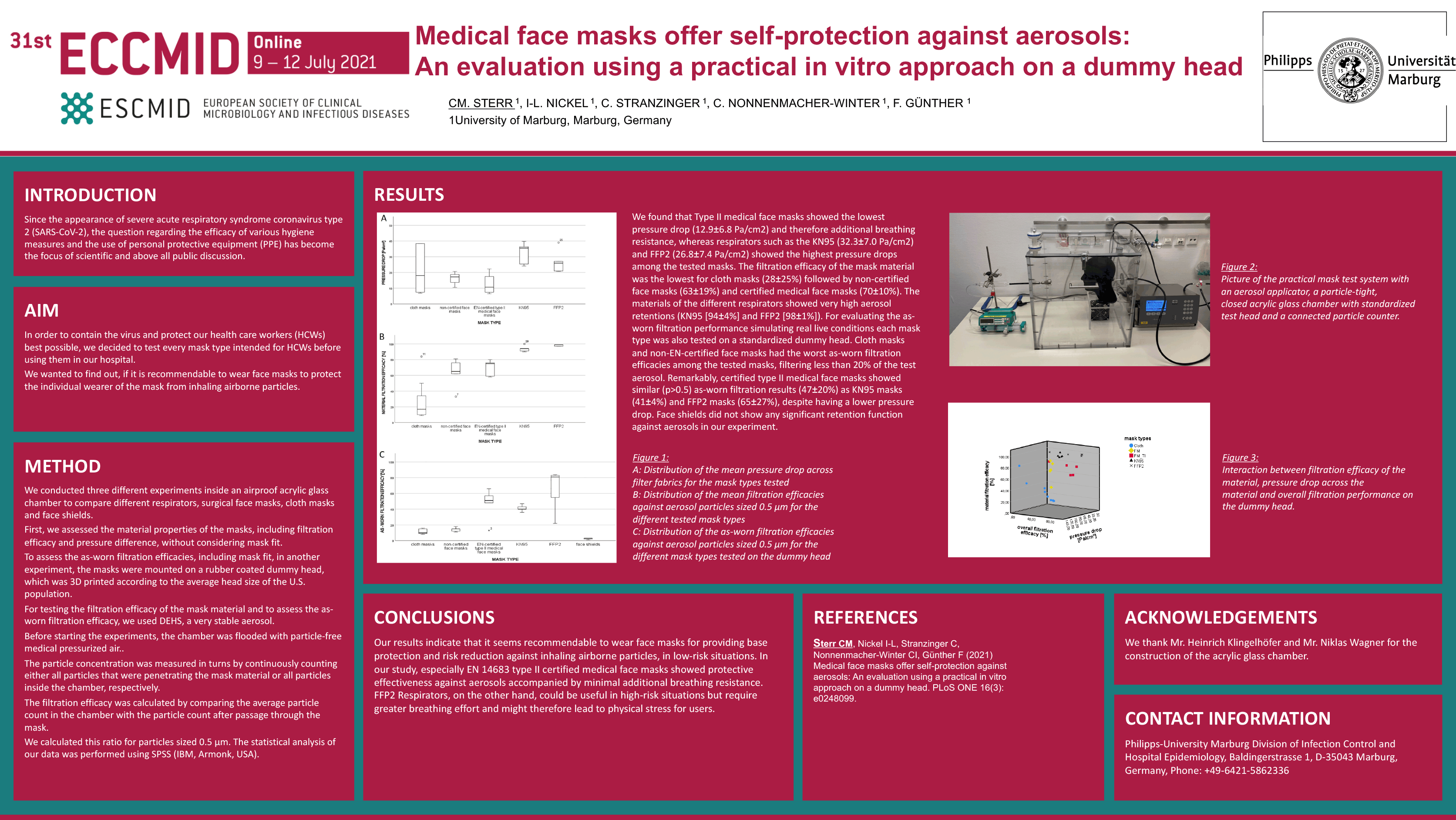
The first experiment measured the filtration efficacy of the mask material. Each mask was fixed to an air-collecting tube inside an airtight tank. An aerosol of the chemical di-ethyl-hexyl-sebacate (DEHS) was pumped into the tank, and the aerosol particles in the collecting tube were counted by a particle counter.
The average filtration efficacy was lowest for the cloth masks (28%), followed by the non-certified surgical masks (63%) and the certified surgical masks (70%). The KN95 respirator material filtered out 94% of particles and the FFP2 mask material, 98%.
The second experiment measured the air pressure on either side of the mask. Surgical face masks produced the lowest drop in pressure and so would provide the least resistance to breathing — type II surgical masks produced a pressure drop of 12.9 Pa/cm², while non-certified surgical masks produced a pressure drop of 16.2 Pa/cm².
Respirators produced pressure drops that were two to three times higher (26.8 Pa/cm² for FFP2 and 32.3 Pa/cm² for KN95). The results for the cloth masks ranged between 6.9 and 149.3 Pa/cm².
The third experiment measured the filtration efficacy of the masks as worn. It used a similar set-up to the first experiment but the masks were mounted on a dummy head with an artificial trachea or windpipe, instead of being fixed to the air-collecting tube. The artificial head was the size of the average person in the US and had a skin-like coating, to provide a more realistic mask fit.
The cloth masks and the non-certified surgical masks had the worst as-worn filtration efficacies, filtering out just 11.3% and 14.2% of the particles, respectively. Remarkably, the type II surgical face masks had similar as-worn filtration results (47%) to the KN95 respirators (41%) and FFP2 respirators (65%). The face shields did not have any significant effect.
Experiments 1 and 3 focused on particles of 0.5 μm — a size judged to be realistic for SARS-CoV-2 particles, which cluster together.
Certified Surgical Masks Rival Respirators
The study’s authors say that for a combination of optimum benefit and ease of breathing, a mask should combine good filtration with a low drop in pressure. They add: “In our tests, these parameters were achieved by the majority of FFP2 and surgical type II face masks.
“EN 14683 type II certified surgical face masks, in particular, can provide high protection with low airflow resistance at the same time. Non-certified cloth and surgical face masks provided very poor protection against our test aerosol. The cloth masks showed high variability between different mask types.
“Not surprisingly, FFP2 respirators provided the best protective effect on an average. KN95 respirators performed relatively poorly, with filtration efficacies ranging from 36% to 47%. These results are inferior to those of the best surgical type II face masks, whose performances ranged from 13% to 66%. The results are remarkable given the higher price, better subjective feeling of protection and higher air flow resistance of the KN95 respirators. However, our findings are consistent with the RAPEX warnings.”
Surgical face masks also produce less resistance to breathing and so are more comfortable to wear, says Dr. Sterr.
He adds: “In our tests, respirators had two to three-fold higher airflow resistances than surgical face masks. This might lead to lower user adherence and, consequently, to a lower overall protection rate. Therefore, it seems reasonable to widely use surgical face masks in hospitals to prevent the virus from spreading, especially if distancing and quarantining are not possible.
“In situations where a patient cannot wear a mask (e.g. intubation), a surgical face mask does not seem sufficient to protect the healthcare worker from SARS-CoV-2. In such cases, respirators such as FFP2 masks should be considered. KN95 respirators should be worn only if other respirators are not available. Face shields should only be used to keep masks and respirators dry when undertaking procedures in which there is a risk of splashes.
“Members of the public should wear certified surgical face masks of good quality, rather than cloth masks or face shields, which performed poorly in our study, or respirators, which should be reserved for medical staff.”
Reference: “Medical face masks offer self-protection against aerosols: An evaluation using a practical in vitro approach on a dummy head” by Christian M. Sterr, Inga-Lena Nickel, Christina Stranzinger, Claudia I. Nonnenmacher-Winter and Frank Günther, 3 March 2021, PLOS ONE.
DOI: 10.1371/journal.pone.0248099
Never miss a breakthrough: Join the SciTechDaily newsletter.
Follow us on Google and Google News.