
New experimental technique with Goethe University’s reaction microscope allows ‘X-ray’ of individual molecules.
For more than 200 years, we have been using X-rays to look inside matter, and progressing to ever smaller structures – from crystals to nanoparticles. Now, within the framework of a larger international collaboration on the X-ray laser European XFEL in Schenefeld near Hamburg, physicists at Goethe University have achieved a qualitative leap forward: using a new experimental technique, they have been able to “X-ray” molecules such as oxygen and view their motion in the microcosm for the first time.
“The smaller the particle, the bigger the hammer.” This rule from particle physics, which looks inside the interior of atomic nuclei using gigantic accelerators, also applies to this research. In order to “X-ray” a two-atom molecule such as oxygen, an extremely powerful and ultra-short X-ray pulse is required. This was provided by the European XFEL which started operations in 2017 and is one of the strongest X-ray sources in the world.
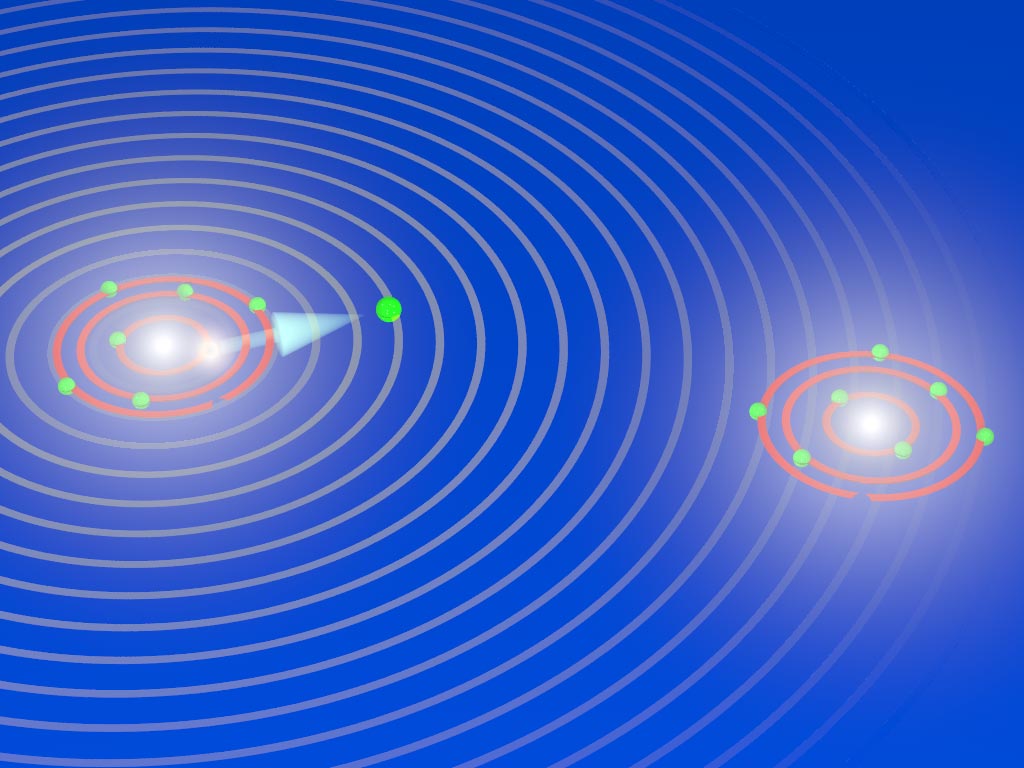
In order to expose individual molecules, a new X-ray technique is also needed: with the aid of the extremely powerful laser pulse, the molecule is quickly robbed of two firmly bound electrons. This leads to the creation of two positively charged ions that fly apart from each other abruptly due to the electrical repulsion. Simultaneously, the fact that electrons also behave like waves is used to advantage. “You can think of it like a sonar,” explains project manager Professor Till Jahnke from the Institute for Nuclear Physics. “The electron wave is scattered by the molecular structure during the explosion, and we recorded the resulting diffraction pattern. We were therefore able to essentially X-ray the molecule from within, and observe it in several steps during its break-up.”
For this technique, known as “electron diffraction imaging,” physicists at the Institute for Nuclear Physics spent several years further developing the COLTRIMS technique, which was conceived there (and is often referred to as a “reaction microscope”). Under the supervision of Dr. Markus Schöffler, a corresponding apparatus was modified for the requirements of the European XFEL in advance, and designed and realized in the course of a doctoral thesis by Gregor Kastirke. No simple task, as Till Jahnke observes: “If I had to design a spaceship in order to safely fly to the moon and back, I would definitely want Gregor in my team. I am very impressed by what he accomplished here.”
The result, which was published in the current issue of the renowned Physical Review X, provides the first evidence that this experimental method works. In the future, photochemical reactions of individual molecules can be studied using these images with their high temporal resolution. For example, it should be possible to observe the reaction of a medium-sized molecule to UV rays in real time. In addition, these are the first measurement results to be published since the start of operations of the Small Quantum Systems (SQS) experiment station at the European XFEL at the end of 2018.
Reference: “Photoelectron Diffraction Imaging of a Molecular Breakup Using an X-Ray Free-Electron Laser” by Gregor Kastirke, Markus S. Schöffler, Miriam Weller, Jonas Rist, Rebecca Boll, Nils Anders, Thomas M. Baumann, Sebastian Eckart, Benjamin Erk, Alberto De Fanis, Kilian Fehre, Averell Gatton, Sven Grundmann, Patrik Grychtol, Alexander Hartung, Max Hofmann, Markus Ilchen, Christian Janke, Max Kircher, Maksim Kunitski, Xiang Li, Tommaso Mazza, Niklas Melzer, Jacobo Montano, Valerija Music, Giammarco Nalin, Yevheniy Ovcharenko, Andreas Pier, Nils Rennhack, Daniel E. Rivas, Reinhard Dörner, Daniel Rolles, Artem Rudenko, Philipp Schmidt, Juliane Siebert, Nico Strenger, Daniel Trabert, Isabel Vela-Perez, Rene Wagner, Thorsten Weber, Joshua B. Williams, Pawel Ziolkowski, Lothar Ph. H. Schmidt, Achim Czasch, Florian Trinter, Michael Meyer, Kiyoshi Ueda, Philipp V. Demekhin, and Till Jahnke, 8 June 2020, Physical Review X.
DOI: 10.1103/PhysRevX.10.021052
Never miss a breakthrough: Join the SciTechDaily newsletter.
Follow us on Google and Google News.
1 Comment
what you wanna create a forcefield and cloaking device for the future uss enterprise being like a Romulan warbird and the death star defense shield even for a planet like earth vs asteroids like Apophis? lol. cartoons man.