
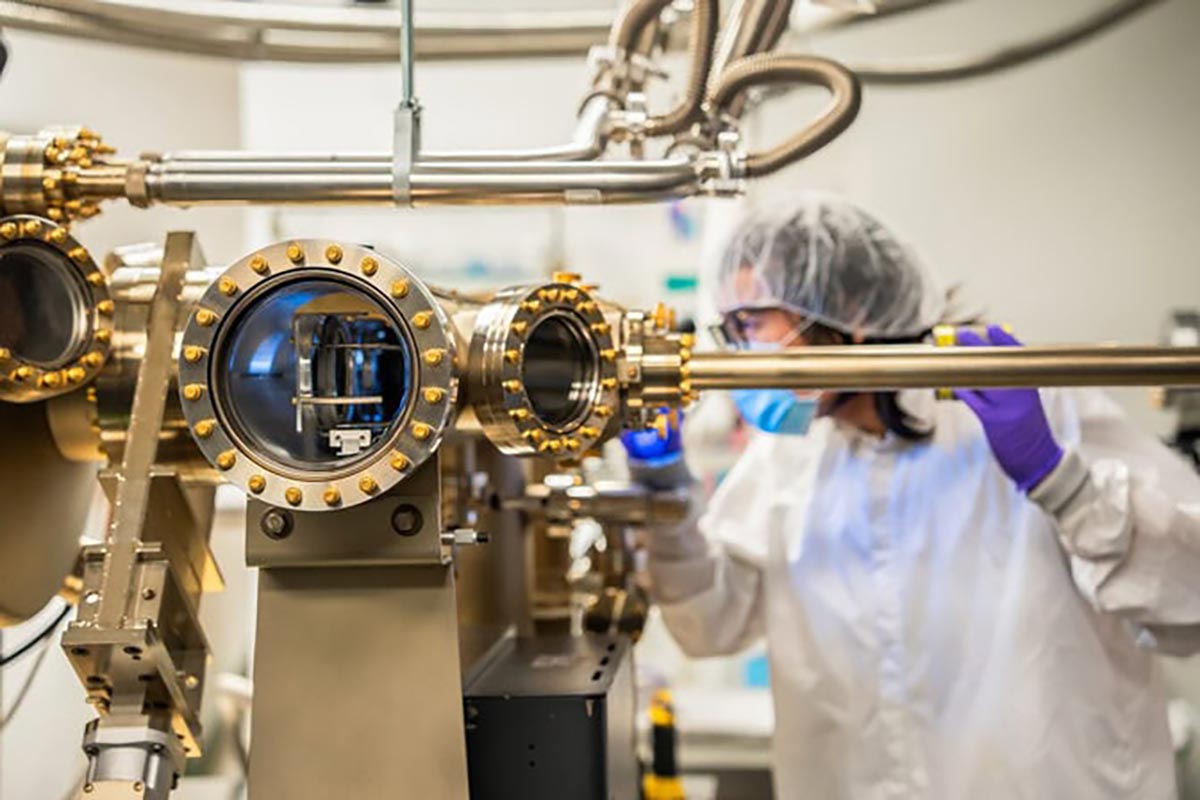
A new system developed at the University of Michigan efficiently produces ethylene from CO2, paving the way for future sustainable fuel production.
The ability to chain carbon atoms together is a crucial step towards reusing CO2 to make sustainable fuels. Now, researchers at the University of Michigan have developed an artificial photosynthesis system that can bind two of them into hydrocarbons with unprecedented performance.
This groundbreaking system produces ethylene with efficiency, yield, and longevity well above other artificial photosynthesis systems. Since ethylene is a hydrocarbon typically used in plastics, the direct application of the system would be to harvest carbon dioxide that would otherwise be vented into the atmosphere for making plastics.

Superior Performance in Ethylene Production
“The performance, or the activity and stability, is about five to six times better than what is typically reported for solar energy or light-driven carbon dioxide reduction to ethylene,” said Zetian Mi, professor of electrical and computer engineering at the University of Michigan and corresponding author of the study in Nature Synthesis.
“Ethylene is actually the most produced organic compound in the world. But it is typically produced with oil and gas, under high temperatures and pressures, all of which emits CO2.”

Advanced Photocatalytic Process and Device Design
The long-term goal is to string longer chains of carbon and hydrogen atoms together to produce liquid fuels that can be easily transported. Part of the challenge is removing all of the oxygen from the CO2 as the carbon source and water, H2O, as the hydrogen source.
The device absorbs light through two kinds of semiconductors: a forest of gallium nitride nanowires, each just 50 nanometers (a few hundred atoms) wide, and the silicon base on which they were grown. The reaction transforming water and carbon dioxide into ethylene takes place on copper clusters, each with about 30 atoms, that dot the nanowires.

Efficient Ethylene Production and Future Prospects
The nanowires are submerged in water enriched with carbon dioxide and exposed to light equivalent to the sun at noon. The energy from the light frees up electrons that split the water near the surface of the gallium nitride nanowires. This creates hydrogen to feed into the ethylene reaction but also oxygen that the gallium nitride absorbs to become gallium nitride oxide.
The copper is good at hanging onto the hydrogen and grabbing onto the carbon of the carbon dioxide, turning it into carbon monoxide. With the hydrogen in the mix and an injection of energy from the light, the team believes two carbon monoxide molecules bond together with the hydrogen. The reaction is believed to be completed at the interface between the copper and the gallium nitride oxide, where the two oxygen atoms are stripped off and replaced with three hydrogen atoms from splitting water.
The team found that 61% of the free electrons that the semiconductors generated with the light contributed to the reaction to produce ethylene. While a different catalyst based on silver and copper achieved a similar efficiency of roughly 50%, it needed to run in a carbon-based fluid, and it could function for only a few hours before it degraded. In contrast, the Michigan team’s device ran for 116 hours without slowing down, and the team has run similar devices for 3,000 hours.
This is in part because of the synergistic relationship between the gallium nitride and the water splitting process: The addition of oxygen improves the catalyst and enables a self-healing process. The limits of the device’s longevity will be explored in future work.
Finally, the device produced ethylene at a rate more than four times higher than the nearest competing systems.
“In the future, we want to produce some other multicarbon compounds such as propanol with three carbons or liquid products,” said Bingxing Zhang, U-M assistant research scientist in electrical and computer engineering and first author of the paper.
Liquid fuels, which could enable many existing transportation technologies to become sustainable, are Mi’s ultimate goal.
Reference: “Interfacially coupled Cu-cluster/GaN photocathode for efficient CO2 to ethylene conversion” by Bingxing Zhang, Peng Zhou, Zhengwei Ye, Ishtiaque Ahmed Navid, Yuyang Pan, Yixin Xiao, Kai Sun and Zetian Mi, 12 September 2024, Nature Synthesis.
DOI: 10.1038/s44160-024-00648-9
This study was supported by the U.S. Army Research Office.
The device was built in the Lurie Nanofabrication Facility and studied at the Michigan Center for Materials Characterization. The team has applied for patent protection with the assistance of U-M Innovation Partnerships and is in the process of licensing the technology to NX Fuels, a U-M startup cofounded by Mi. Mi and the University of Michigan have a financial interest in NX Fuels.
Never miss a breakthrough: Join the SciTechDaily newsletter.
Follow us on Google and Google News.